
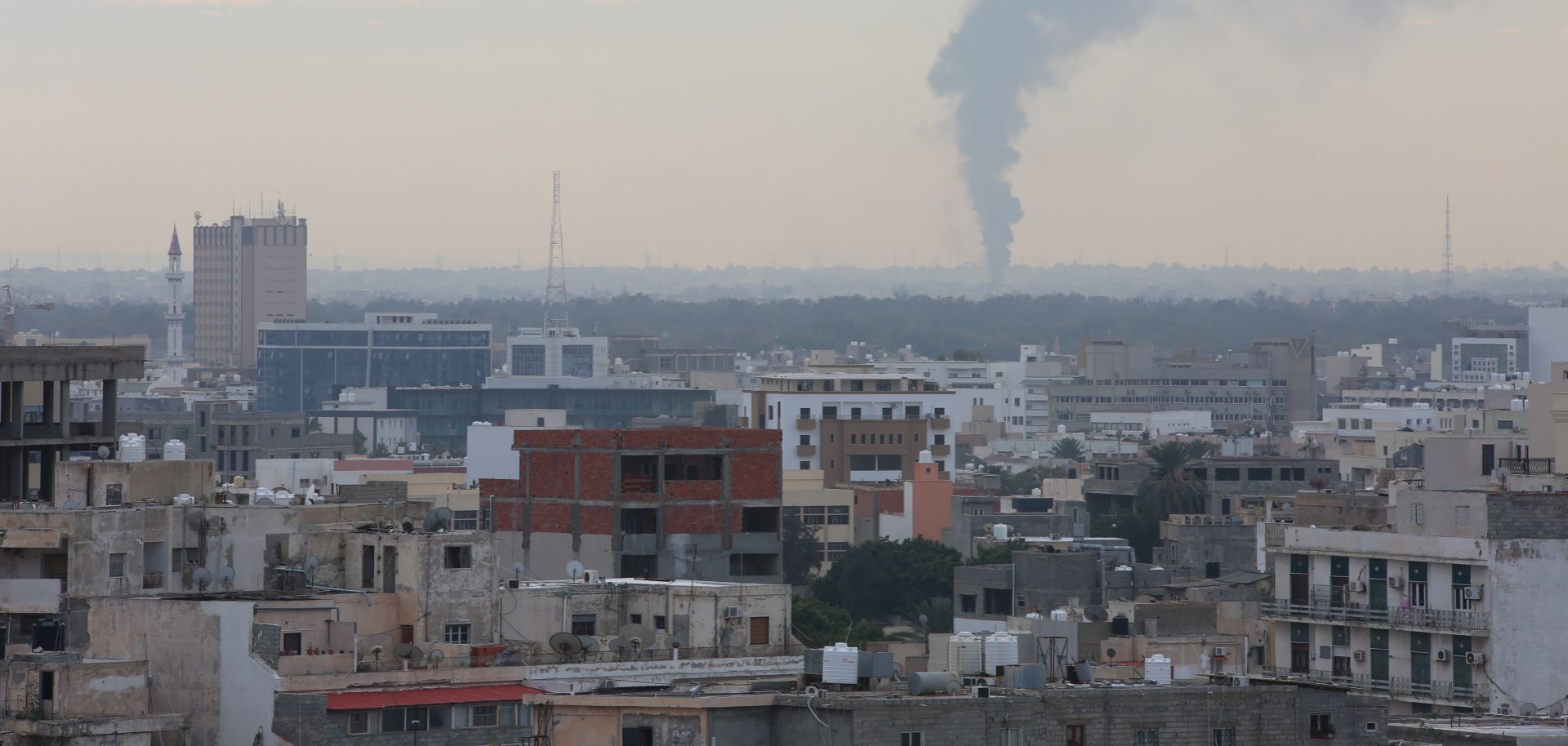
Billowing smoke marks the aftermath of an attack by Libyan National Army leader Khalifa Hifter's troops on Tripoli on Jan. 19, 2019. Control of the country's oil exports is a major weapon in Hifter's arsenal.
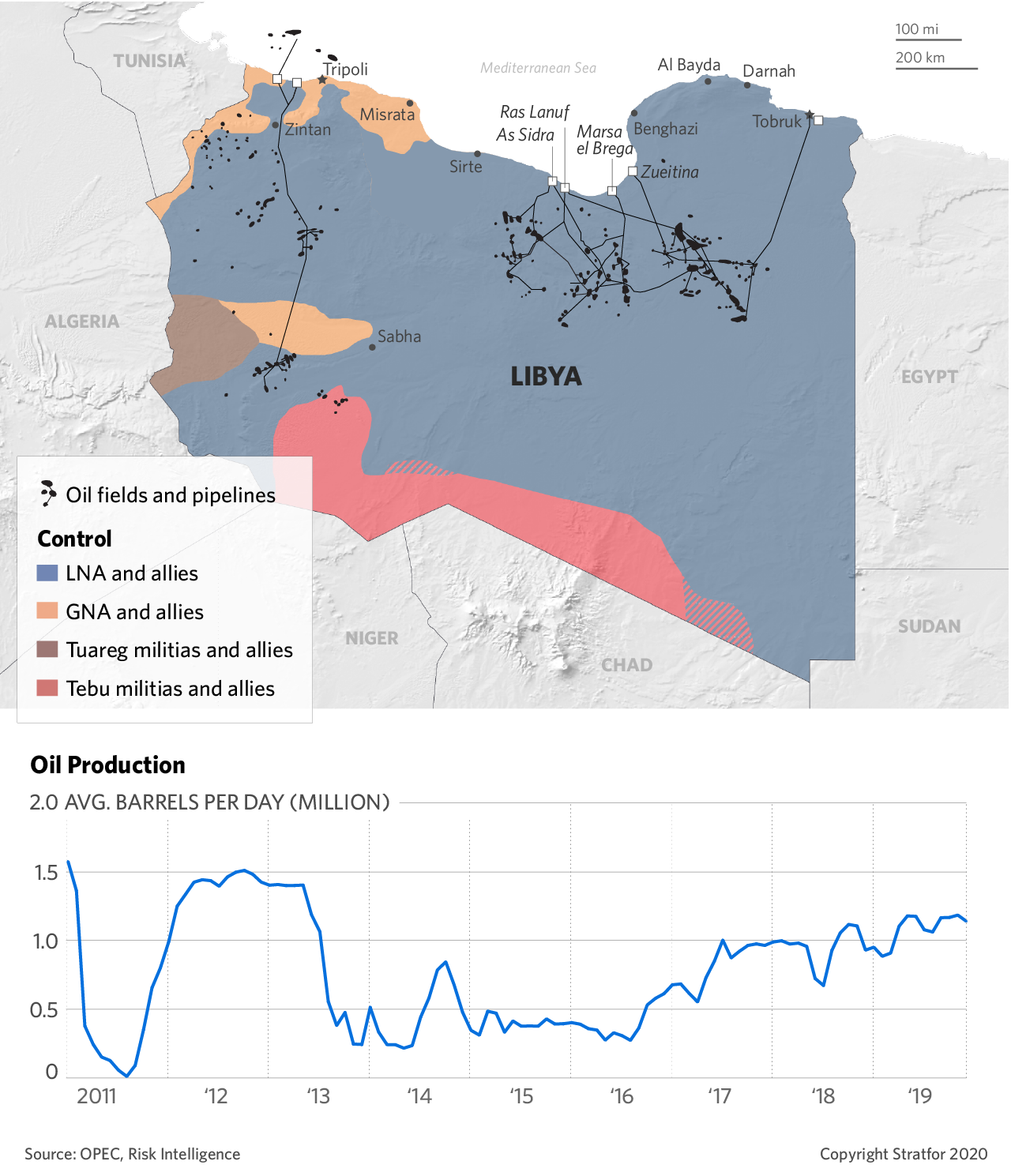
Just hours before global powers kicked off a Jan. 19 conference in Berlin to discuss ways to end Libya's conflict, one of the war's major parties, the Libyan National Army, made a major announcement: It was closing the country's five oil export terminals in eastern Libya. Not long after, the LNA shut off a key pipeline connecting Libya's two main oil fields in western Libya to ports. If the closures continue, they could torpedo Libya's oil production from approximately 1.15 million barrels per day to less than 75,000 b/d.
Eventually, the LNA and its leader, Field Marshal Khalifa Hifter, are likely to come under enough pressure that they will bring the country's production back online. More crucially for Libya, however, the merely modest progress at the Berlin peace conference shows that the country remains months away from any meaningful political solution to its civil war. And ironically, if the country does edge closer to a peace settlement, its energy exports are likely to become more volatile as the LNA tries to play its most powerful card — control of the country's oil flows — in any talks with the Tripoli-based Government of National Accord.
The Bumpy Road to Peace
On the surface, the Berlin conference seemed like a success. The attendees, including representatives from Algeria, China, Egypt, France, Germany, Italy, Russia, Turkey, the Republic of the Congo, United Arab Emirates, the United Kingdom and the United States, signed a 55-point plan to reduce external influence in the conflict and facilitate a United Nations-led peace process. The plan includes promises by each country to respect the U.N. arms embargo and calls on the U.N. Security Council to impose sanctions on sides that violate the cease-fire agreement and arms embargo. Participants also agreed to respect the Libyan National Oil Corporation as the country's sole national oil company.
But these are all issues that Libya's rivals and outside powers have discussed, proposed and agreed to before. There is no shortage of foreign support for Libya's dueling factions, as evidenced most recently by Turkey, which sent more equipment to Libya earlier this month in support of the GNA. There's also no real way to enforce the arms embargo, as Russia can veto any sanctions against itself, while the close military ties that the United Arab Emirates (one of Hifter's prime backers) enjoys with the United States will likely spare it from the effect of any sanctions. Moreover, Hifter and GNA Prime Minister Fayez al-Sarraj did not sign the agreement; in fact, they didn't even meet in Berlin. German Chancellor Angela Merkel, for one, lamented that Hifter and al-Sarraj are not speaking to one another due to the "magnitude of differences" between them. And last week, Hifter even declined to sign a cease-fire agreement in Moscow after al-Sarraj had signed it and departed.
As it is, neither the GNA nor the LNA has an incentive to sign a peace agreement at present. If Hifter and his foreign backers were to accept any sort of a permanent cease-fire or peace process before he gains control of key parts of central Tripoli, it would be tantamount to admitting that his nine-month offensive to take the city was unsuccessful. Moreover, it would legitimize the GNA and those whom the LNA has portrayed as terrorists in talks. With Hifter and supporters such as Abu Dhabi keen to avoid such outcomes, they will passively agree to peace talks, although they do not want the negotiations to tie their hands unless the GNA agrees to the LNA's maximalist demands, which would include Hifter's appointment as national military chief and the institutionalization of the LNA.
As for the GNA, it is sitting in a much stronger position than it was two months ago. The military agreement with Turkey has given it increased support, including reports of more advanced surface-to-air missiles, which will improve its ability to defend Tripoli's airspace from the LNA's Emirati-provided drones. Through Turkish support, the GNA has also reportedly started deploying up to 2,000 Syrian rebels in the fight. All of this will allow the administration to hold the line in Tripoli and Misrata against the LNA for the time being, but in the longer term, Ankara may need to provide an even greater degree of support as Cairo and Abu Dhabi are unlikely to reduce their support for Hifter.
Although the Berlin conference envisioned the establishment of follow-up committees, including a 10-person military committee split between the LNA and GNA to draft a more permanent cease-fire, a lasting truce is not likely. More probable, by contrast, is just an informal modus vivendi between the LNA and the GNA. This could keep significant conflict in check, but any halt to hostilities — formal or not — would be so fragile that a return to conflict would never be far away.
Oil Volatility
Given Libya's current political and military standoff, its oil exports could become more volatile over the course of 2020. Hifter and the LNA control virtually all of the country's onshore oil production, as well as five of the country's most important export terminals, yet they have little control over the flow of oil revenue through the Central Bank of Libya. Despite gaining significant control over Libya's oil sector in September 2016, Hifter has only occasionally exploited oil in negotiations. This is due to a number of reasons. First, eastern Libya's economy is deeply dependent on public salaries that are funded by oil revenues. Second, the National Oil Corporation has also supplied eastern Libya with refined fuel, which industrial cities like Benghazi must source from elsewhere in the absence of operating refineries closer to home. And third, there are fears that the central bank would withdraw credit and cash from eastern Libya if the LNA were to take oil offline for an extended period of time.
Nevertheless, Hifter and his allies could use their control of the country's oil production as leverage to try to pressure the central bank so as to increase transparency and determine where the lender is spending Libya's oil revenue. Hifter and the LNA shut down oil production last June for about a month, demanding an international audit of the central bank in return for permitting oil exports to restart. At the time, U.S. and other international pressure forced the LNA to abandon its action, but the intervention certainly didn't solve some Libyans' underlying concerns about where the country's oil revenue is going.
At present, Hifter has far more political cover in eastern Libya to continue cutting oil exports despite the economic consequences — particularly because of the GNA's decision to bring in Syrian mercenaries to fight against Hifter, the LNA and eastern tribal militias. (As part of the agreement, the GNA is reportedly paying each mercenary a monthly salary of $2,000, although it will provide further compensation in the event of death or lasting injury.) As far as many LNA supporters are concerned, these payments prove that oil exports are now directly funding the foreign mercenaries and Libyan militias that they are fighting. Locally, too, the LNA enjoys backing for its move, as a number of tribal leaders called for the halt to oil exports last week, allowing the LNA to justify the shutdown as a reflection of the will of the Libyan people.
The political support for the LNA's action could result in a halt to oil exports this time that lasts several weeks, instead of just a few days, even if the result is a deepening of eastern Libya's economic crisis. That risk, ultimately, will force the LNA to eventually turn the pumps back on — in contrast to the period from 2013 to 2016, when Petroleum Facilities Guard commander Ibrahim Jadhran could cut oil production for extended periods in the area because he made no pretence of trying to rule the entire region. Hifter, though, is trying to govern the region, and he has other reasons to avoid waiting too long before restarting production: If Washington threatens to sanction him for his actions, it could scuttle his political future in Libya.
In the end, a major conundrum lies at the heart of the relationship between Libya's political impasse and its oil: The closer the LNA and GNA get to a cease-fire and a permanent political solution, the more likely Hifter is to exploit his control of oil production in negotiations. In so doing, the field marshal would not only be able to lean on western Libya's actors to concede on key issues, but it would also demonstrate that any stalemate in the talks and military conflict could lead to Libya's de facto partition, leaving a lot of oil in the LNA's hands — permanently. The LNA's decision to take such a drastic step on oil on the eve of a major conference on Libya just goes to show that it intends to play the energy card for all its worth.
