
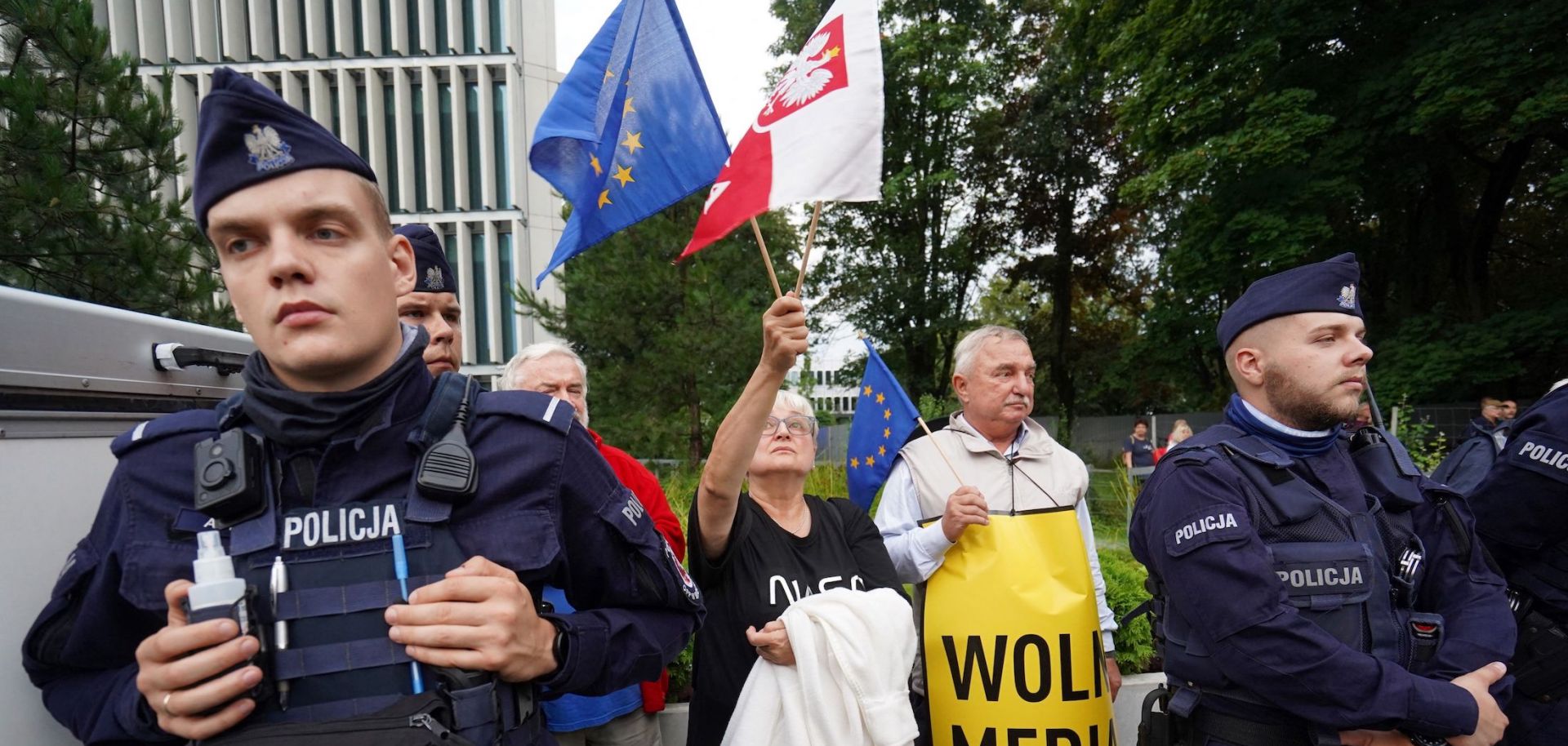
Police stand guard in Warsaw, Poland, as demonstrators holding EU and Polish flags protest the country’s proposed media law on Aug. 10, 2021.
Poland’s ongoing political uncertainty raises the prospect of an early general election that could see pro-EU parties return to power after years of clashes between Warsaw and Brussels. On Aug. 11, Polish Prime Minister Mateusz Morawiecki’s nationalist and euroskeptic Law and Justice party, known in Poland by its acronym PiS, ended its coalition with the small Accord party amid disagreements over a controversial media reform. While the lower chamber of parliament, the Sejm, passed the law with support from lawmakers from other parties on Aug. 12, PiS and the remaining members of the government alliance no longer control a majority in the chamber. Poland’s Senate, where the government also lacks a majority, will vote on the bill in September.
- The proposed media reform would prevent companies outside the European Economic Area (EEA) from taking control of Polish radio and television stations. The European Union and the United States have criticized the reform, arguing that it is meant to silence the popular U.S.-owned news channel TVN24, which is critical of the Polish government.
- The small Accord party and members of the Polish opposition have warned that the media reform could strain Warsaw’s relations with Washington, Poland’s most important military partner.
If PiS remains in power, disputes with the European Union will continue to create economic and political risk for Poland. Since taking over in 2015, the PiS government has clashed with the European Union over Warsaw’s increased oversight of the judiciary, pressure on critical media, and controversial positions on LGBTQ+ rights, among other issues. Brussels has repeatedly threatened to impose financial fines and suspend EU funding, of which Poland is a net receiver. As leverage in its disputes with Warsaw, the European Commission has delayed the approval of Poland’s plans to spend its share of the bloc’s COVID-19 relief funds. Because the Polish government no longer controls a majority of seats in the Sejm, it will now depend on smaller parties and independent members of parliament to pass legislation. Some of these lawmakers are far-right and anti-establishment, which means that cooperation with them could spur new clashes between Poland and the European Union over rule of law issues or anti-EU positions.
- On Aug. 17, the Polish government announced the elimination of a controversial chamber at its Supreme Court devoted to disciplining judges. Brussels argued that the chamber was meant to pressure judges and had threatened to impose financial sanctions if Warsaw did not dismantle it. But the Polish government said it will continue to look for ways to punish judges who break the law or abuse their power, meaning disputes with Brussels could continue.
PiS’s weakened position could ultimately see it replaced by a more pro-EU government in an early general election, which would substantially reduce the risk of financial sanctions and the suspension of EU funding. Poland does not need to hold a general election until late 2023. However, PiS’s dependence on non-government parties to pass legislation and survive no-confidence votes could trigger an early vote to secure a new parliamentary majority. But this would be a risky gamble, given the increasing popularity of Poland’s pro-EU opposition amid frustration over Warsaw’s handling of the COVID-19 pandemic.
- The survival of Poland’s minority government will be tested in September, when the Polish parliament will start the debate over key policies promoted by PiS, including its flagship “Polish Deal” economic program. PiS hopes the program, which includes spending hikes and tax cuts, will improve its popularity after Poland’s pandemic-induced recession. The opposition can also trigger no-confidence votes on the Polish government and on individual members of the cabinet, which would test PiS’s ability to find support in parliament as well.
- According to an Aug. 16 poll, support for PiS is at 34%, while the main opposition party, the pro-EU Civic Platform, is at 26%.
