
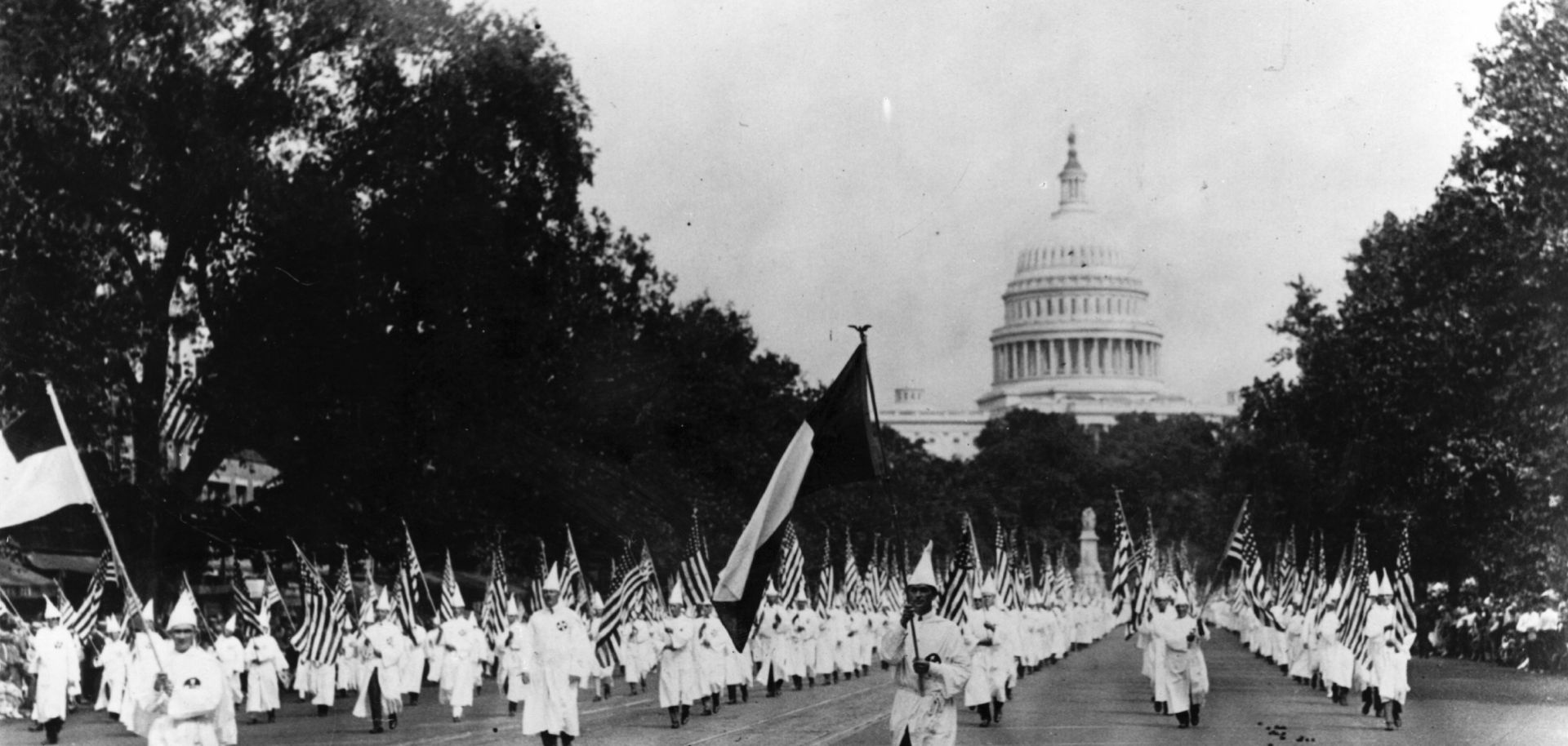
A Ku Klux Klan march on Aug. 19, 1925, on Pennsylvania Avenue in Washington. The respective ideologies driving white supremacist and jihadist terrorism share a number of similarities despite their different tenets and opponents.
In last week's On Security column about the Christchurch attack in New Zealand, I noted that white supremacists adopted the leaderless resistance model of terrorism before jihadists did. A knowledgeable reader subsequently asked about the similarities between white supremacist and jihadist terrorism. Like jihadism, the various ideologies driving white supremacism are not going away any time soon, and comparing the two can provide valuable lessons for understanding the ongoing threat. Fragmentation and a Leadership Vacuum The white supremacist/nationalist universe is heavily fragmented. In general, white supremacists believe white people are inherently superior to other races, while white nationalists, or separatists, focus on maintaining a white race that is separate from other races.
