
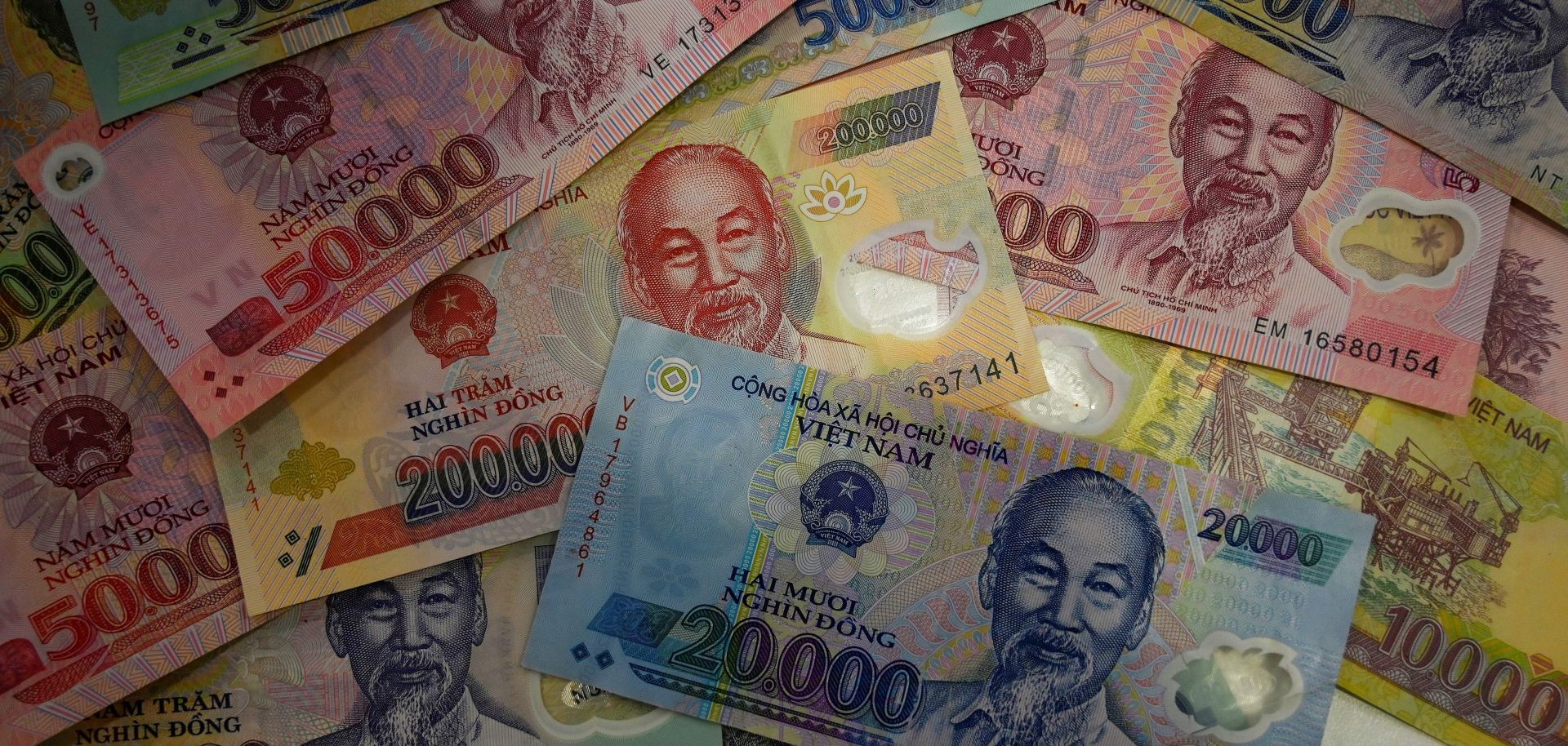
A photo illustration shows banknotes of the Vietnamese dong on May 21, 2019.
A new U.S. investigation into Vietnam’s potential currency manipulation and undervaluation could result in a limited amount of tariffs being levied against Vietnamese goods, should U.S. President Donald Trump be re-elected in November. On Oct. 2, the Office of the U.S. Trade Representative announced the launch of the investigation under Section 301 of the U.S. Trade Act of 1974, which is the United States’ most powerful tool in enacting tariffs on foreign governments with policies deemed harmful to U.S. commercial interests. If concluded by the Trump administration, the investigation — which will likely take months and could last into 2021 — would probably find that Vietnam’s currency, the dong, is undervalued due to government policymaking.
Trump has taken a strong stance against foreign governments on currency manipulation and undervaluation, particularly for those countries that have large trade surpluses with the United States — and Vietnam has long been a focus in that criticism. In 2019, Vietnam was the fifth-largest contributor to the U.S. trade deficit at $58 billion. Among the top five countries that the United States had a trade deficit with in 2019, its trading relationship with Vietnam was also the most unbalanced.
- In August, the U.S. Treasury Department determined that the Vietnamese dong was undervalued by 4.7 percent in 2019 as part of a separate anti-dumping and countervailing duties investigation conducted by the Commerce Department regarding the exports of Vietnamese tires.
- Trump has also accused Germany of manipulating its currency despite using the euro, arguing that the European Central Bank’s policy has created an undervalued currency for the German economy.
But while the Trump administration views Vietnam’s currency as undervalued, there is not a global consensus among financial experts and institutions on the matter. The economic think tank Bruegel estimated that the dong’s real effective exchange rate index — a measure commonly used to gauge whether a currency is over/undervalued — increased from 142.1 to 148.8 between January 2019 and July 2020, showing a real increase in the currency’s value. In its latest assessment of the Vietnamese economy, completed in July 2019, the International Monetary estimated that the Vietnamese currency was undervalued by 8.4 percent in 2018. But Fitch Solutions (the research and consulting branch of Fitch Ratings) has said it views dong as overvalued due to its real effective exchange rate being traded at far above the 10-year average.
Despite the conflicting data, a Trump-led Treasury Department would likely determine that the dong is undervalued as a result of politically-motivated actions by the Vietnamese government. None of the many trade-motivated investigations that the Trump administration has formally launched over the past four years have failed to find fault with the country in question. The new Section 301 investigation into Vietnam is unlikely to prove different, as it was likely launched with a high expectation that Treasury officials would conclude that Hanoi had a hand in its currency becoming undervalued. The White House would then use the findings of the investigation to pressure Vietnam into allowing for the dong to appreciate in real terms against the U.S. dollar.
- When making that determination for the Commerce Department's report last month, the Treasury was primarily concerned with whether the Vietnamese currency was undervalued, which can technically occur for reasons outside Hanoi’s direct control. Under the new Section 301 investigation, however, the Treasury Department will be more focused on the Vietnamese government’s actions and intent surrounding the dong’s exchange rate.
- The U.S. Treasury has yet to officially determine whether Vietnam is, in fact, a currency manipulator. But in its August report, it did conclude that the dong’s undervaluation was partially driven by “government action on the exchange rate.”
Any U.S. tariffs imposed on Vietnamese goods, however, would likely be modest in order to preserve the United States’ strong relationship with Hanoi amid its ongoing competition with Beijing. Unlike its aggressive approach to Beijing, the United States has repeatedly reached out to Vietnamese authorities in order to clarify their exchange rate policy. In 2019, the Treasury Department delayed its semi-annual report on the currency practices of the United States’ major trading partners, specifically over not wanting to label Vietnam a currency manipulator under the report’s strict definitions in order to give Vietnamese authorities more time to produce information. This has since likely prompted Hanoi to alter its currency policies, which will leave room for negotiation between the United States and Vietnam over the findings for the Section 301 report.
- The dong has been remarkably stable since the beginning of last year, with its exchange rate only rising from 23,194 to 23,178 dongs per one U.S. dollar between Jan. 4, 2019, and Oct. 1, 2020. This suggests that Vietnamese authorities have sought to keep the exchange rate stable and not let it depreciate further, perhaps due to U.S. pressure.
Nevertheless, a re-elected Trump administration would likely still impose some level of tariffs against Vietnam — whether through the use of Section 301 itself if its negotiations with Hanoi fall apart, or through additional Commerce Department investigations on export subsidies for Vietnamese industries. The White House has accused global companies of using Vietnam to circumvent U.S. tariffs on China through transshipment. Any targeted tariffs would thus likely focus on Vietnam’s industries that are closely related to China’s industries, including heavy manufacturing (such as steel, aluminum, tires), electronics (such as smartphones), textiles and toys.
Vietnam would likely remain measured in its response to such tariffs, as Hanoi also has a strong geopolitical interest in maintaining its close ties with the United States. Vietnam’s political relationship with Washington is key to counterbalancing against its powerful neighbor China, with which Hanoi has numerous maritime disputes. Vietnam has long separated its strategic geopolitical behavior from trade issues, as evidenced by its repeated confrontations with Beijing in the South China Sea, despite China making up 22 percent of Vietnamese trade.
