
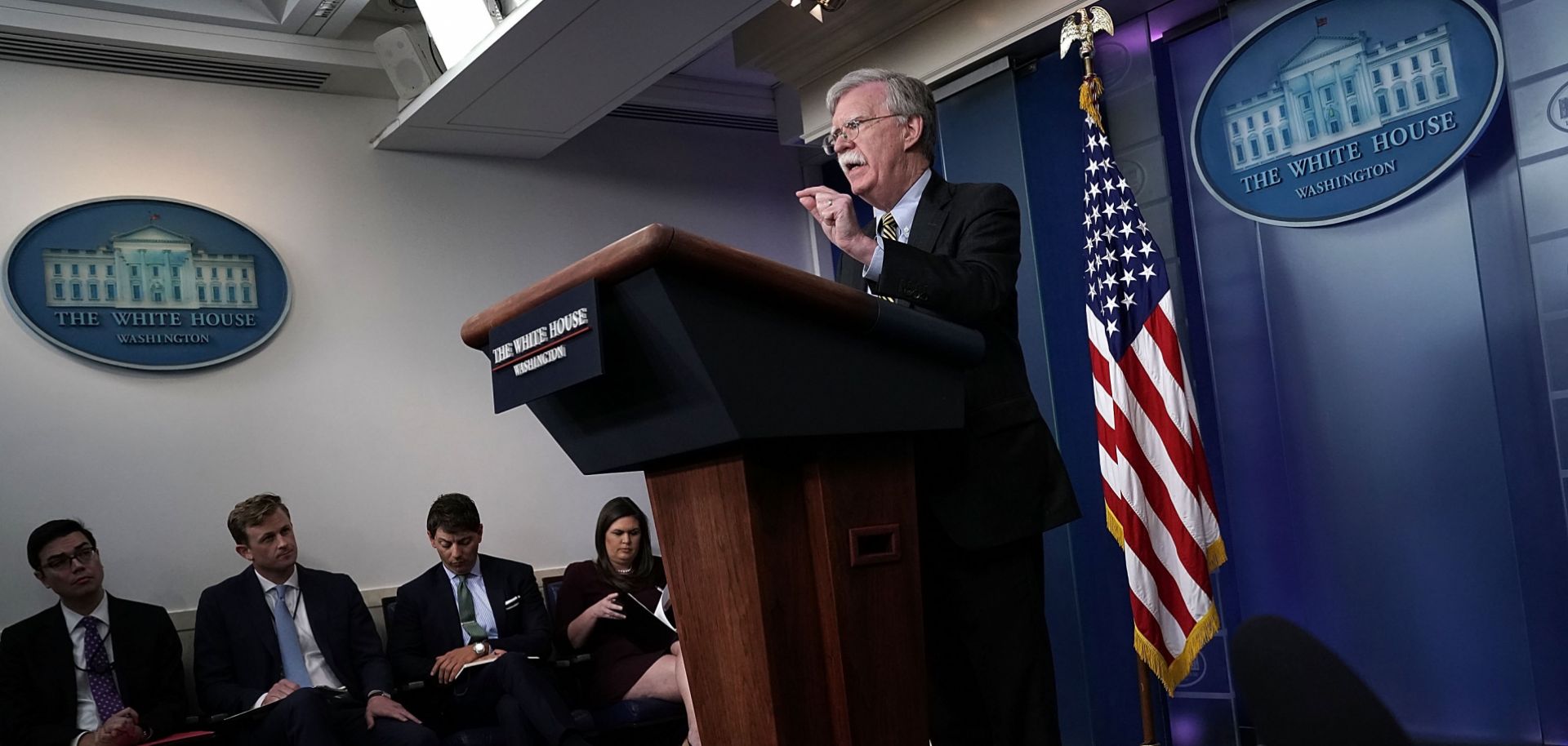
U.S. national security adviser John Bolton speaks during a White House news briefing on Oct. 3, 2018. Several factors have pushed the United States to this tipping point on the INF, including the growing power of China, Russia's continuing INF violations and the ascent of ardent arms-control skeptics in the White House like Bolton.
U.S. President Donald Trump announced on Oct. 20 that he intends to withdraw the United States from the Intermediate-Range Nuclear Forces (INF) Treaty. That agreement prohibits the deployment of nuclear and conventional ground-launched ballistic and cruise missiles with intermediate ranges, defined as 500-5,500 kilometers (310-3,410 miles). While the withdrawal will allow the U.S. military to build a formidable arsenal of missiles to challenge China and Russia, the treaty's termination will undoubtedly stoke a budding arms race between global great powers , and it could lead to the demise of other key arms control treaties such as the New START agreement. In recent years, the United States has accused Russia of violating the INF treaty and has tried to force Moscow to comply using sanctions and weapons development. The Russians, however, have refused to adhere to U.S. demands and have accused the United States of violating the treaty .
