
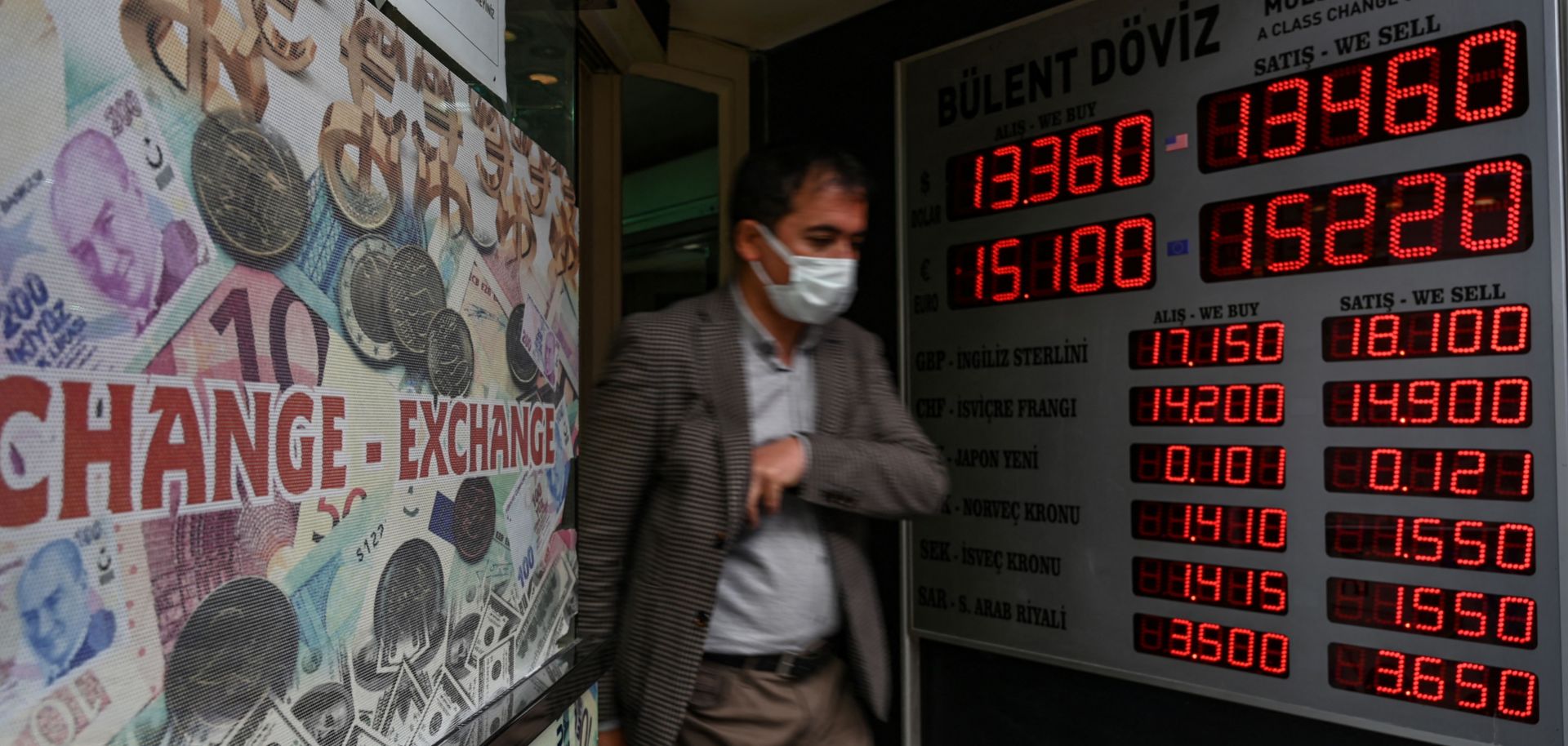
A customer leaves a currency exchange agency in Istanbul, Turkey, on Dec. 2, 2021.
To reduce inflation, Turkey has focused on cutting interest rates to stimulate investment while hoping to raise exports to a level that would override the country’s dependence on external financing and produce a current account surplus in the balance of payments. But recent data points suggest this strategy is backfiring — badly. Failure to address macroeconomic problems and resulting economic instability will increase political pressure on Turkey’s ruling Justice and Development Party (AKP) to reverse course, lest risk further eroding the party’s popularity ahead of the scheduled 2023 elections. Inflation in Turkey was 48.69% (y-o-y) in January, a 20-year high. Energy and food prices increased and exchange rate depreciation passed through to core inflation, which was 39.45% in January compared with 31.88% the previous month. On a monthly basis, inflation accelerated to 11.1% in December, which annualizes to a 354% rate if sustained over a year.
