
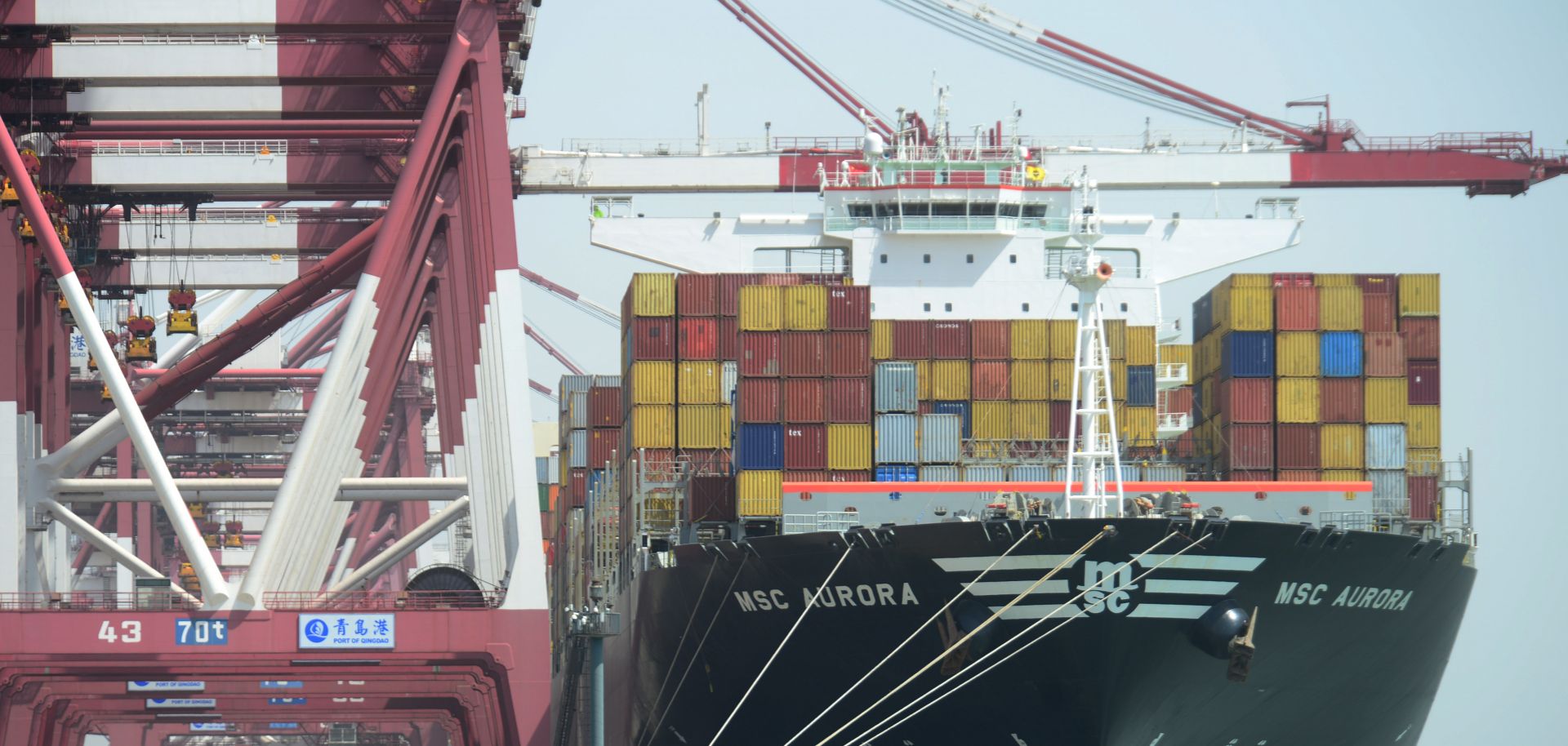
A cargo ship carrying containers stops at Qingdao Port on April 6 in Qingdao, China. The United States has shown little fear of the consequences of escalating trade tensions with China far beyond what would be considered a typical dispute, and China has so far stood up to those escalations.
U.S. President Donald Trump keeps nudging China toward a trade war. After markets closed on April 5, the White House announced in a press statement that Trump had directed U.S. Trade Representative Robert Lighthizer to consider increasing the amount of Chinese goods subject to new U.S. tariffs by another $100 billion in value. This move triples the severity of the $50 billion in tariffs that Washington announced on March 22 , which Beijing responded to in kind earlier this week. If implemented, the new tariffs could mark the beginning of an all-out trade war between the world's two largest economies. Typically during trade disputes, one country retaliates against another's first moves, then both countries call a de-facto ceasefire to prevent further escalation. But neither the United States nor China appears to be backing down.
