
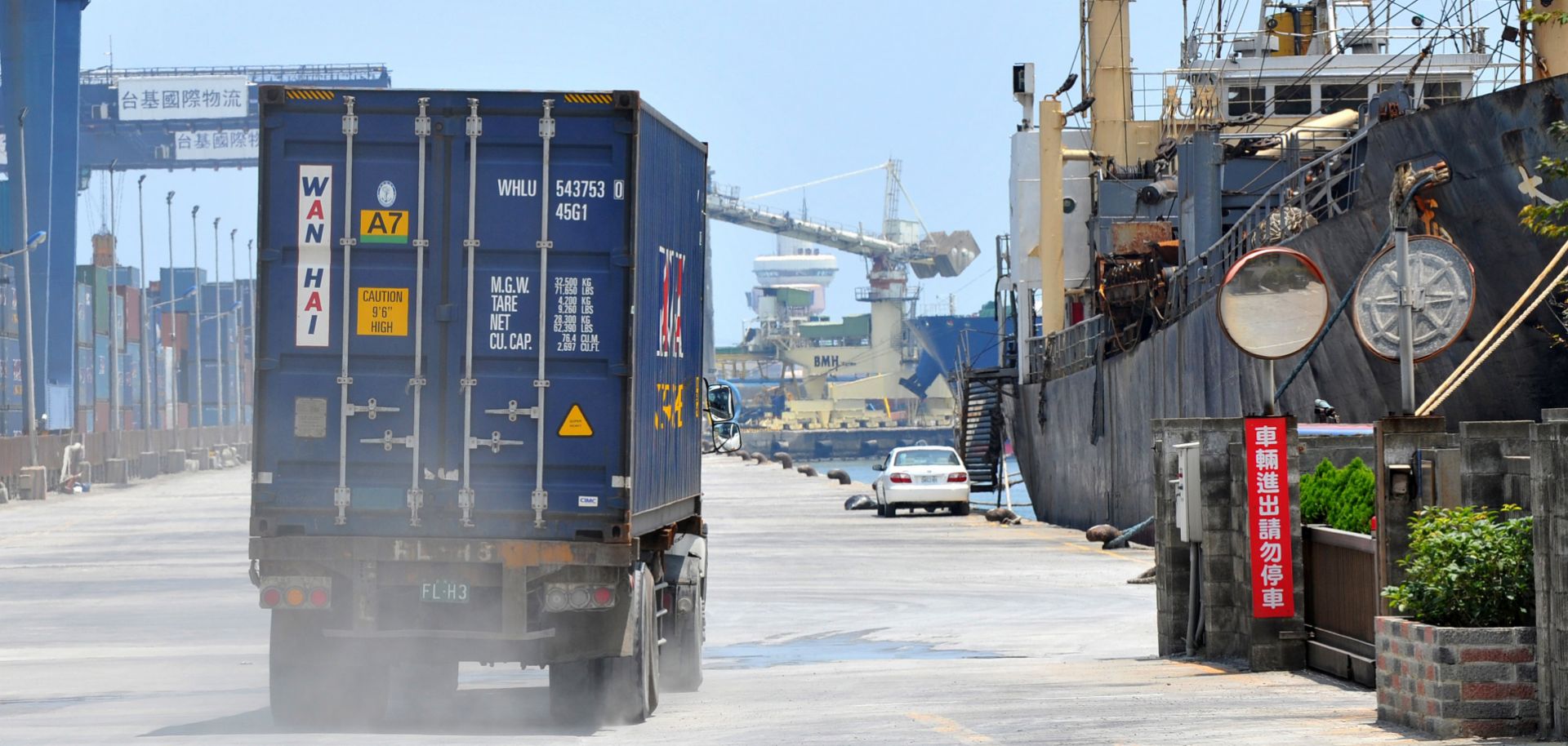
A container truck drives along a pier at Taiwan's busy northern Keelung harbor on Aug. 8, 2011. Today, China accounts for over 40 percent of Taiwan's exports, of which 80 percent are intermediary goods that are assembled in China before being sold domestically or exported.
Taiwan is caught in the middle of the escalating trade war and larger strategic competition between mainland China and the United States. And the clash is threatening the self-governing island's export- and tech-oriented economy, which relies heavily on the mainland's supply chains for assembly, export opportunities and market access. (This is particularly true for its electronic and semiconductor industries, which together account for about 25 percent of the island's gross domestic product.) Adding to Taiwan's economic troubles is Beijing's two-pronged campaign to diplomatically isolate the island and poach its businesses and talent, all in the hopes of eventual reunification. Together, these threats are increasing Taipei's desire to rely less on the mainland's economy, to diversify its trade and investment relationships with its neighbors, particularly India and those in Southeast Asia, and to establish more free trade agreements.
