
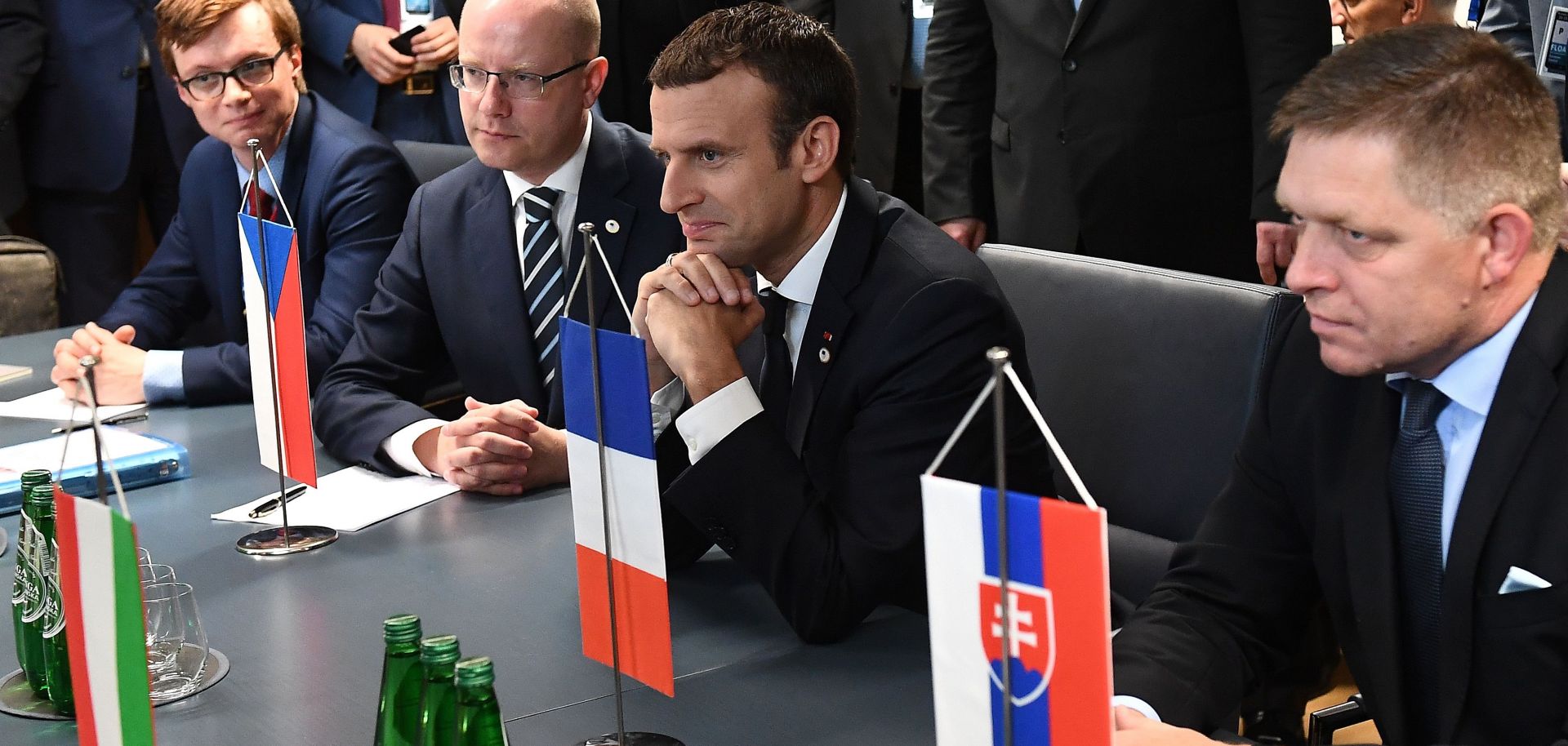
French President Emmanuel Macron (C) meets with the Visegrad Group. Since taking office in June, the French government has been building its foreign policy at a frenzied pace. Macron will soon focus on Central and Eastern Europe, meeting with the leaders of Austria, the Czech Republic and Slovakia in Salzburg on Aug. 23, and then visiting Romania on Aug. 24 and Bulgaria on Aug. 25. The official goal of these meetings is to discuss the situation of Eastern European nationals working in Western Europe. But France is also playing a more subtle political game. The European Union is about to start a debate about its future and Central and Eastern European countries will have to decide what role they want to have in it.
The French government has said that Macron will use his tour to discuss the posted-workers system, an EU scheme by which companies in Western Europe can hire cheaper labor from poorer countries in Eastern Europe. Though less than 1 percent of all European workers carry out their jobs under the scheme, Macron has identified it as a form of social dumping that creates unfair competition for French workers. The European Union is unlikely to abolish the posted-workers system, but it will seek to reform it and probably limit its use. Support from at least some Central and Eastern European countries will be important to prevent the reforms from widening the divisions between Western and Eastern EU member states. But Macron's visit also has the unstated goal of strengthening France's presence in a region that hasn't been a priority in recent years.
