
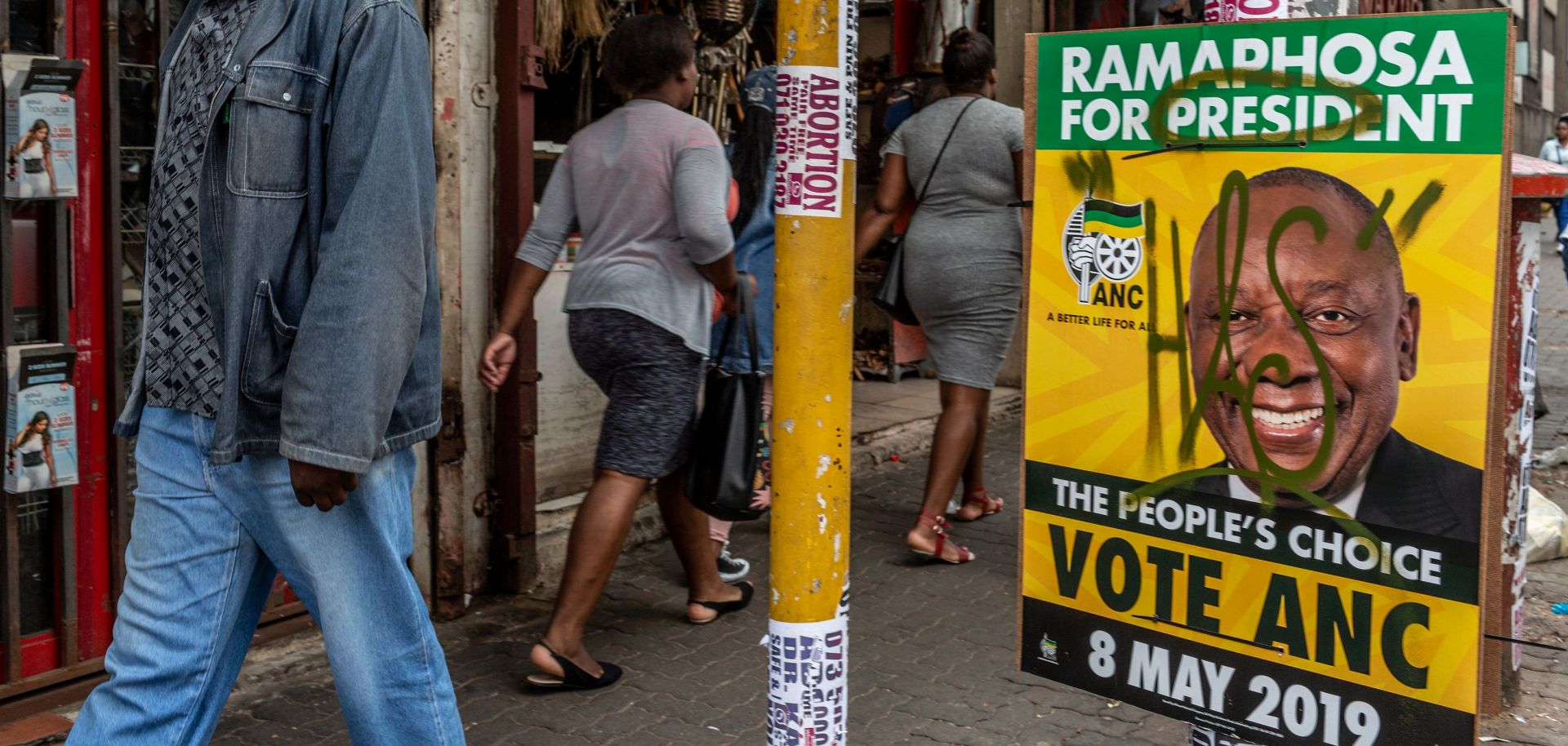
People in Johannesburg walk past an election poster promoting the African National Congress on April 28, 2019. The May 8 general election will serve as a referendum on Ramaphosa's rule and, by extension, his pro-business and anti-corruption tilt.
South Africans celebrated Freedom Day on April 27, the day marking the 1994 election that officially ended the country's apartheid era and kicked off a new social and government order. Now, exactly 25 years later, as the country prepares for its May 8 general election, the question of South Africa's future political and economic directions weighs heavily. The African National Congress (ANC) has been the country's dominant political party for the past two and a half decades, and it's almost guaranteed to remain in power. But the election could reveal that South Africans' faith in the party — and their current President Cyril Ramaphosa — is declining. A strong public mandate for Ramaphosa's ANC would encourage his efforts to implement pro-business, anti-corruption policies. But if the party's margin of victory is slim compared to rivals, South Africa's government could begin embracing less efficient and business-friendly policies .
