
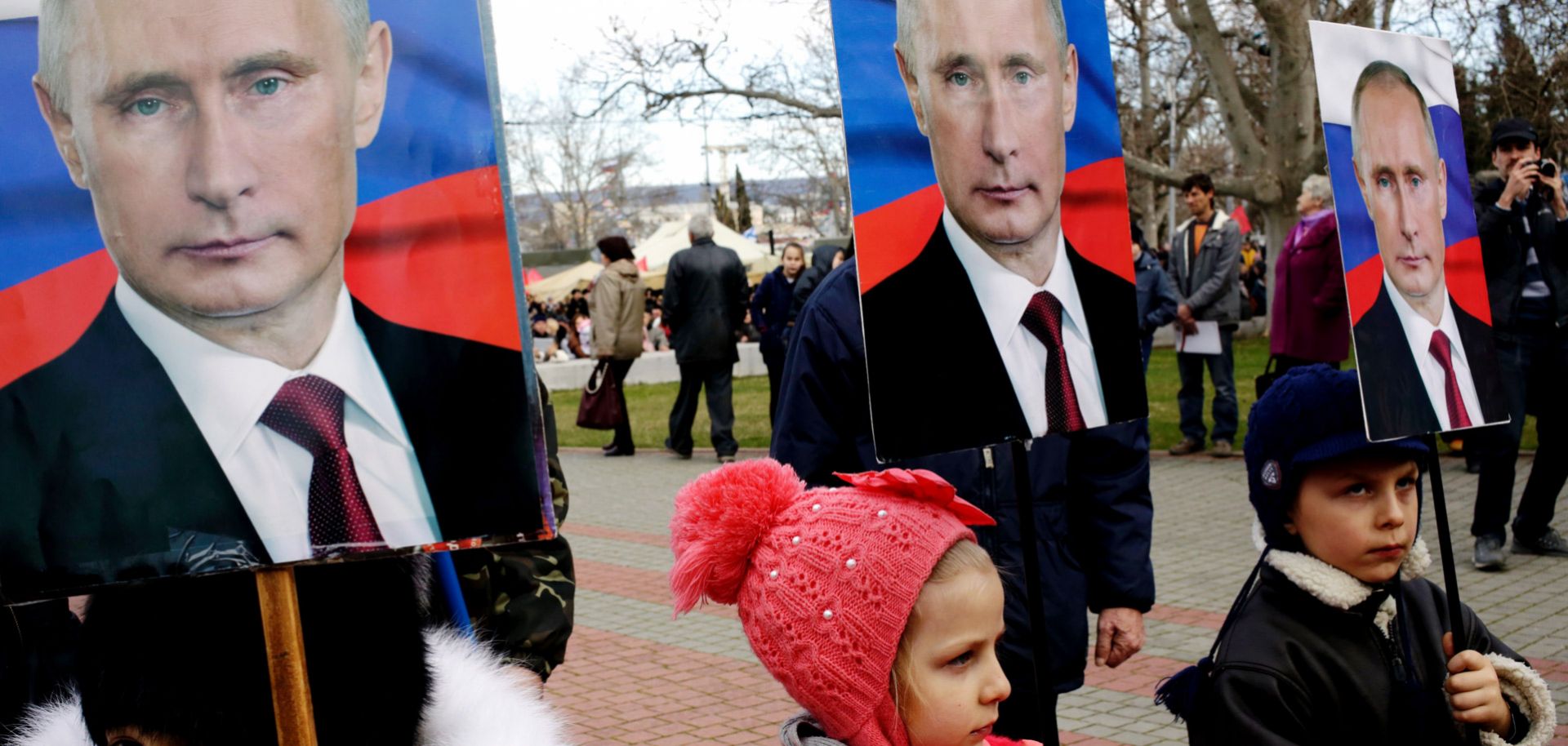
Children hold portraits of Russian President Vladimir Putin as they take part in a rally in the Crimean city of Sevastopol. Ukraine has become a symbol of the ongoing competition between two superpowers: Russia and the West.
Throughout the Cold War, the symbolic center of the standoff between the Soviets and the West was Germany, split in two — much as the whole of Europe was — by the infamous Iron Curtain. But now, in Ukraine, a new center has emerged in the rivalry between East and West, dividing the country in ways that could prove just as enduring as the decadeslong partition of Germany. This week marks the second anniversary of the Euromaidan uprising that drove former Ukrainian President Viktor Yanukovich from power, shaking Ukraine to its foundations and driving Russia-West relations to their lowest point since the end of the Cold War. Much has changed in the two years since: A pro-West government formed in Kiev, Russia annexed Crimea, and a rebellion in eastern Ukraine developed into a full-fledged war. Meanwhile, the United States and the European Union have levied sanctions against Russia.
