
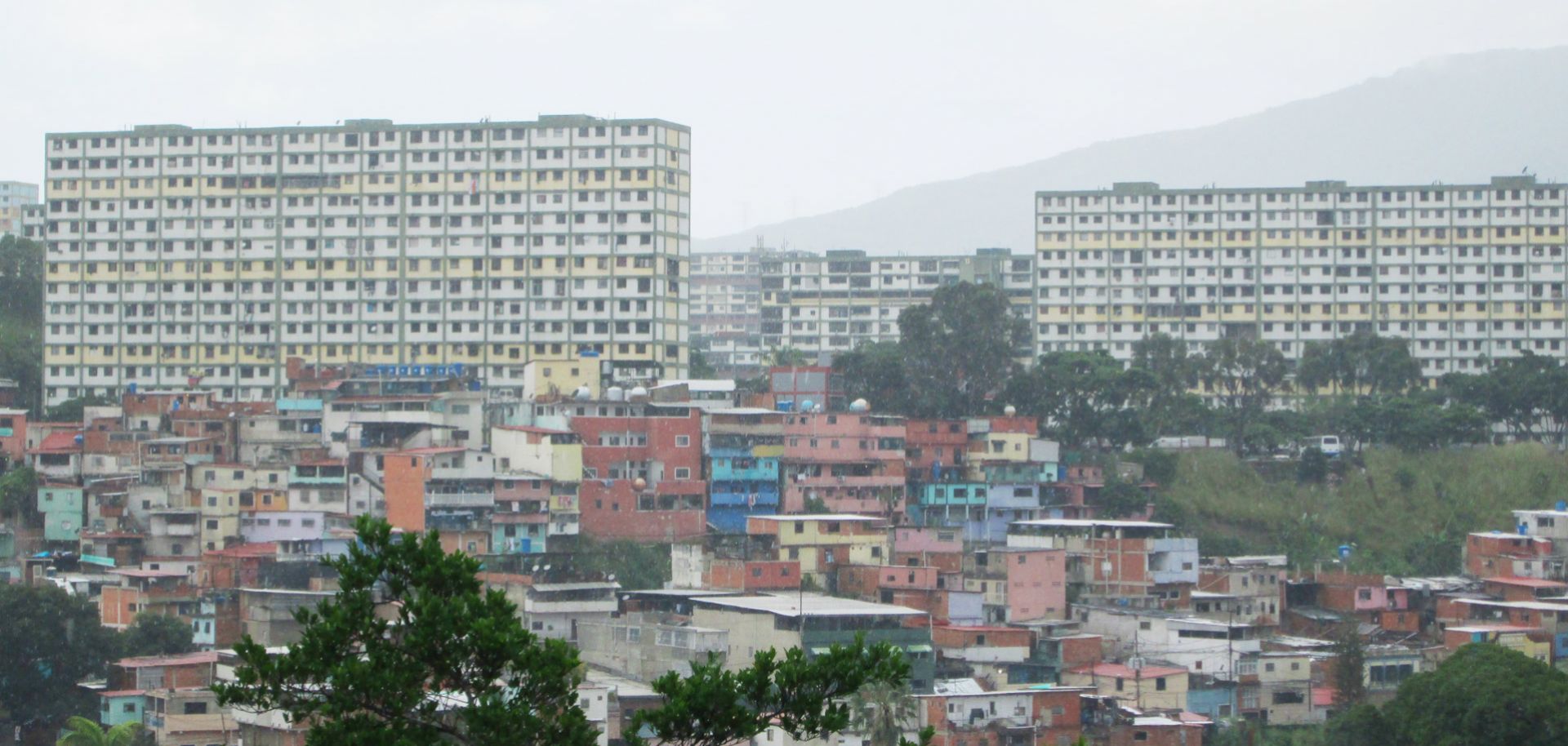
A general view shows the concrete superblocks in Barrio 23 de Enero in Caracas.
The heart of Venezuela beats loudly in Barrio 23 de Enero. In this low-income neighborhood of Caracas, long concrete superblocks containing thousands of housing units tower above the streets, their peeling facades of teal, yellow, orange and blue speckling the skyline. In the mid-20th century, when Venezuela's oil economy drove rapid urbanization and European postwar modernist architects extolled the virtues of class-neutral social housing, the military dictatorship of Gen. Marcos Perez Jimenez commissioned architect Carlos Raul Villanueva to address Venezuela's growing housing challenge. Villanueva's blueprints borrowed from Swiss-French architect Le Corbusier's Soviet-inspired Unite d'Habitation communal housing experiment in Marseille. What resulted was not a utopian community that erased the cleavages between the lower and middle classes but a densely populated ghetto where a revolutionary spirit took root.
