
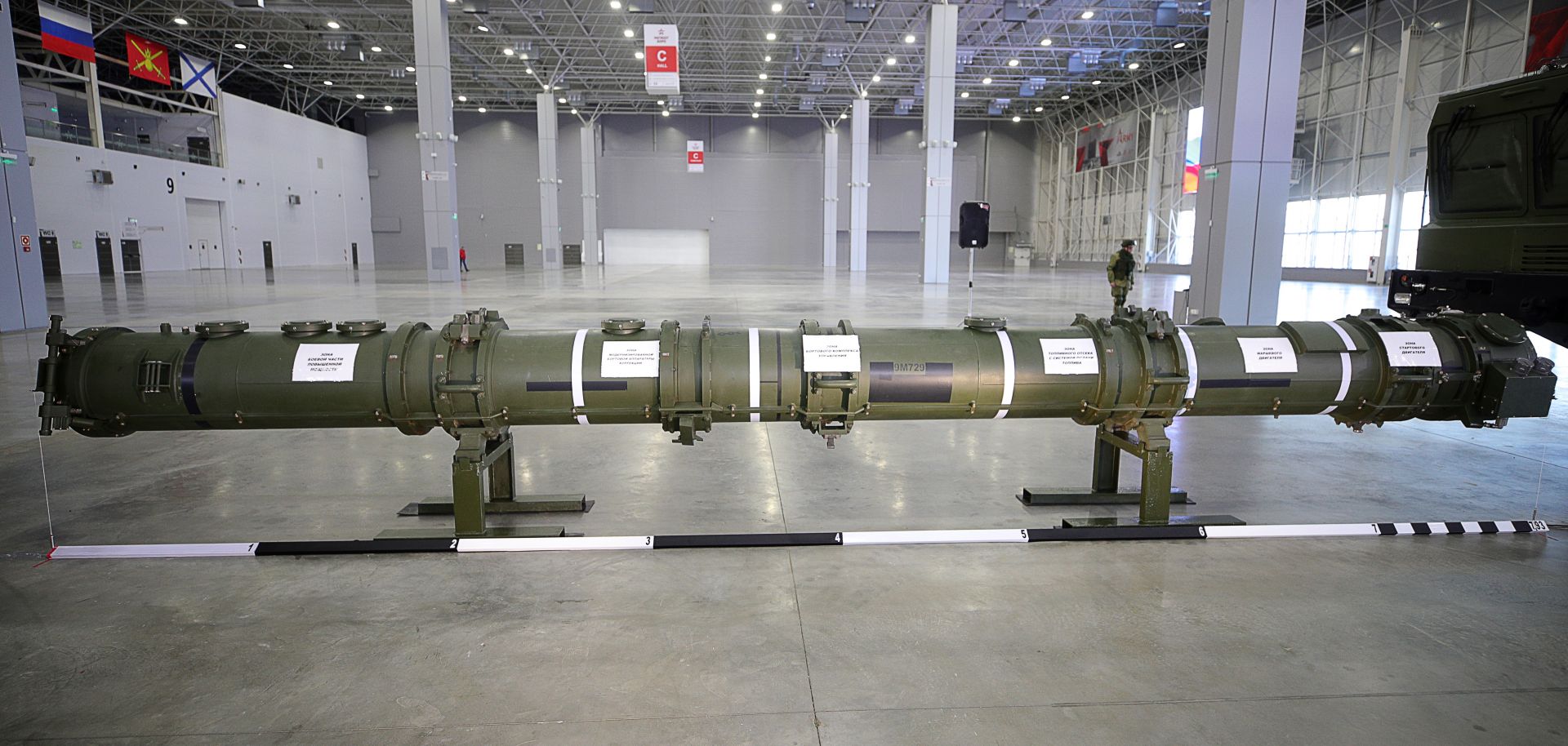
The 9M729 missile demonstrated after a briefing for military attaches and international media by the Russian Defence Ministry at the Patriot Congress and Exhibition Centre in Kubinka, Moscow Region, on the 9M729 missile system; Russia does not recognize the USA's unilateral decision to quit the 1987 INF disarmament treaty (the Intermediate-Range Nuclear Forces Treaty). Sergei Bobylev/TASS (Photo by Sergei Bobylev\TASS via Getty Images)
With the Intermediate-Range Nuclear Forces Treaty (INF) officially dead, observers are watching to see whether the types of land-based missiles the treaty banned in Europe in the late 1980s will return to the Continent. The United States may have delivered the coup de grace to the treaty by withdrawing from it, but unlike in the Western Pacific , it has no immediate plans to deploy the formerly banned nuclear-capable missiles in Europe. Russia meanwhile has said it would only deploy its intermediate-range missiles within reach of Europe if U.S. intermediate missiles were deployed on the Continent first. But even though each has indicated it won't take the initiative, either one might, in fact, do so — especially Russia. A Russian move would likely provoke a U.S. missile deployment in Europe, but Moscow could calculate that the cost of moving first would be less than the benefits it could gain.
