
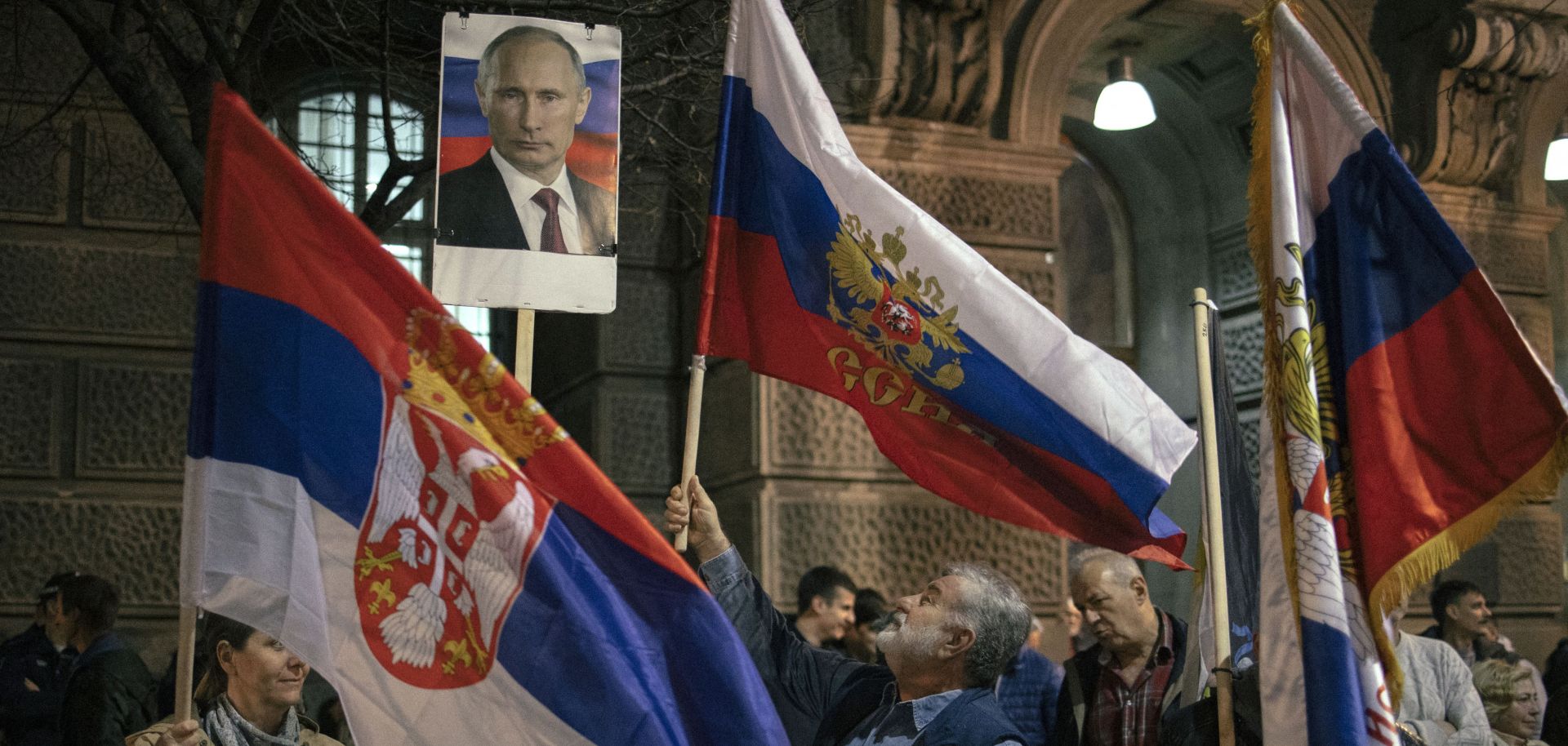
Demonstrators in Belgrade, Serbia, hold up a photo of Russian President Vladimir Putin and wave Serbian and Russian flags on March 24, 2022, during a rally in support of the Russian invasion of Ukraine.
Editor's Note: This column is the second of a two-part series that assesses the risk of another war breaking out in the Balkans amid renewed concerns over ethnic tensions, political unrest and competing external influence in the region. In the first part of this series , we examined the local drivers and constraints on the potential for renewed conflict in the Balkans. However, the actions of external actors — namely Russia and China — are also key to evaluating regional stability. Russia's Historical Influence Russia has historically seen the Balkans as falling within its sphere of influence. This has contributed to some of the corruption, political paralysis, increased militarization and other challenges that bedevil Balkan countries. Moscow's influence is most pronounced in Serbia, with which it shares a variety of practical and symbolic ties.
