
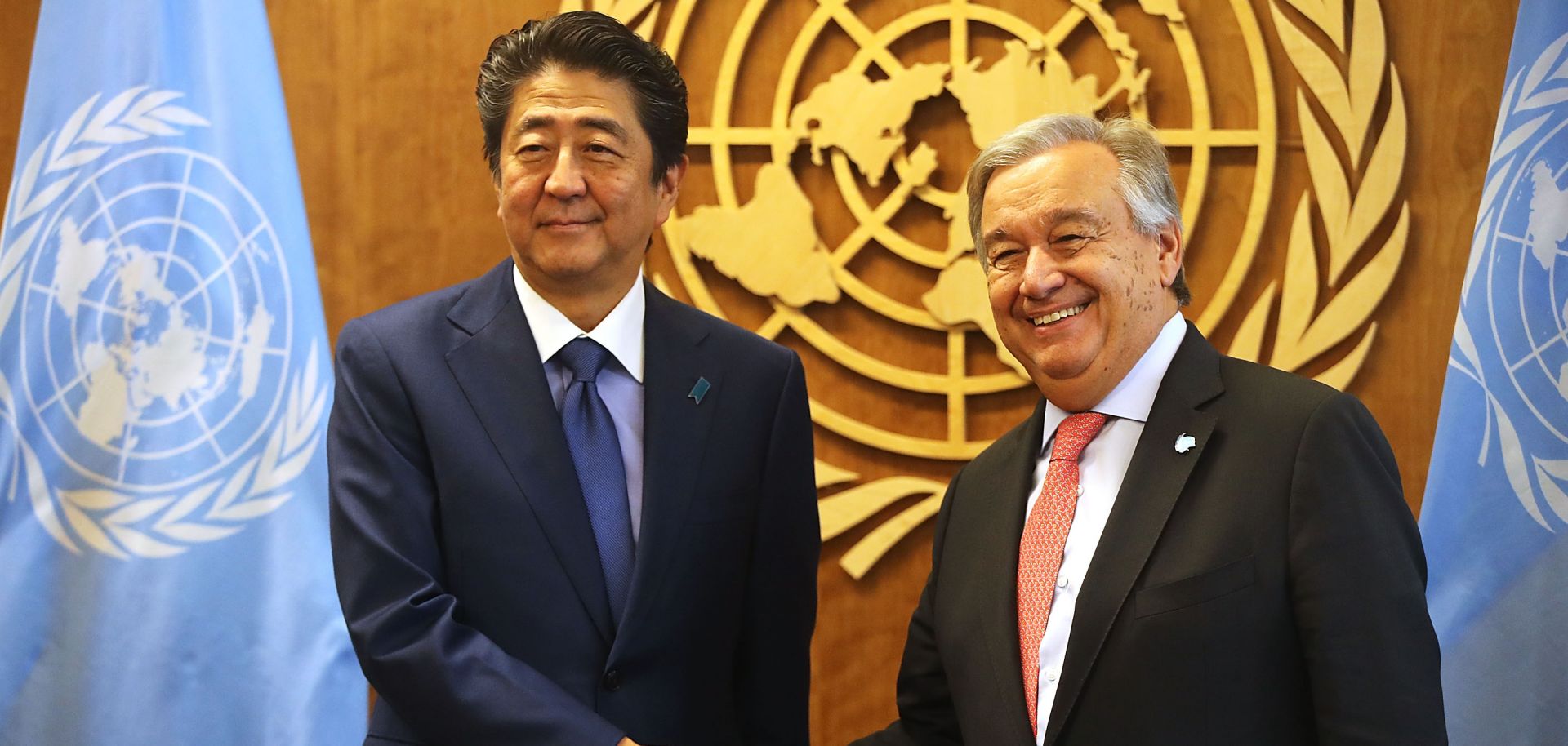
Then-Japanese Prime Minister Shinzo Abe shakes hands with the Secretary-General of the United Nations in New York City during the 73rd U.N. General Assembly on Sept. 25, 2018.
Editor’s Note: This assessment is the second of a two-part series on the life and legacy of former Japanese Prime Minister Shinzo Abe . The first part, which explores historical events and figures that shaped the late Japanese leader's ideologies, can be found here . A Brief But Impactful First Term When Abe first became prime minister in September 2006, he faced the immediate challenge of North Korea’s first nuclear test at a time when the United States appeared increasingly entangled in the Middle East and Central Asia. At home, Japanese GDP growth was slowing again after a brief uptick during his predecessor Junichiro Koizumi’s term, while Chinese GDP growth was skyrocketing. The United States, meanwhile, was fighting wars in both Iraq and Afghanistan, which Tokyo feared would limit Washington’s ability to ensure Japanese interests in the Asia-Pacific region.
