
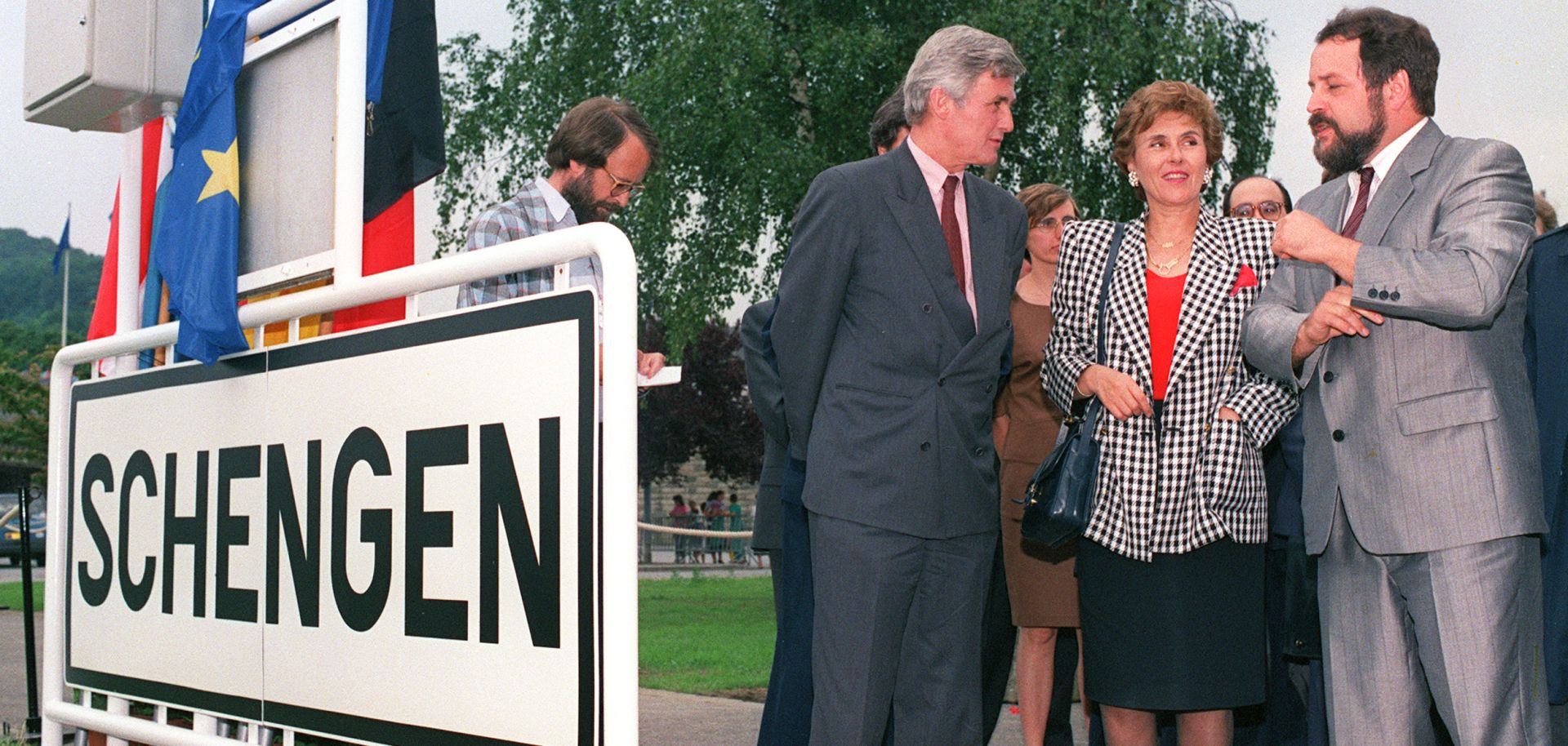
French minister for European affairs Edith Cresson (C) is flanked by Luxemburg's G. Wohlfahrt (D) and Belgium's Keersmaeker (L) in Schengen, 1990.
The principle of the free movement of persons, one of the pillars the European Union was built upon, is coming under threat. In the early 1980s, a group of countries signed the Schengen Treaty, under which internal border controls between signatory countries would be eliminated while the signatories' external borders would be reinforced. Over time, this treaty has become one of the most visible symbols of the union. For the first time, most of Western and Central Europe lacked internal border controls. Now, a German citizen traveling to France is more likely to realize that he has changed countries because the road signs are no longer in German, not because he had to stop at a checkpoint to show his passport. At present, 26 countries have signed the Schengen Treaty.
