
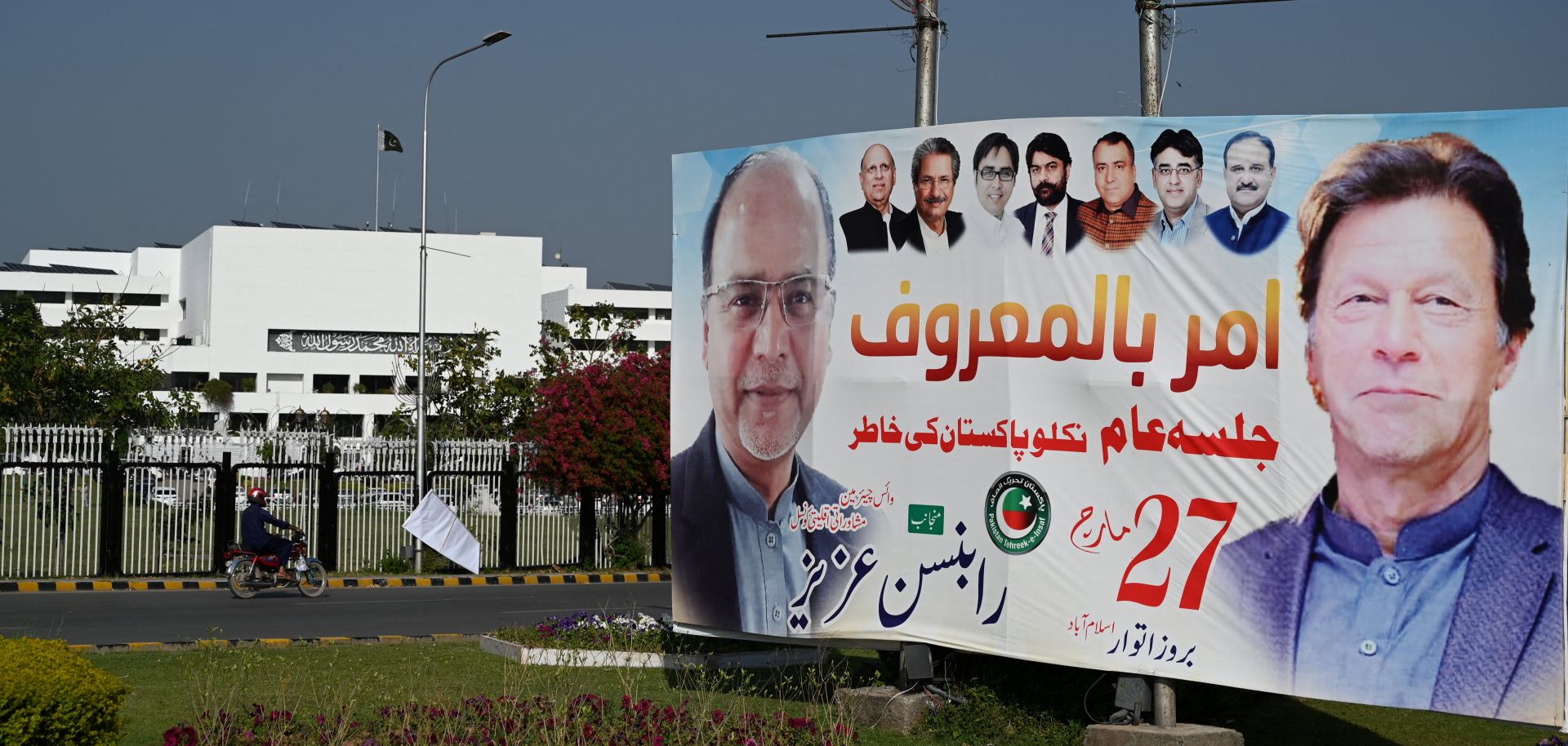
A banner featuring an image of Pakistani Prime Minister Imran Khan (right) is seen outside the parliament building in Islamabad on March 31, 2022.
Political instability in Pakistan will make it hard for the country to address its mounting economic challenges, opening the door to social unrest and threatening the continuity of the government's agreement with the International Monetary Fund. Pakistan's lower house of parliament, the National Assembly, will likely hold a vote of no confidence against Prime Minister Imran Khan in early April. On March 8, a coalition of opposition parties filed a no-confidence motion against the prime minister, accusing him of mismanaging the economy. On March 28, the deputy speaker of the National Assembly approved the motion, which has to be voted on by April 4. A no-confidence vote can be passed by a simple majority of 172 votes in the 342- member National Assembly. If Khan loses the vote, he will cease to be the prime minister and the National Assembly will have to appoint a successor.
