
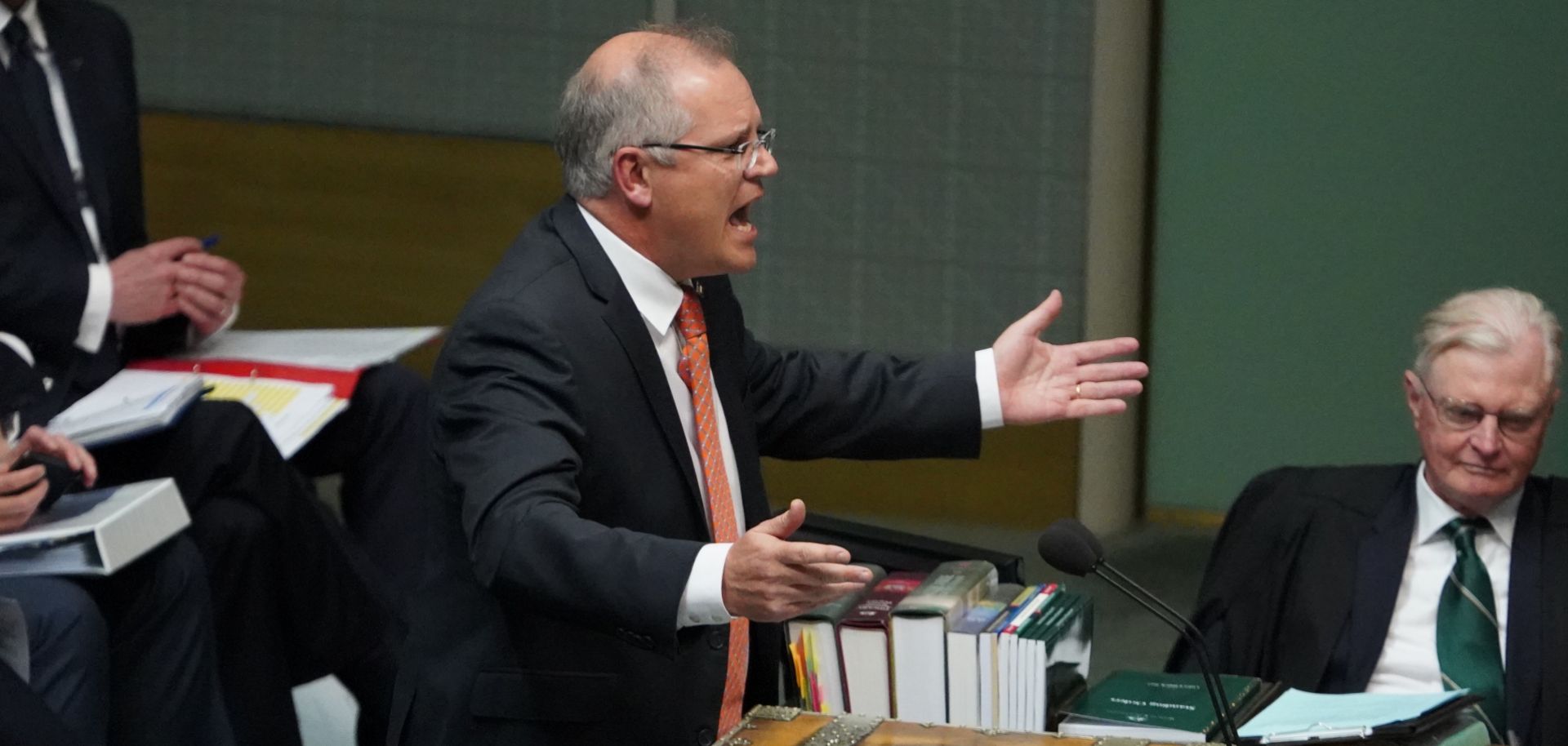
New Australian Prime Minister Scott Morrison speaks during question time in the House of Representatives in Canberra on Sept. 13. Australia's revolving door of prime ministers has produced turmoil that has hurt its relations with major powers in the Asia-Pacific region.
For the past decade, Australia has been politically adrift . Like some counterparts in the Western world, it has been experiencing a cycle of deep fragmentation, polarization and swings in the political balance that have put its governments off kilter. Prime Minister Malcolm Turnbull's downfall in late August ushered in the country's sixth prime minister in less than a decade — with that period nearly evenly split between the country's two political pillars: the Australian Labor Party and the Liberal-National coalition. Turnbull's removal comes as Australia is facing numerous foreign policy challenges. The country is attempting to balance both its deep strategic ties with the United States and its deep economic ties to China. The United States' protectionist push further complicated Australia's predicament , because its geographical isolation means it must depend on the free flow of goods and investment across the region.
