
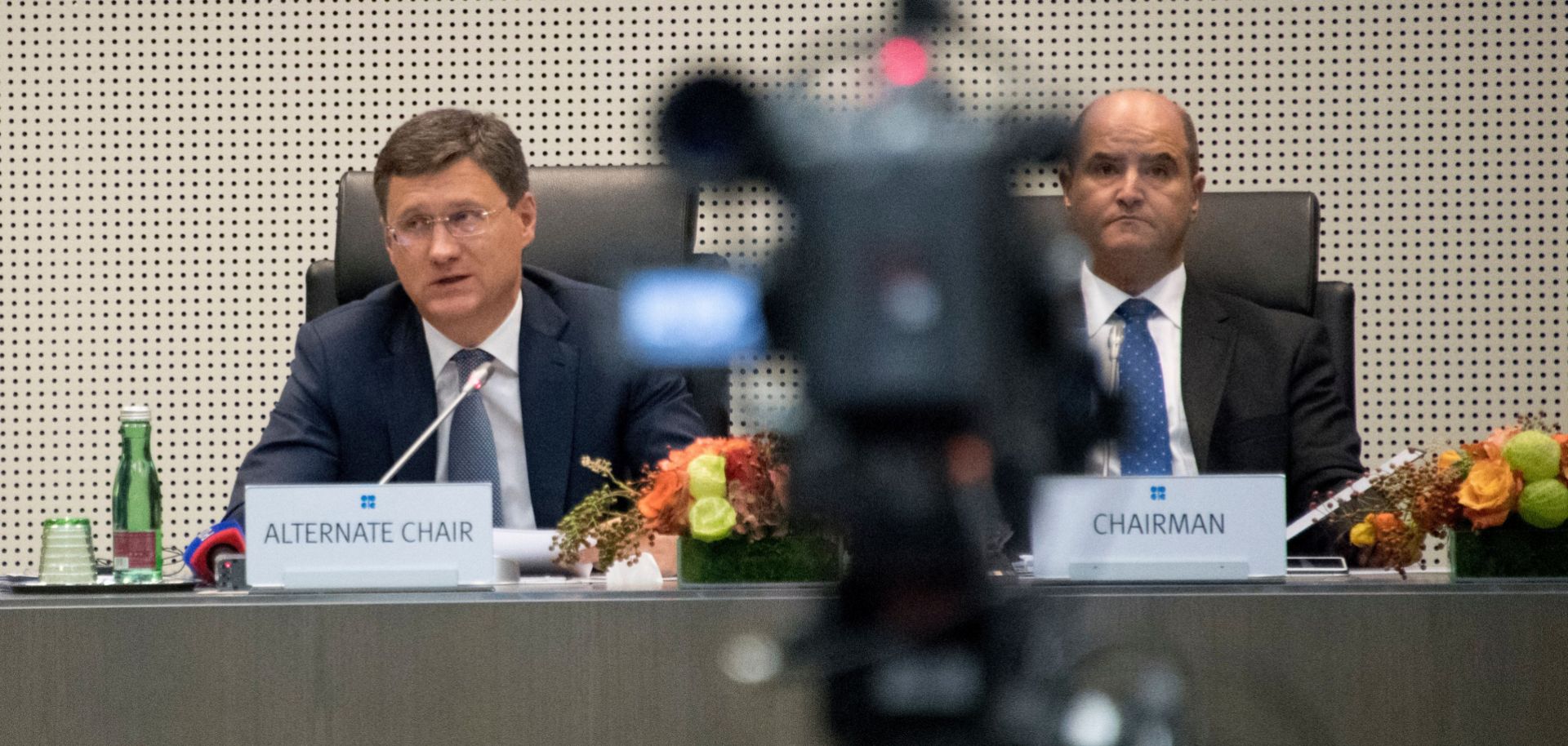
Russian Energy Minister Alexander Novak (left) and Kuwaiti Oil Minister Essam al-Marzouq oversee the OPEC meeting in Vienna on Sept, 22, 2017. Members of the organization and its allies reviewed progress on their 2016 agreement to curb oil output.
OPEC's work to cut oil production may be finally starting to pay off. The oil-exporting organization and its allies have slashed output by about 1.6 million barrels per day (bpd) since the beginning of the year, helping to lift oil prices. And key producers, such as Saudi Arabia and Russia, have already indicated that they may push to extend the production-cut deal beyond its expiration date in March 2018. But the organization's Joint Ministerial Monitoring Committee (JMMC), meeting in Vienna, declined to make a recommendation on the cuts. Kuwaiti Oil Minister Essam al-Marzouq said that there was no need to decide now that the market was "well on its way toward rebalancing." Predictions Not Panning Out Although oil prices were pushed down earlier this year as Libyan, Nigerian, Brazilian, U.S. and other producers saw their oil production rise, those drops may be nearing an end.
