
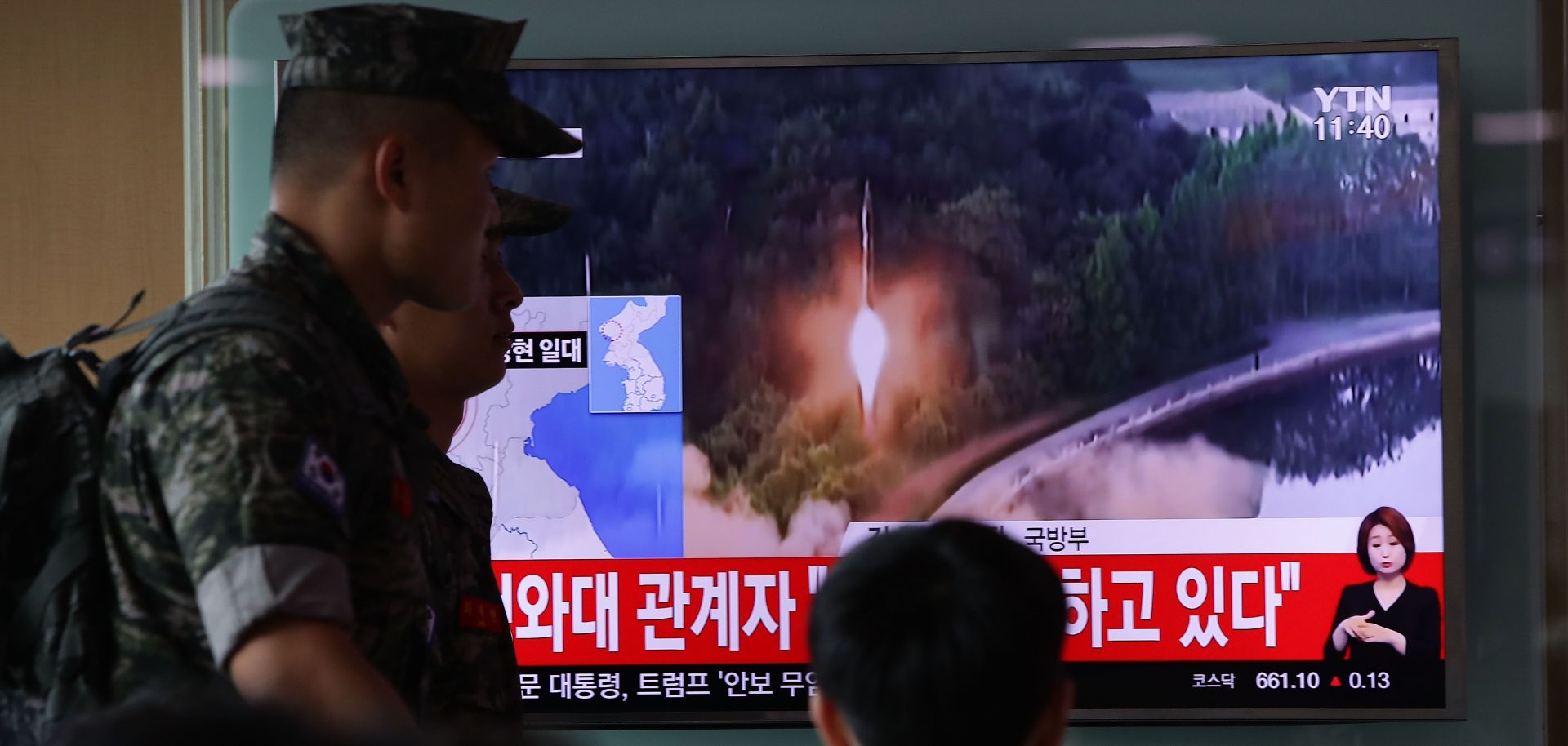
People watch a television broadcast reporting the North Korean missile launch from the Seoul Railway Station in South Korea, on July 4. The latest launch drew strong criticism from the U.S. and came ahead of a summit of leaders from the G20 countries in Germany later this week.
At 9:10 a.m. local time on July 4, North Korea launched a new ballistic missile, the Hwasong-14, from the Panghyon Airport in North Pyongan Province. The Hwasong-14 was tested at a lofted, or steep, trajectory. This flight path maximizes the altitude of the missile and reduces its distance traveled in order to avoid overflying neighboring regions and countries such as Japan. Pyongyang further claimed that the Hwasong-14 missile was an Intercontinental Ballistic Missile — a statement that is thus far backed up by the available flight data. The Hwasong-14 achieved the farthest distance traveled by a North Korean missile in tests so far. The previous longest shot occurred on May 14 with a test of the Hwasong-12. That missile reached an apogee of 2,111.5 kilometers (1312 miles) and a range of around 700 kilometers (435 miles) with a flight time of 30 minutes.
