
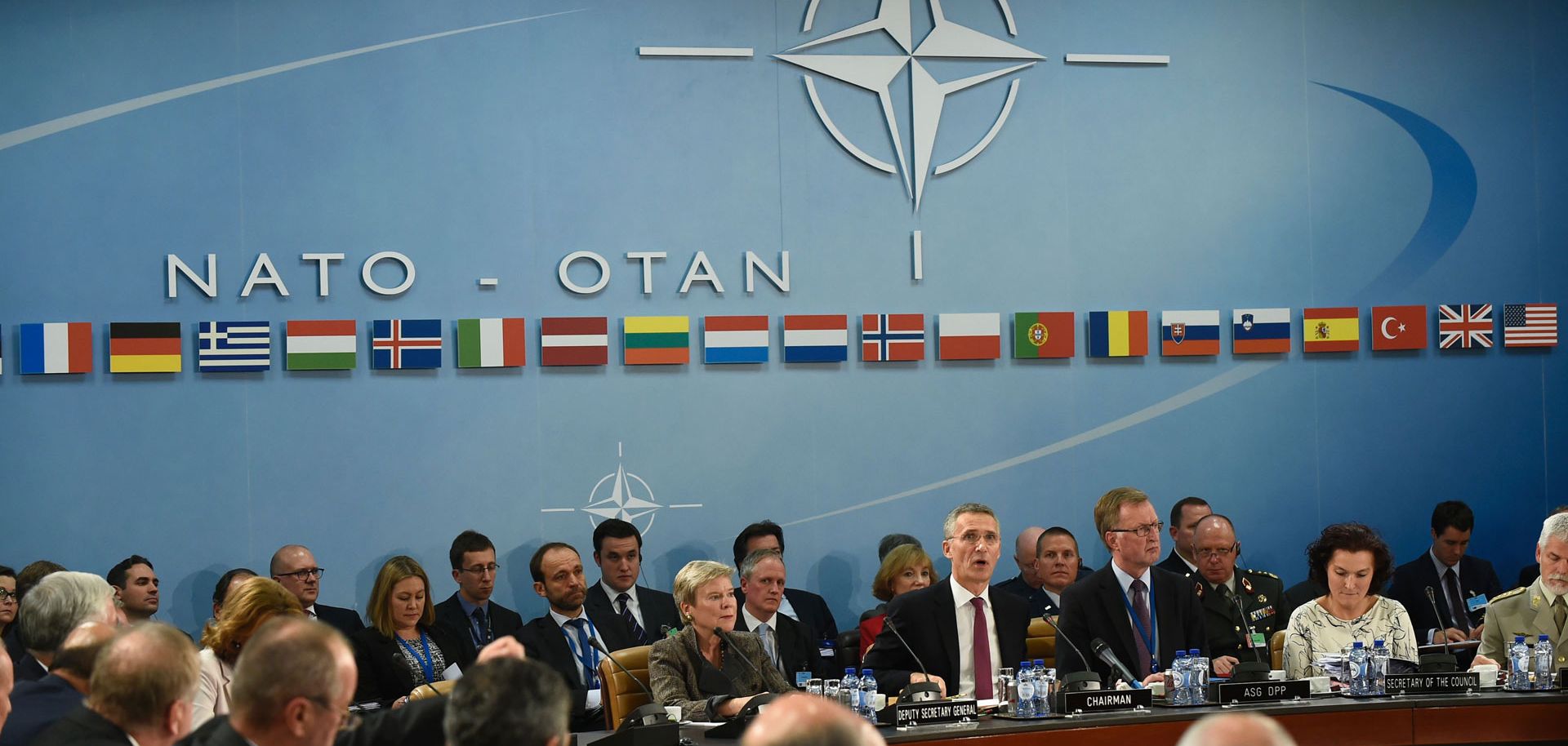
NATO Secretary-General Jens Stoltenberg speaks at a NATO Defense ministers' meeting at the NATO headquarters in Brussels on October 26, 2016.
The escalating crisis in Ukraine serves as an illuminating case study of a measured response by NATO. Barring an extreme flashpoint, the crisis will de-escalate in time, perhaps leaving more questions than answers for NATO's leadership, which will be forced once again to consider the alliance's position in an ever changing global security environment. A conventional Russian attack against an alliance member beyond Ukraine, although extreme, would be a relatively straightforward proposition for even a depleted NATO, which was originally built for such an eventuality. However, the absence of a major adversary remains a quandary, fueling the uncertainty that plagues any organization lacking a defining purpose or prominent challenger. NATO's struggle to redefine itself in the 1990s created a sprawling and indecisive organizational structure. New members brought large swathes of Europe , previously inaccessible under Soviet rule, into the alliance.
