
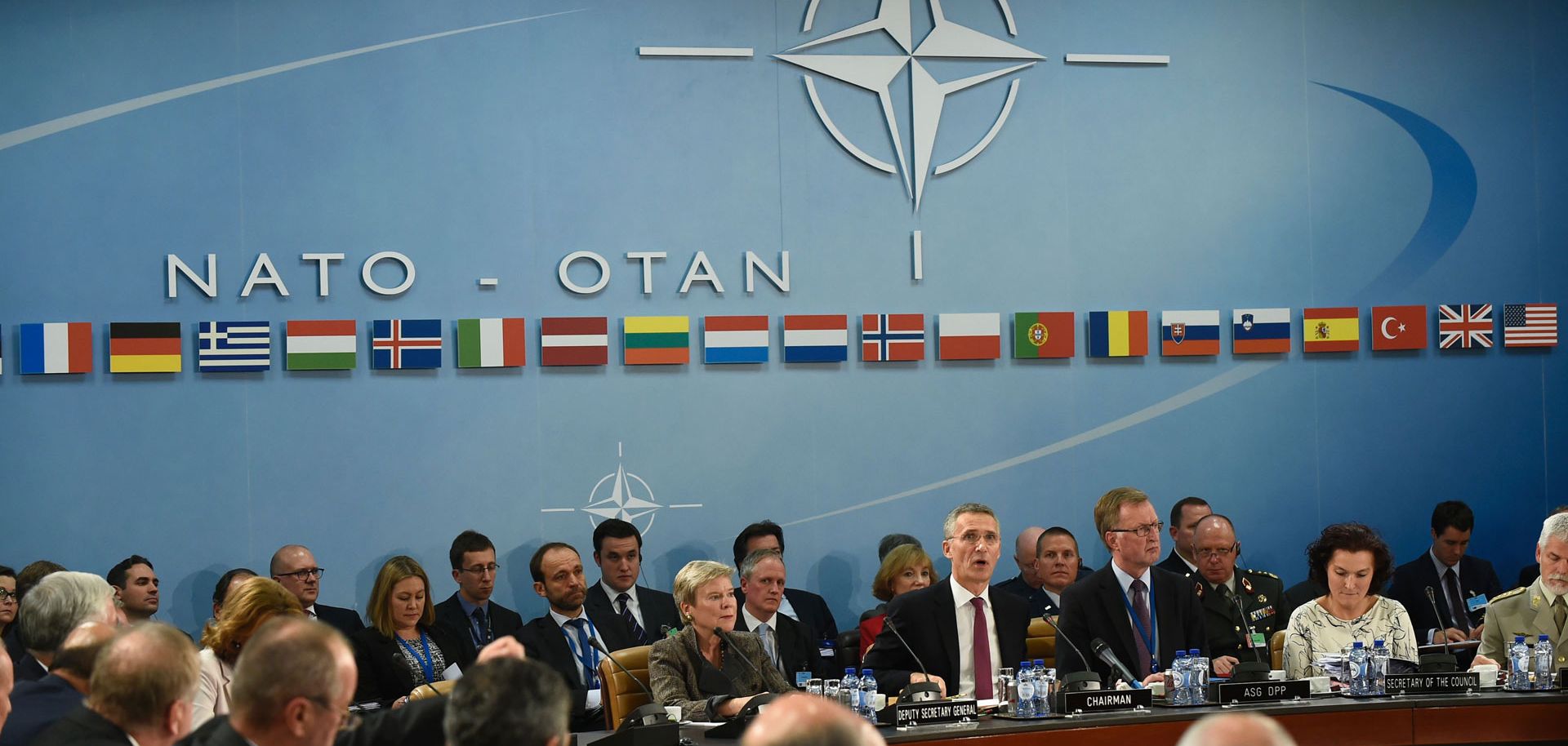
NATO Secretary-General Jens Stoltenberg (4th R) speaks at the start of a NATO Defense ministers' meeting at the NATO headquarters in Brussels on October 26, 2016.
NATO was originally created as a counterweight to the might of the Soviet Union after World War II. The deep yet fractious roots that enabled the alliance to prosper have also presented challenges to its leadership and management. More than an organization, NATO is best envisioned as an overarching structure made up of individual, autonomous parts, each with different thought processes, competencies and imperatives. NATO adapted to survive beyond the Cold War but its continued existence remains under threat. The North Atlantic Treaty Organization was conceived and designed as an intergovernmental military alliance, based on the principle of collective defense. At its inception four years after the end of World War II, NATO was primarily seen as a deterrent against Soviet aggression in Western Europe, keeping vulnerable states in a Western orbit and checking the rise of Eurasian power.
