
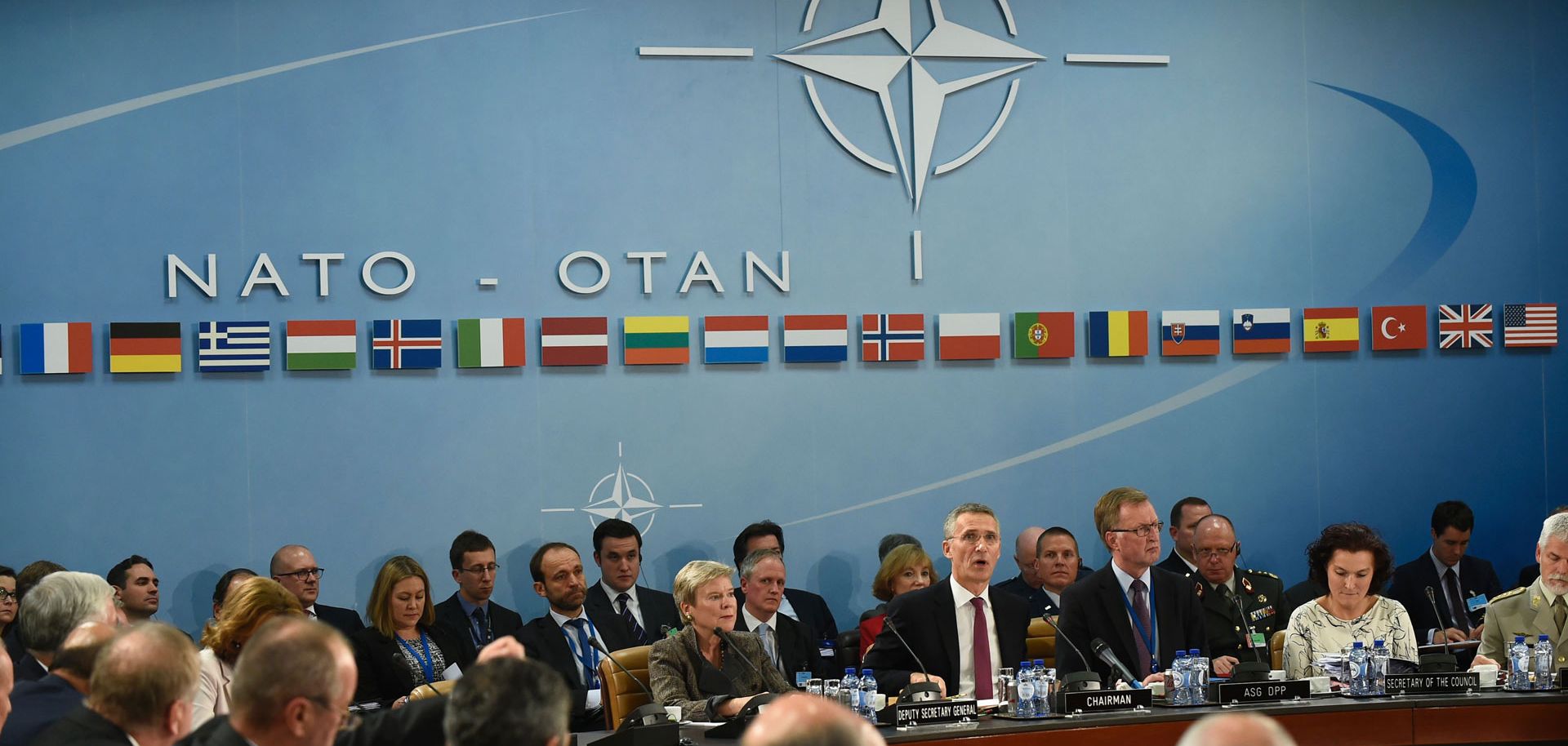
NATO Secretary-General Jens Stoltenberg speaks at a NATO Defense ministers' meeting at the NATO headquarters in Brussels on October 26, 2016.
NATO weathered the Cold War significantly better than its Warsaw Pact rivals, but it did not escape unscathed. Without the anchor of the Soviet bloc, NATO was cut adrift from its strategic imperative , suffering diminished budgets and dwindling force levels. Despite this, NATO has conducted more operations since the fall of the Soviet Union than it did during the previous four decades of carefully orchestrated stalemate. A modern NATO has been forced to learn new lessons, forged in the crucible of intervention, global terrorism and numerous Balkan winters. The new, adaptive framework of NATO has enabled members to conserve resources and avoid the associated costs of large standing forces. However, without these large armies the alliance has lost some of its deterrence capability, forcing it to be a relatively slow reactor to world events.
