
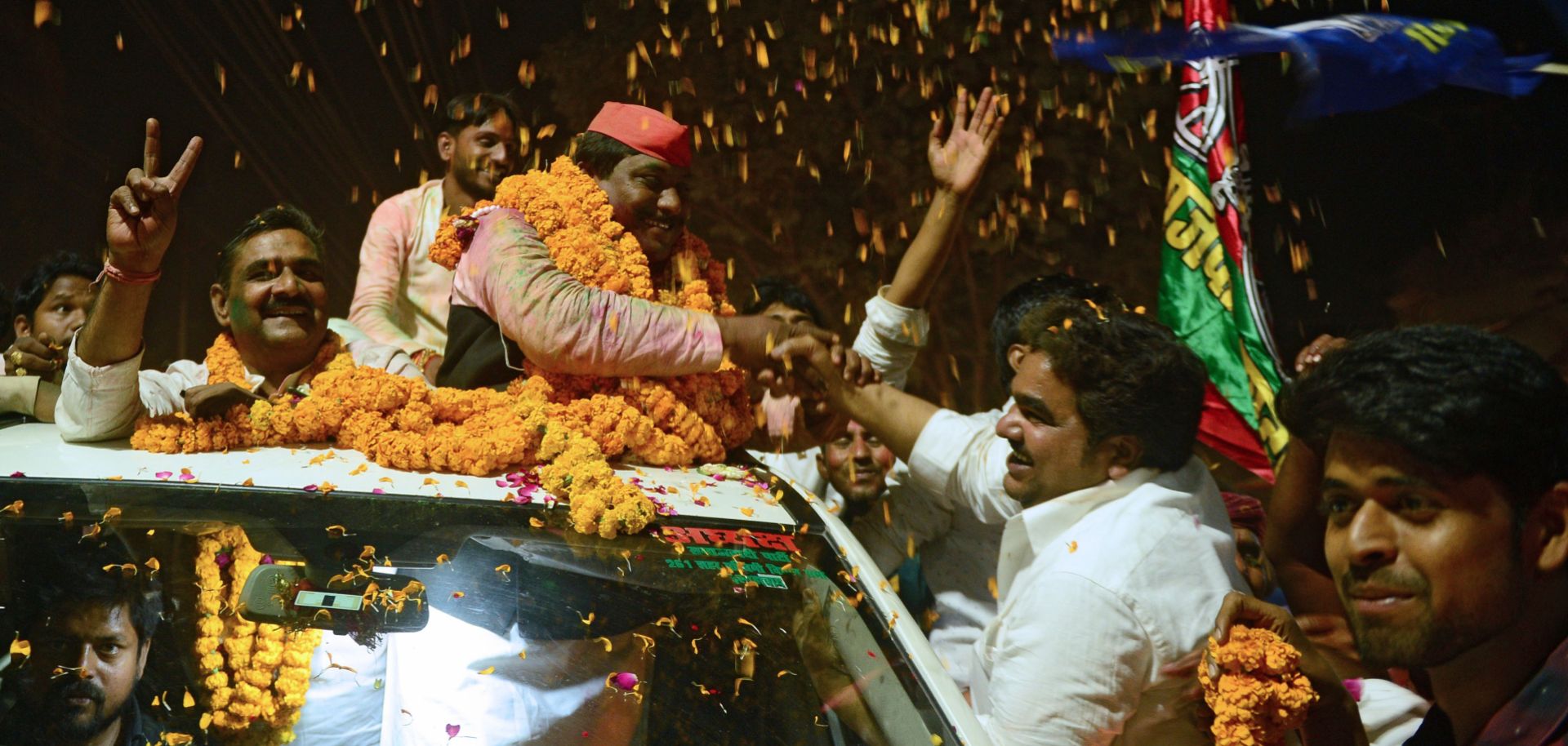
Samajwadi Party candidate Nagendra Pratap Singh Patel, center, celebrates after winning election to India's lower house of Parliament on March 14. In elections next year, Indian Prime Minister Narendra Modi's ruling Bharatiya Janata Party will face an emboldened opposition determined to deny Modi a repeat of his landslide victory in 2014.
Editor's Note : This assessment is part of a series of analyses supporting Stratfor's upcoming 2019 Annual Forecast. These assessments are designed to provide more context and in-depth analysis on key developments in the coming year . The world's largest election is fast approaching. Starting in April 2019, hundreds of millions of Indians will head to the polls to choose 543 representatives to serve in the Lok Sabha, the country's lower house of Parliament. For Prime Minister Narendra Modi , leader of the ruling Bharatiya Janata Party (BJP), the elections will serve as a referendum on his five years in office. The BJP surged to victory in 2014 by winning 282 seats, dealing a humiliating loss to the incumbent Indian National Congress (INC), which picked up a paltry 44 seats — its worst-ever performance.
