
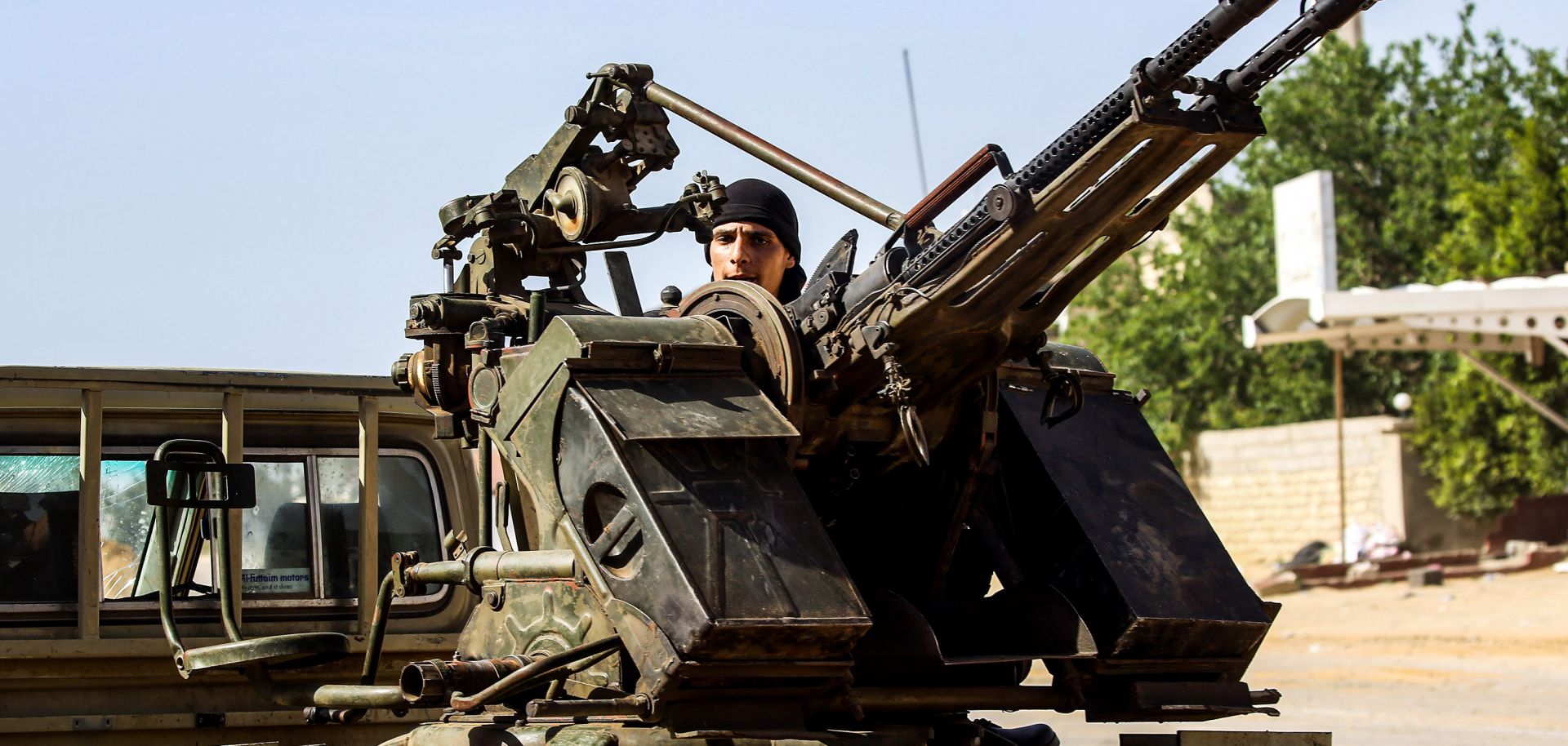
A Libyan fighter loyal to the Government of National Accord mans a heavy weapon mounted on a pickup truck during clashes with Libyan National Army (LNA) forces south of Tripoli's suburb of Ain Zara on April 10. After a two-year cease-fire in Libya, LNA Field Marshal Khalifa Hifter launched an offensive on Tripoli on April 4.
The decision by Libyan National Army (LNA) Field Marshal Khalifa Hifter to launch an offensive on Tripoli has sent shockwaves through the Libyan political system. The operation started just a week before a scheduled UN-backed National Conference that aimed to facilitate national elections in the divided country, which had previously been under a nearly two-year cease-fire. Already, militias supporting the Tripoli-based Government of National Accord (GNA) have stopped Hifter's offensive. But the LNA's continued efforts may evolve into a prolonged conflict and a renewed civil war. For now, the latest fighting has not resulted in any parties preventing oil production or exports in Libya, and that may remain the case if the situation quickly ends in a new cease-fire. But the longer fighting goes on, the more likely it is that the Libyan oil industry will be used as leverage in some way.
