
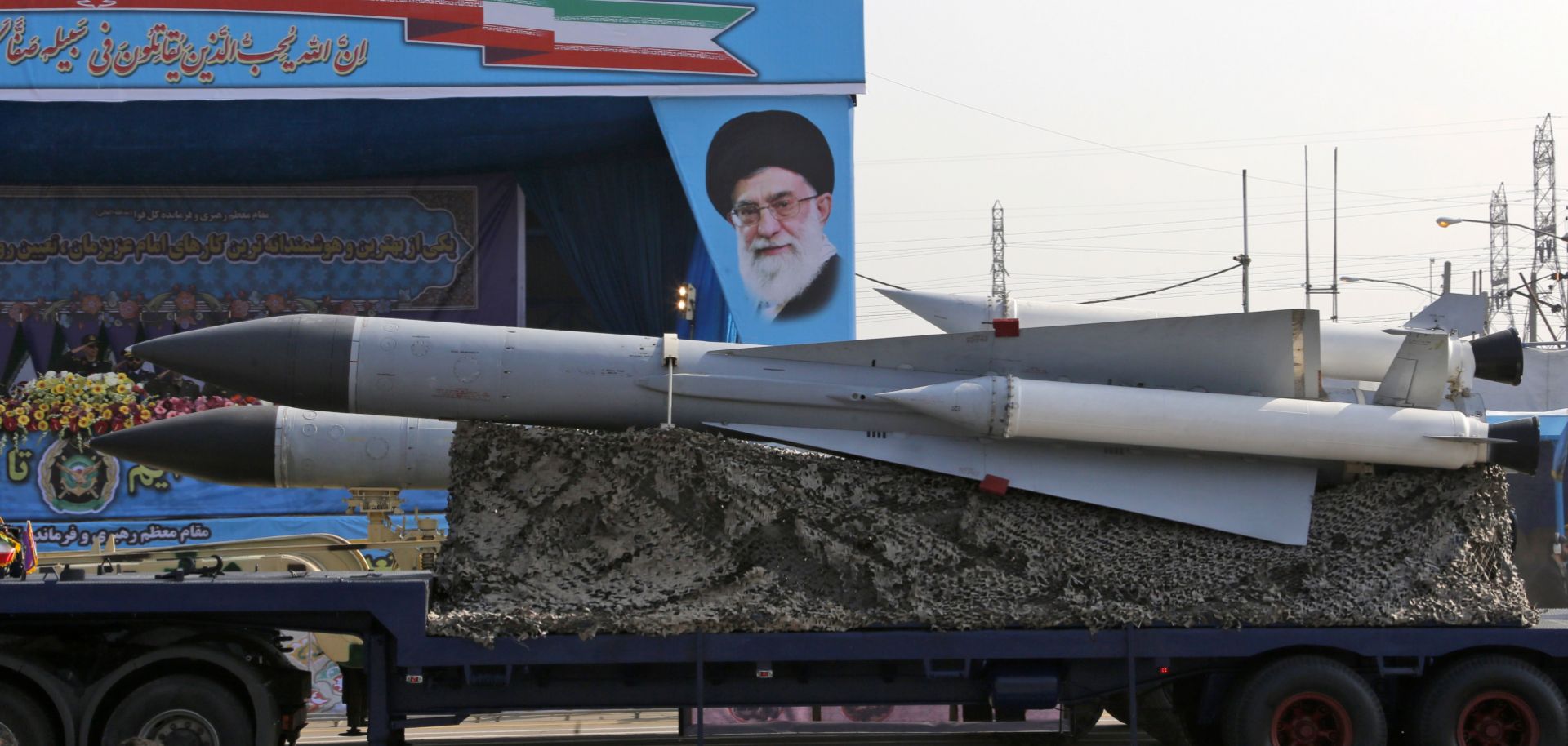
An Iranian military truck carries surface-to-air missiles past a portrait of Iran's Supreme Leader Ayatollah Ali Khamenei during a parade April 18, 2018, in Tehran. For now, Iran will shy away from a conventional response to U.S. and Israeli pressure, as it hopes to maintain European support for the nuclear deal.
Iran of late has been beset with a growing list of challenges: the withdrawal of the United States from the nuclear deal, the looming imposition of more U.S. sanctions and Israel's determination to attack it inside Syria to prevent its entrenchment there. Like any country intent on defending itself, Iran is compelled to retaliate against these two stronger military powers. And Iran has a baseline defensive posture from which it will not retreat, all the more as it is facing such intense pressure to change. But because Iran is intent on retaining as many of the economic benefits as it can from the existing framework of the Joint Comprehensive Plan of Action (JCPOA), as the nuclear deal is formally known, it is also reticent to rapidly escalate some of its retaliatory moves for fear of alienating the European Union, which remains in the deal.
