
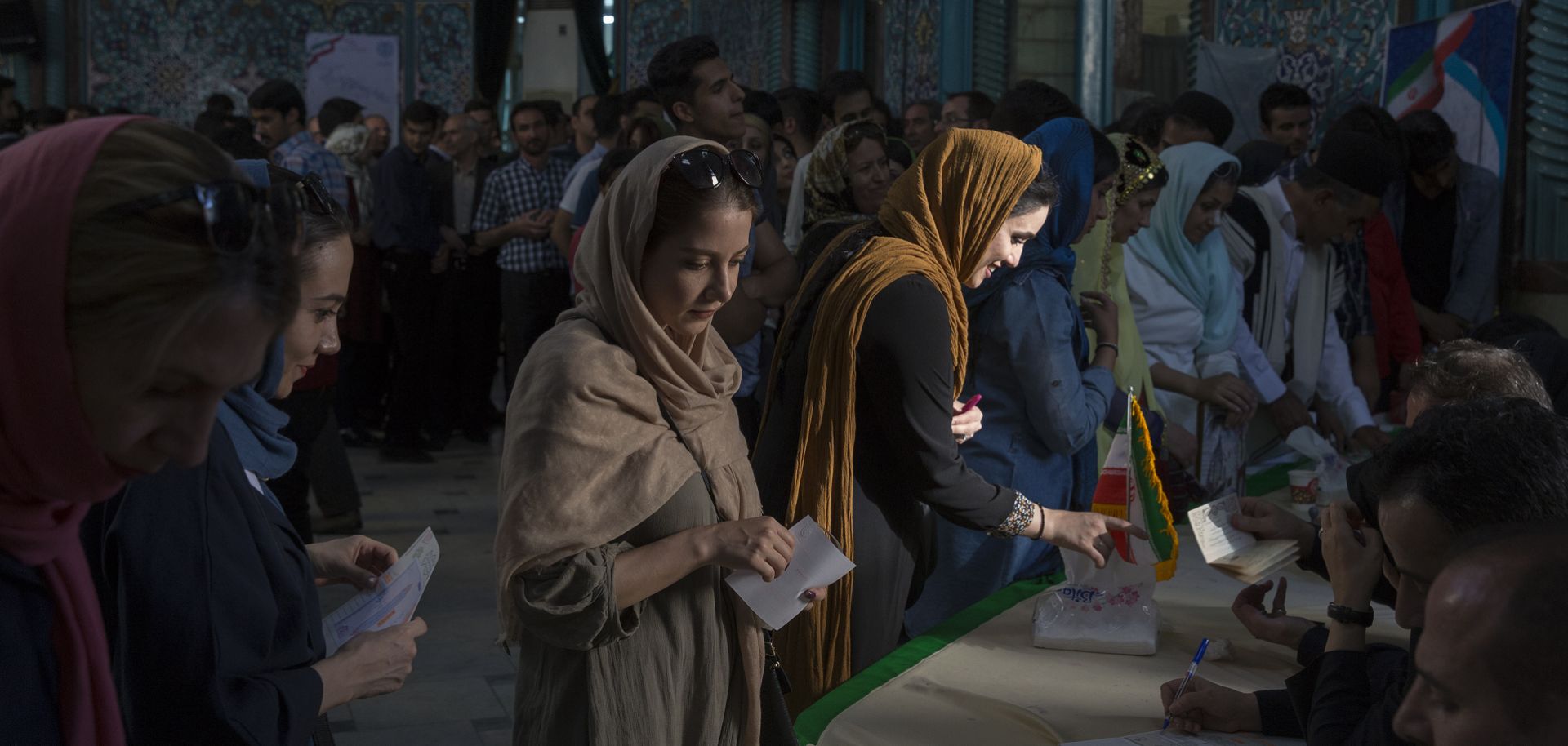
Voting goes late into the night in May in Tehran. Millions cast ballots to decide whether President Hassan Rouhani would receive another four years in office after the landmark nuclear deal or whether the sluggish economy needed a new hard-line leader. Rouhani won.
(Keystone/Getty Images) In 1979, demonstrators in Teheran called for the replacement of the Shah of Iran during the Islamic Revolution. The placards depict Ayatollah Mahmoud Taleghani, one of Iran's most militant religious leaders. The revolution overthrew the Pahlavi dynasty under Shah Mohammad Reza Pahlavi, who was supported by the United States. He was replaced by the Grand Ayatollah Ruhollah Khomeini, the leader of the revolution. (STRINGER/AFP/Getty Images) Zolfaghar short-range ballistic missiles are displayed during a rally on al-Quds Day in Tehran during June. Though Iran's rhetoric has traditionally targeted the United States, it is Turkey and Russia that may be more likely to threaten Tehran's security interests, especially as Washington withdraws from the region. Iran is deeply concerned about Turkey's resurgence in the lands it controlled during the Ottoman Empire, including Iraq and the Levant.
