
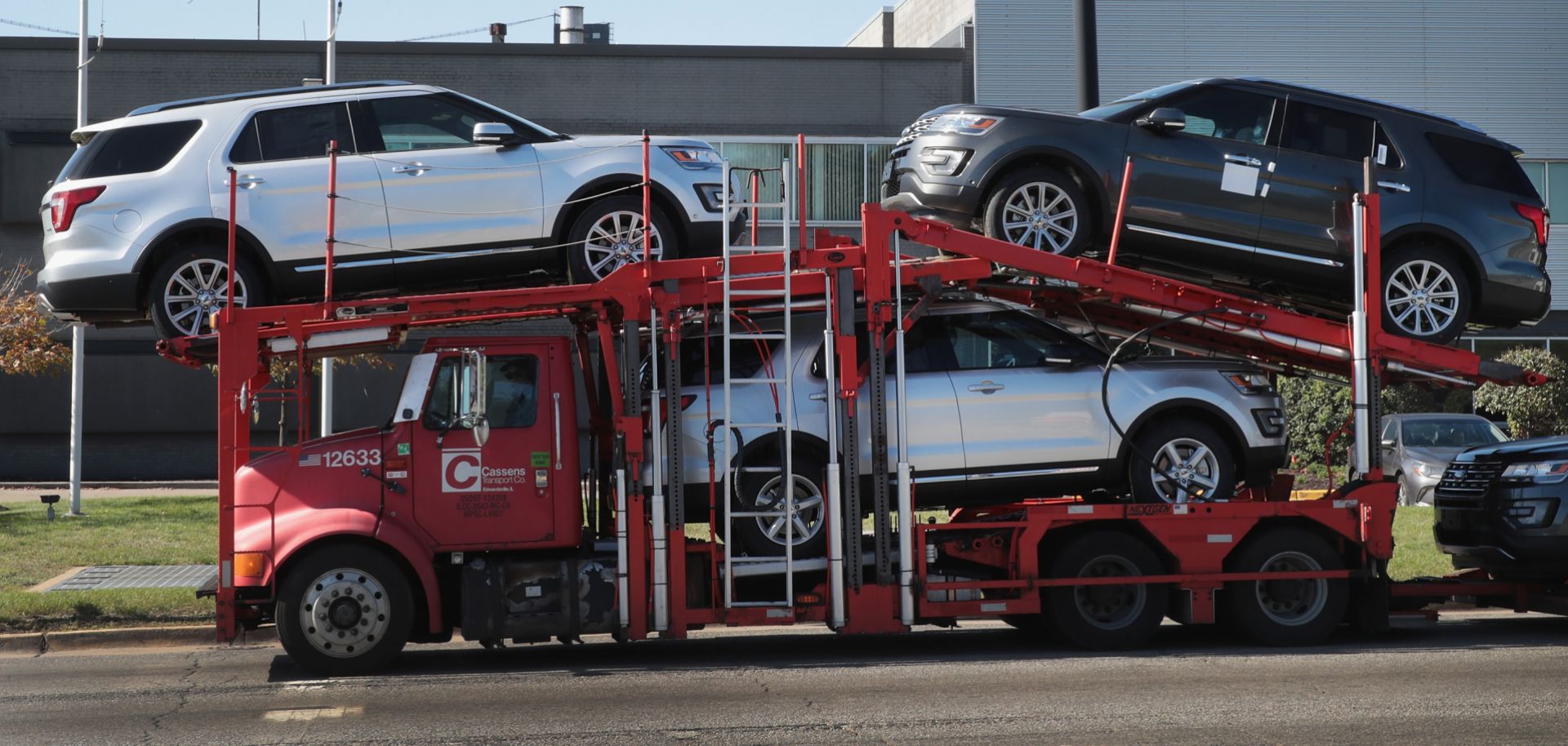
Ford Explorers leave Ford's Chicago Assembly Plant on Oct. 18, 2017, in Chicago, Illinois. The United States could announce tariffs or quotas on imports of finished vehicles and auto parts in the next six months, which could very well raise the price of vehicles in the United States.
By using tariffs as a weapon in NAFTA negotiations, U.S. President Donald Trump could end up harming automotive networks that have taken decades to build. As home to one of the largest car-importing nations in the world, North America has attracted numerous companies supplying the U.S. market with Canadian and Mexican finished vehicles and parts. The size and complexity of the U.S. market has led to the sprouting of a network of supply chains across the continent — first to capitalize on Canadian manufacturing capacity and later to take advantage of far cheaper Mexican labor. Now the Trump administration is weighing tariffs or quotas under Section 232 of the Trade Expansion Act of 1962 to curb the import of automobiles and auto parts as a way to reduce the overall U.S. trade deficit and to protect the jobs of U.S. workers.
