
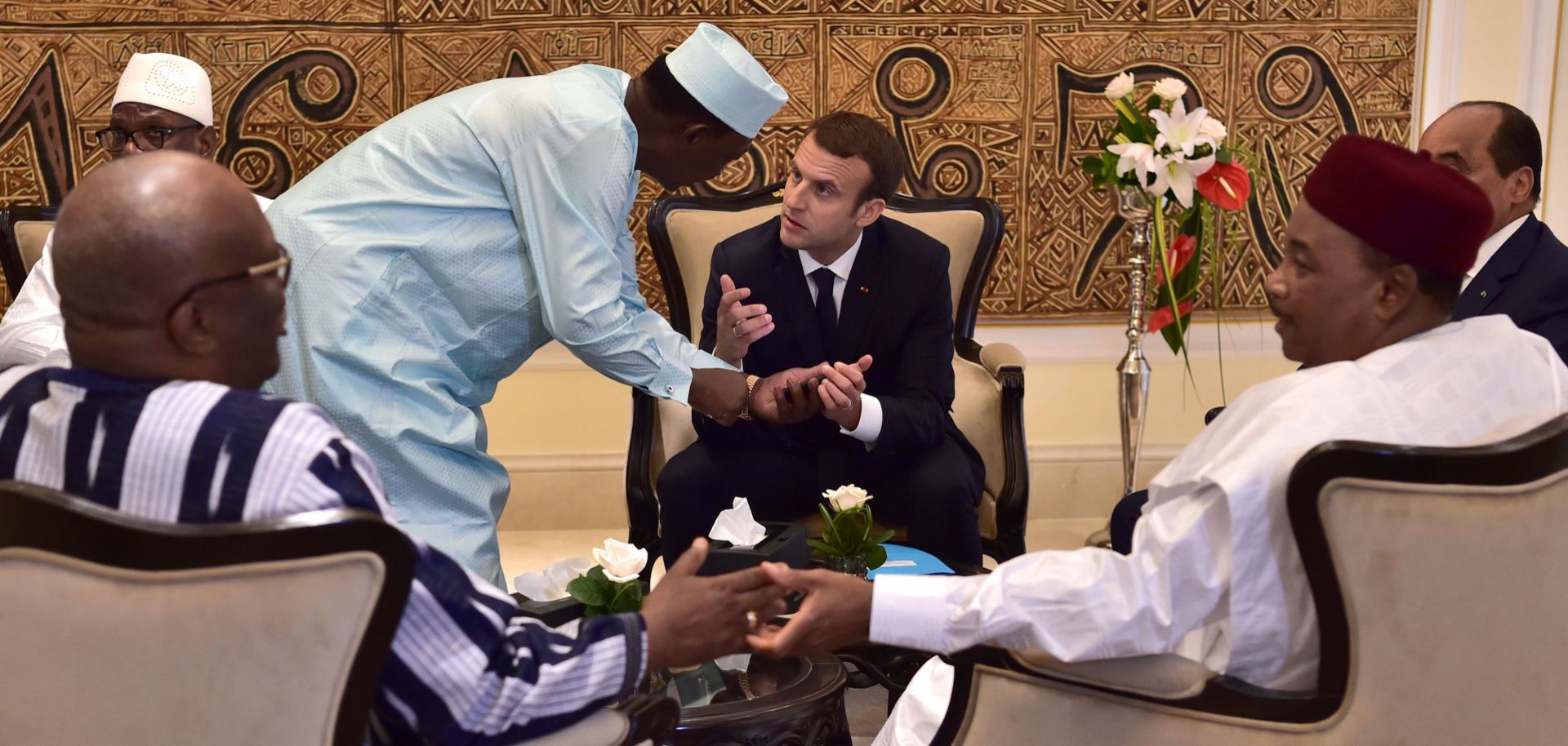
Chad's president Idriss Deby Itno (2nd L) speaks with French President Emmanuel Macron (C) as they gather with President of Burkina Faso Roch Marc Christian Kabore (front L), Mali's President Ibrahim Boubacar Keita (rear L), Niger's President Mahamadou Issoufou (front R) and Mauritanian President Mohamed Ould Abdel Aziz (rear R) for a meeting during the G5 Sahel summit in Bamako, July 2. French President Emmanuel Macron threw his weight behind a planned Sahel force to fight jihadists but told countries their efforts had to bear fruit. The so-called 'G5 Sahel' countries -- Burkina Faso, Chad, Mali, Mauritania and Niger -- have pledged to set up a joint force to combat the wave of Islamist bombings, shootings and kidnappings south of the Sahara.
The days of the French colonial empire may be long gone, but Paris' involvement in the unstable region of the Sahel is not. French forces have been offering support for countries in the region — notably Group of 5 (G5) members Burkina Faso, Mali, Chad, Niger and Mauritania — for years. But as French concerns about the overmilitarization of the Sahel have grown, Paris seeks to find another solution in the form of the G5 Sahel Force. Made up of African troops from the G5 states, this counterterrorism and counter-trafficking entity may eventually play a critical role in stabilizing the Sahel region. As recently as Aug. 2, French Minister of the Armed Forces Florence Parly visited the Sahel states of Chad, Niger and Mali to engage with soldiers and speak with leaders. The subtext for Parly's trip was a desire to reaffirm French support for the Sahel Force.
