
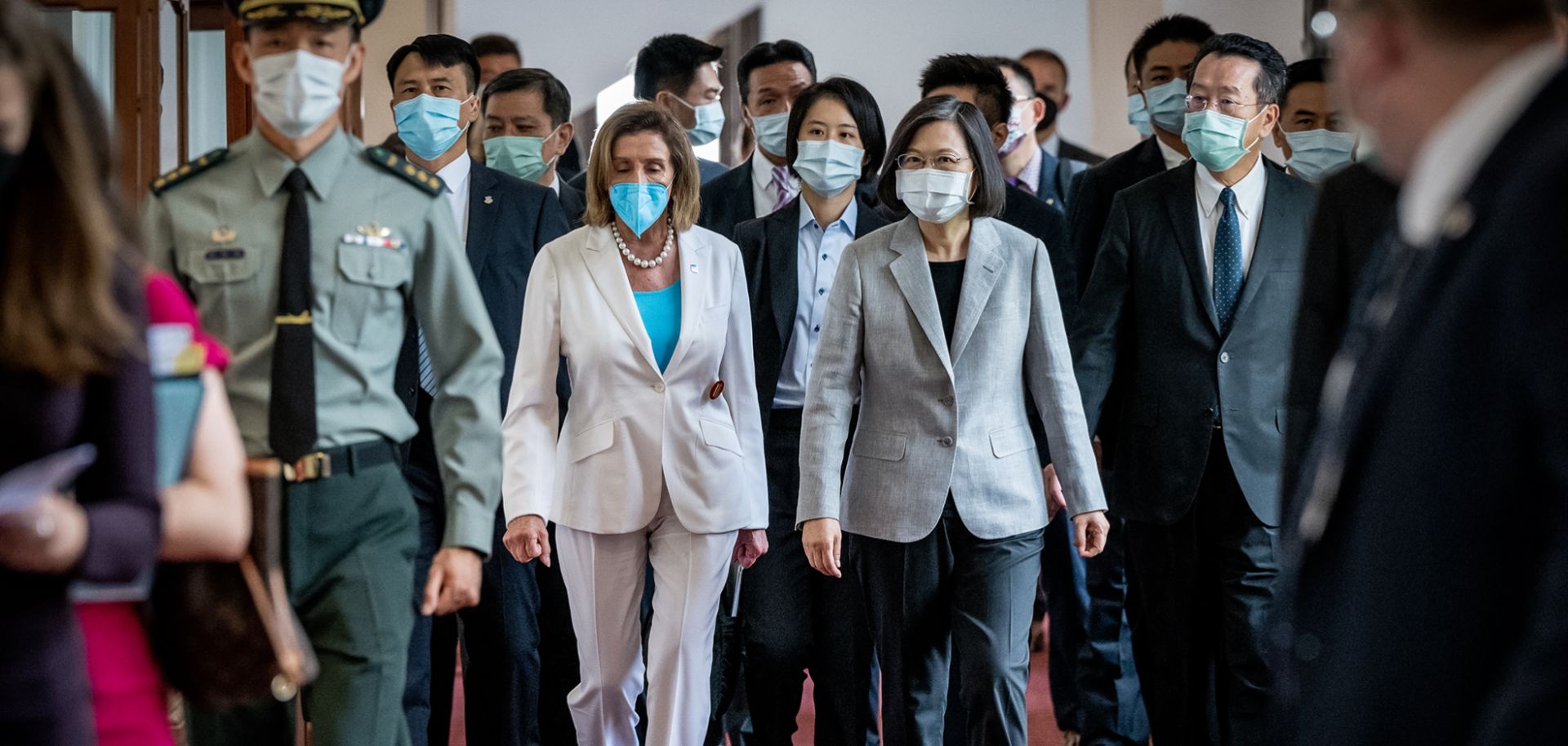
Then-U.S. House Speaker Nancy Pelosi (center left) walks alongside Taiwanese President Tsai Ing-wen after arriving at the president's office in Taipei on Aug. 3, 2022.
Editor's Note: This assessment is the fourth and final part in a series exploring China-Taiwan relations through the lens of economics , politics , military affairs and diplomatic relations. Taiwan's shifting diplomatic ties hold great potential to accelerate China's military and economic coercive efforts and catalyze the decoupling of global supply chains, though they're unlikely to spur a Chinese invasion any time soon . Over the past five decades, most countries have switched diplomatic recognition from Taiwan to China, partly in order to gain access to the Chinese market (which Beijing still predicates on diplomatic non-recognition of Taipei). Now, only 13 small nations in the Pacific Islands, the Caribbean and Latin America formally recognize Taiwan, and even these relations are under threat. Taiwan has also been excluded from participation in most international institutions, including the World Health Assembly (WHA).
