
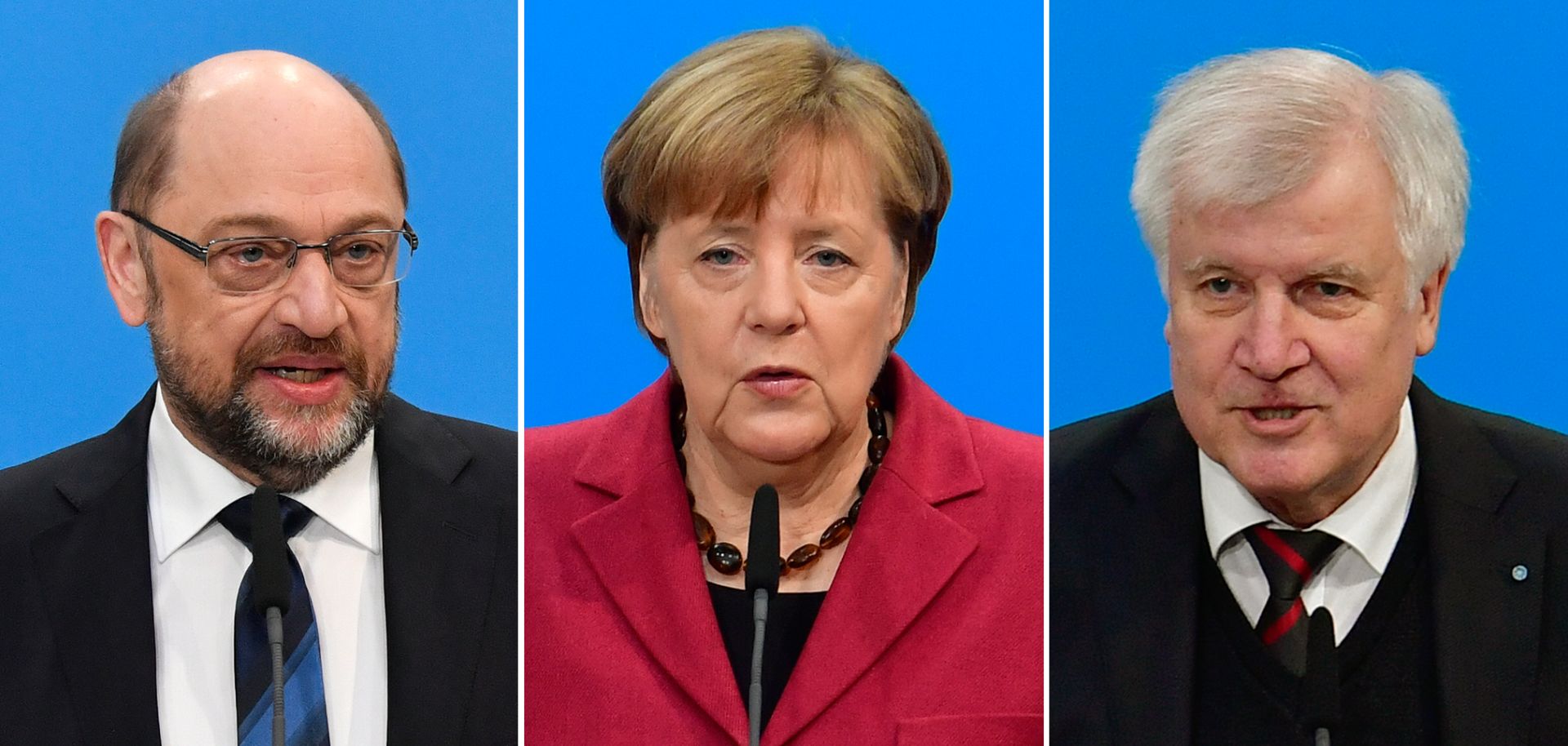
Germany's Social Democratic Party leader Martin Schulz, left; Chancellor Angela Merkel, who leads the Christian Democratic Union; and Horst Seehofer, leader of the CDU's sister party, the Christian Social Union. France's drive to reform the eurozone could lose momentum if EU negotiations are repeatedly postponed by Germany's attempt to forge a coalition government.
Europe's largest economy went to the polls months ago, but only now does Germany appear to be ready to sail forward. Chancellor Angela Merkel's Christian Democratic Union (CDU) and its Bavarian sister party, the Christian Social Union (CSU), have sat down with the center-left Social Democratic Party (SPD) to produce a "grand coalition" by March. While the negotiations will mostly focus on domestic issues such as taxes, welfare spending and asylum policies, a host of critical issues related to the European Union is already piling up in Merkel's inbox . Berlin's northern and southern partners — particularly France — are pushing and pulling the Continent's preeminent economy over issues such as eurozone reform and the next multiyear budget for the European Union, and the pressure is only likely to increase after the new government officially takes office.
