
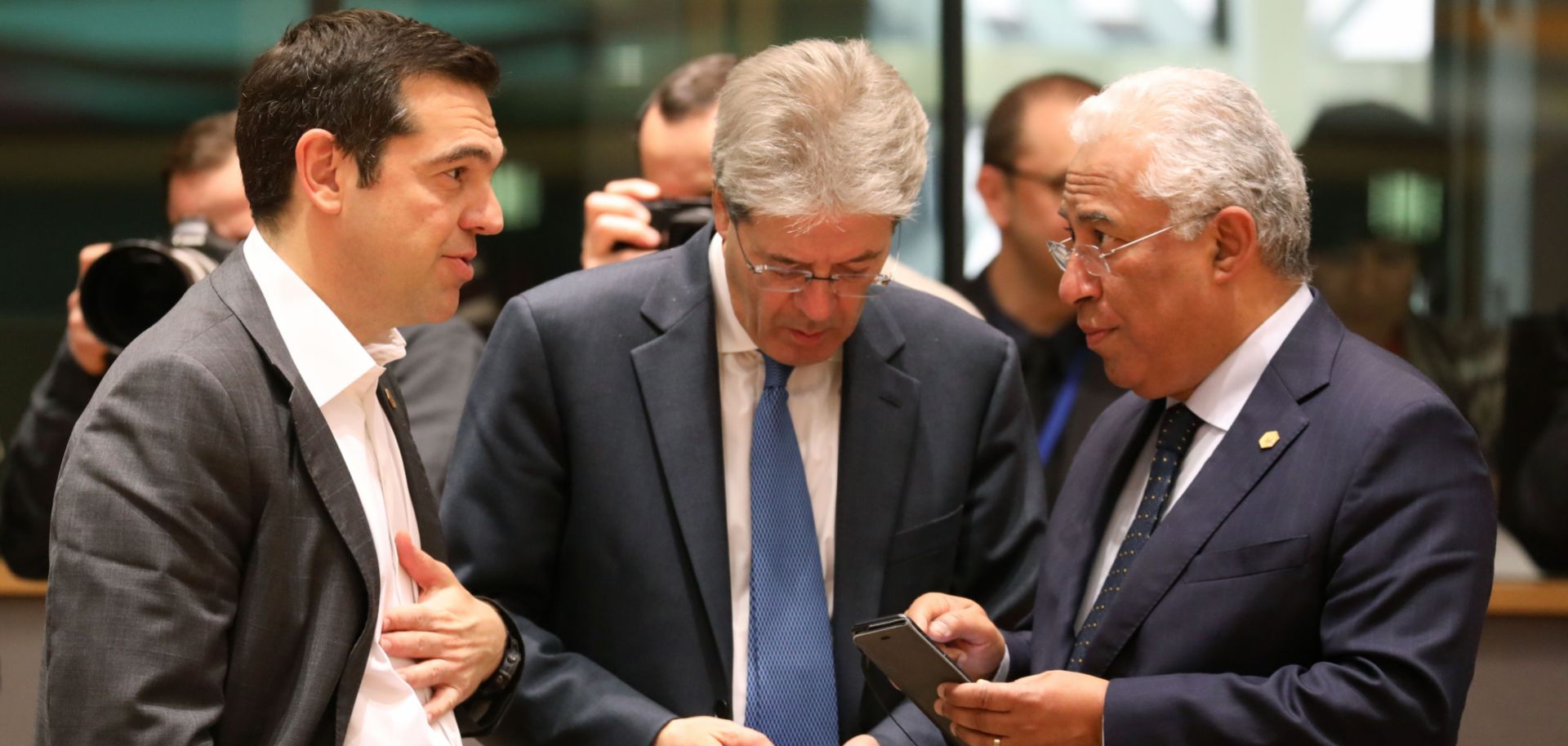
Greece's Prime Minister Alexis Tsipras (left) speaks with Italy's Prime Minister Paolo Gentiloni and Portugal's Prime Minister Antonio Costa during a summit of European Union leaders in Brussels on March 23, 2018. EU leaders adopted negotiating guidelines for talks on the future relationship with the United Kingdom, the European Council said.
Since the start of the European project more than six decades ago , the question of how the bloc should make decisions has been a crucial one. The signatories of the Treaty of Rome in 1957 came up with a creative solution: A supranational institution, the European Commission, would propose policy and act as the executive arm of the European Economic Community, the European Union's predecessor. The member states, represented in the council, would vote on the proposals. With this arrangement, the founders of the European project sought to strike a balance between supranational institutions, which would look after the interests of the bloc and be in charge of moving integration forward, and member states, which would be protecting their national interests. During the early stages of European integration, most decisions were made by unanimous consent, but successive treaty reforms expanded the use of majority voting.
