
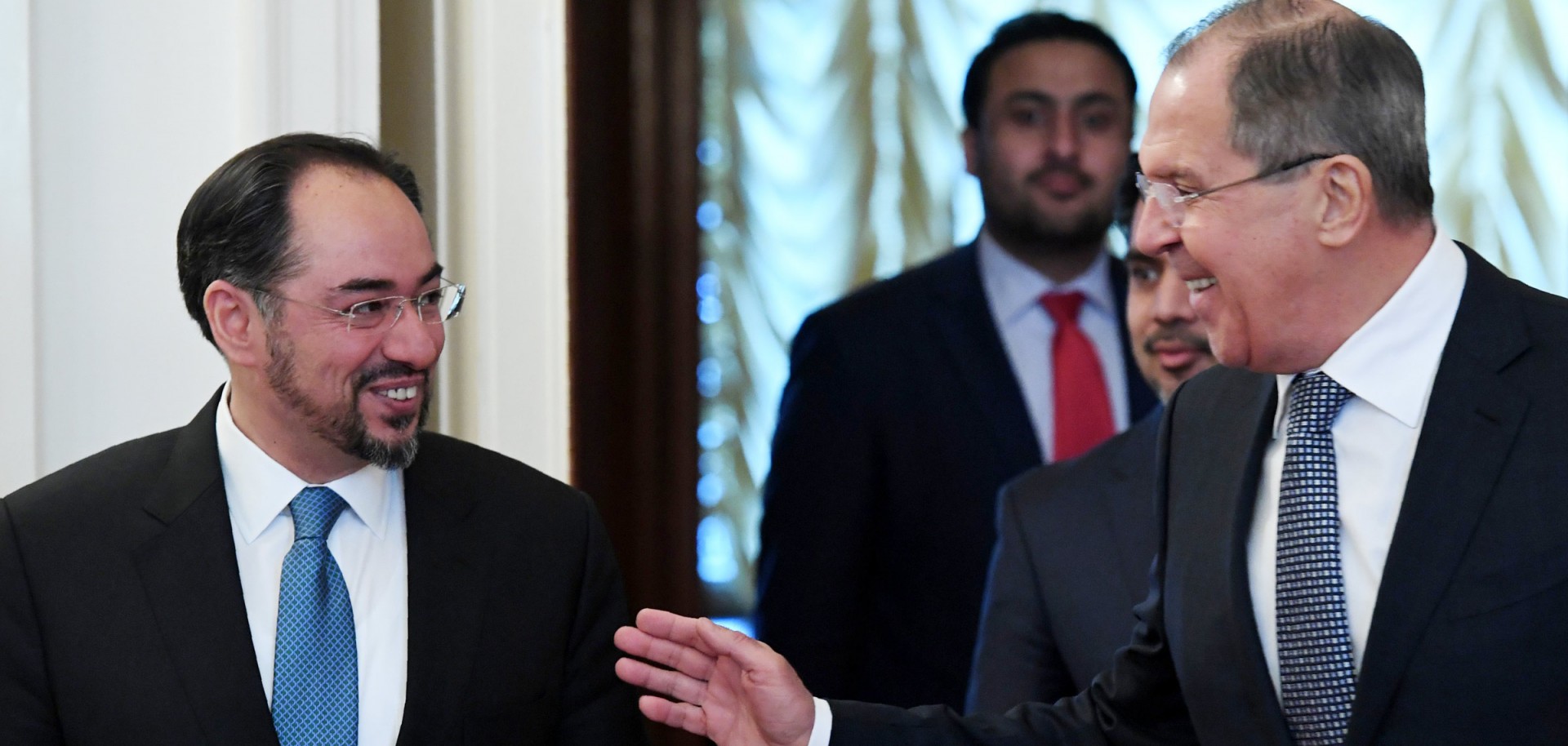
Russian Foreign Minister Sergei Lavrov (R) welcomes his Afghan counterpart, Salahuddin Rabbani, during a meeting in Moscow. International rivalries are playing out in Afghanistan, which occupies a strategic crossroads in the region.
As the administration of U.S. President Donald Trump works its way toward a policy on Afghanistan, Russia is wasting no time getting involved in America's longest-running war. Moscow is hosting talks April 14 aimed at jump-starting negotiations on the conflict in Afghanistan, the third such attempt since December. Officials from China, India, Pakistan, Afghanistan, Iran, Uzbekistan, Turkmenistan, Tajikistan, Kazakhstan, and Kyrgyzstan will be in attendance. The United States, a key stakeholder in Afghanistan, is conspicuous in its absence. The talks are coming at an especially relevant time given that the Taliban usually launch their annual spring offensive in mid-April. Aspirations aside, peace is not one of the expected outcomes of the negotiations. The real significance of the talks is in highlighting the international rivalries playing out in Afghanistan, which ultimately undermine the very opportunity for conflict resolution such discussions are meant to present.
