
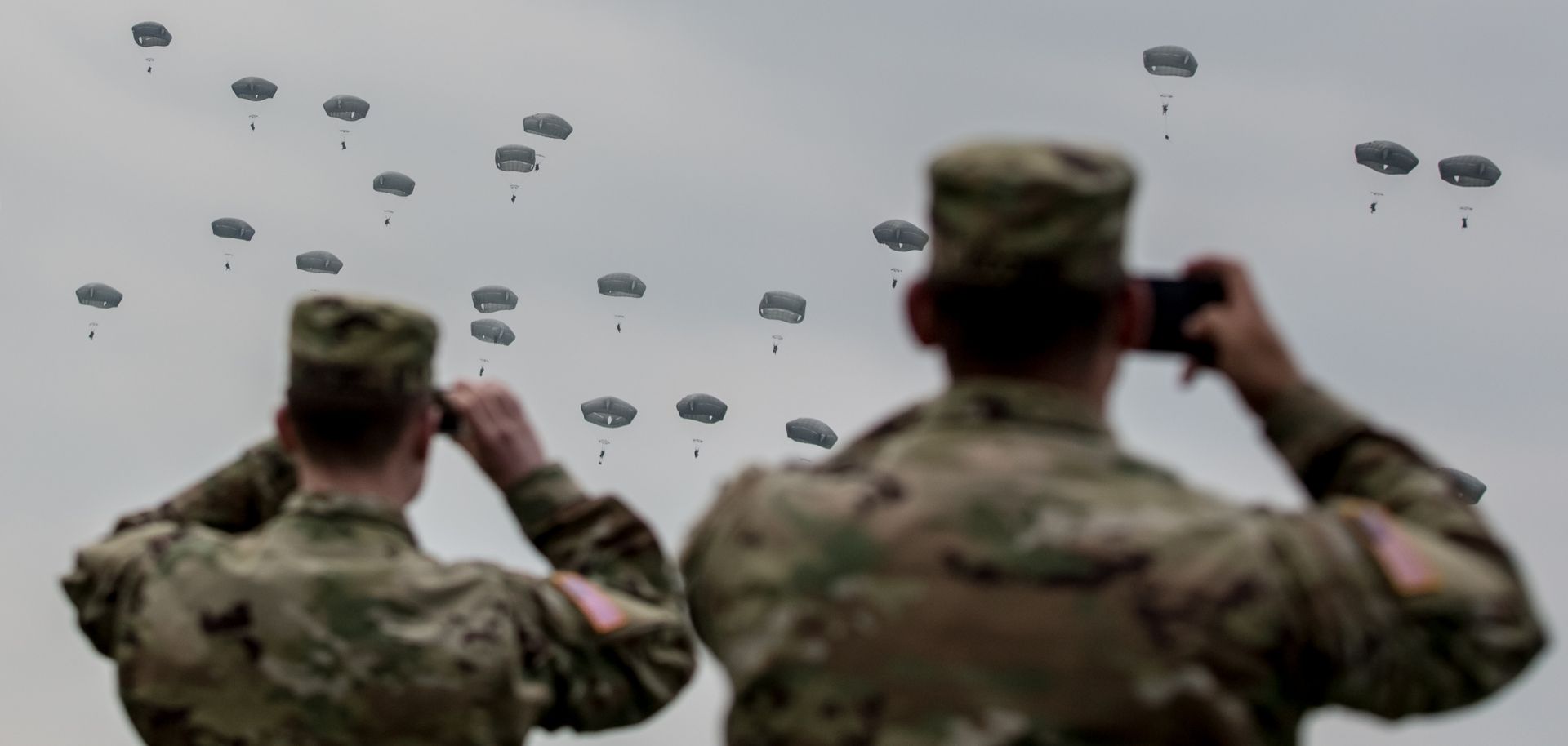
U.S. soldiers watch paratroopers from the U.S. Army 173rd Airborne Brigade, the UK's 16 Air Assault Brigade and Italian Folgore Airborne Brigade as they parachute to the ground during a training jump as part of the Saber Junction 16 military exercises near the Hohenfels Training Area. April 2016, near Grafenwoehr, Germany. The United States is adjusting its force structure top adapt to emerging global threats.
Changing times call for changing measures. In the face of an intensifying great power competition with Russia and China , the United States is expanding its efforts to refocus its global strategy, force deployments and resources to better position itself in a new struggle. But recalibrate as it might, the United States' enduring commitments, along with global flashpoints, will continue to sap the country's attention and resources as it wages a new global battle for influence. Finding a New Focus Following the collapse of the Soviet Union, the advent of the so-called global "war on terrorism" in 2001 ushered in a change in the United States' strategic defense posture, which shifted from a primary focus on defeating a great Eurasian power toward a more diffuse, enduring and amorphous effort against violent non-state actors and "rogue" states.
