
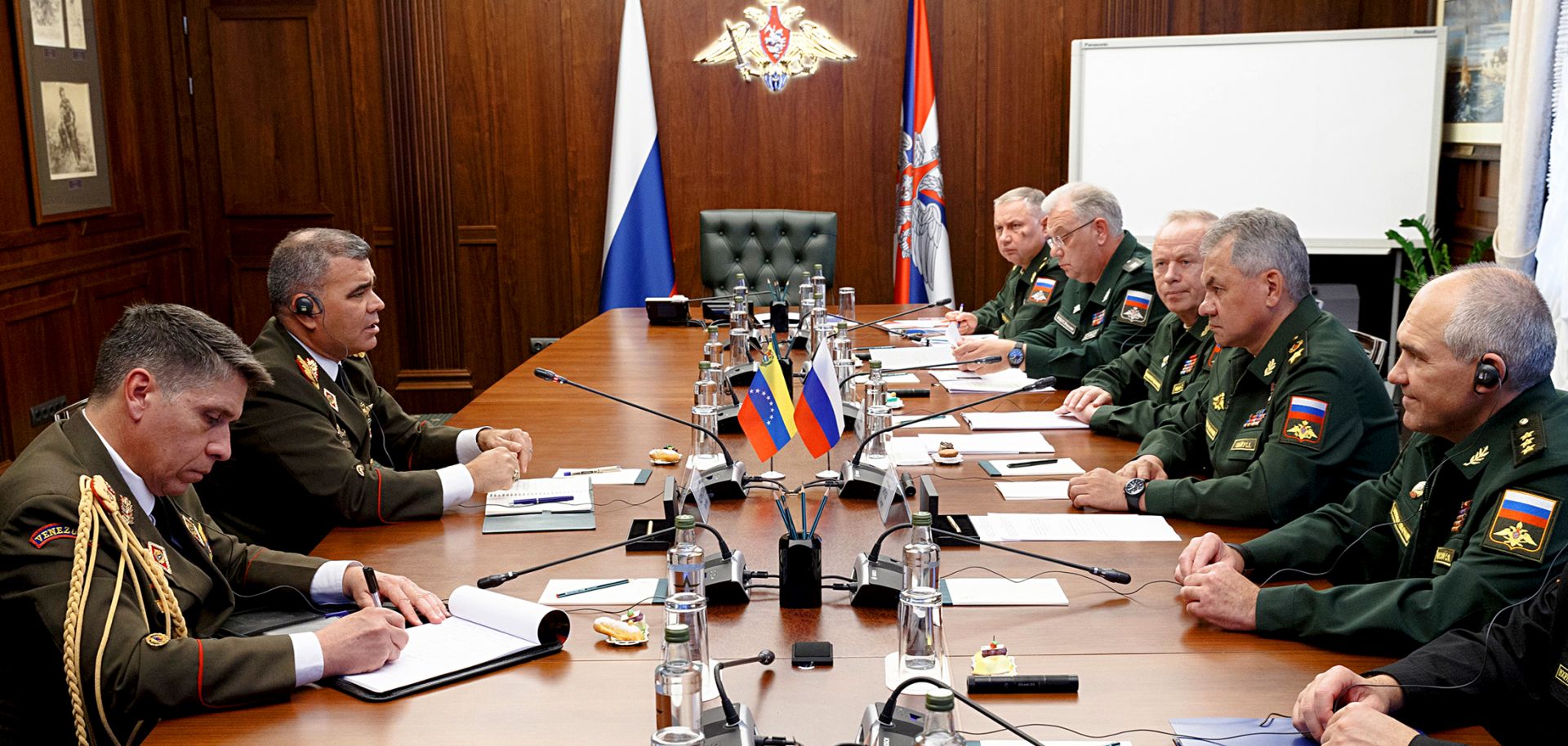
Russian Defense Minister Sergei Shoigu (second from right) and his Venezuelan counterpart, Vladimir Padrino Lopez (second from left), hold a meeting in Moscow.
(Vadim Savitsky\TASS via Getty Images)

Russian Defense Minister Sergei Shoigu (second from right) and his Venezuelan counterpart, Vladimir Padrino Lopez (second from left), hold a meeting in Moscow.

South America is again in flames. A wave of anti-government protests has ravaged the streets of Ecuador, Chile, Bolivia and Colombia in recent months. Such chaos, of course, isn't new to the region. From the 1960s to the 1990s, terrorist and insurgent groups instigated a series of vicious Cold War proxy battles. But in this iteration, which I'm calling the "Cold War 2.0" in Latin America, it's not armed proxy groups in play but already existing social tensions that Moscow is adeptly weaponizing to sabotage Western power structures in the region. 

Indeed, with threats to Russia's periphery more daunting than ever, it can be argued that the Cold War never really ended for Moscow. But regardless of whether Russia's current actions in Latin America constitute a second Cold War, or if they're instead merely a reinvigoration of the original struggle, it's apparent that many of the same actors are actively involved in the unfolding unrest in Washington's backyard — and largely, for the same reasons. 

The Soviet Legacy in Latin America

In its push to establish a global communist utopia, the Soviet Union encouraged exporting its revolution abroad to "liberate" workers around the world. But as the United States and its allies banded together to contain communist expansion, the Soviet Union began to feel threatened by the alliance structures that surrounded it, as well as the presence of U.S. troops and weapons on its periphery. In response, the Soviets embraced the Cuban Revolution and attempted to place nuclear missiles in Cuba — a gambit that ultimately led to the Cuban Missile Crisis. But even after the Soviets removed their missiles from Cuba, they continued to use the island as a beachhead in the Western Hemisphere from which to expand their influence from Canada to Chile — supporting communist parties in the Americas, while also training, financing and arming a host of Marxist terrorist and insurgent groups across the region.
 
Moscow's efforts in South and Central America, in particular, were largely conducted through their battle-hardened Cuban allies, as evidenced by the revolutionary Ernesto "Che" Guevara's ill-fated foray into Bolivia in the late 1960s. The Soviets viewed such activities as a way to not only expand world communism, but to counter U.S. anti-communist efforts elsewhere. By creating problems in Washington's own backyard, Soviet actions also helped distract the United States and its resources from those other efforts. Growing communist influence in the region embroiled the U.S. government in a series of efforts that involved high-profile events such as the 1954 coup in Guatemala; the failed 1961 Bay of Pigs Invasion in Cuba; the 1973 coup in Chile; and support for the Nicaraguan Contras in the 1980s. 

Russia's Current Activities

Fast forward to the present, however, and the U.S. threat to Russian influence has only become more acute. The peripheral security buffer that once protected Russia from Europe has significantly eroded following the collapse of the Soviet Union in 1991. Former Warsaw Pact member states such as Bulgaria, Poland, Hungary, the Czech Republic, Slovakia and Romania have since become NATO members, as have the former Soviet-occupied Baltic states of Latvia, Estonia and Lithuania. 

Growing fears of entrapment in Russia ultimately paved the way for the rise of President Vladimir Putin in 2000. But despite Putin's promises of restoring the country's past power, Russia's strategic buffer has continued to take hits. The fall of pro-Russian leaders in Ukraine in the wake of the 2014 Maidan protests and the 2005 Orange Revolution, in particular, have only ratcheted up Russian unease. To help offset the loss of such a crucial borderland, Putin has annexed Crimea and invaded southeastern Ukraine. But Russia still undoubtedly feels the sting of having lost the strategic depth of the Warsaw Pact and Soviet Bloc that had long shielded the country's soft underbelly.

Instead of arming Marxist groups with weapons, this time Moscow's arming anti-government protesters with rhetoric to counter U.S. interests in Latin America.

The loosening grasp on its borderlands is now again compelling Russia to resort to its old tricks in Latin America. This has notably included propping up Nicolas Maduro's failing regime in Venezuela over the past year with the help of Moscow's Cuban partners. Cuba has been a key security partner of Venezuelan regimes since shortly after former Venezuelan President Hugo Chavez came to power in 1999. The vast web of Cuban intelligence operators and assets that has infiltrated Venezuelan society since then have informed the Maduro regime about potential threats while keeping the opposition divided and squabbling. Meanwhile, Russia's financial, military and technical intelligence support — not to mention the close protection from Russian military contractors — have been critical to the Maduro regime in recent years as well. In fact, I would go so far as to say that Maduro would have long been ousted had it not been for Russia's and Cuba's help. 
 
But the activities of Russia and its Cuban partners in Latin America are not limited to Venezuela. On Nov. 13, officials arrested four Cubans in Bolivia for allegedly financing anti-government protests in support of the country's former socialist president, Evo Morales. An ally of the Russian-backed Maduro regime, Morales was forced to seek refuge in Mexico after his victory in an apparently fixed election sparked widespread protests. In recent weeks, the Organization of American States (OAS) has also accused Cuba and Venezuela of helping instigate the anti-government protests in Ecuador, Chile and Colombia. Just as the Soviets bankrolled Cuban paramilitary efforts in Latin America during the first Cold War, it is clear that Russia is still funding these efforts, as both Cuba and Venezuela are severely cash-strapped and could not conduct these external operations alone. 

Using Social Angst for Political Gain

The Soviets and Russians have had ample experience using protests to undermine their Western opponents' place in power. In the United States, there's evidence of Moscow's hand in both the anti-war protests of the 1960s and anti-nuclear protests of the 1980s, as well as the anti-hydraulic fracturing movement and the Occupy Movement in more recent years. And, of course, there's Russia's intervention in the 2016 Brexit referendum followed by the U.S. presidential election that same year. 

Indeed, over the decades, Russia has become increasingly adept at tapping into very real social sentiments and issues to achieve its own political goals. In concert with its Cuban and Venezuelan allies, Russia has proven adept at amplifying the tension along very real social fault lines within these countries. Russia is not simply fabricating issues underpinning the unrest out of thin air; rather, it's simply providing the "spark" to ignite the underlying economic and social grievances that have quietly been brewing just beneath the surface in these countries for years. 

Russia also now has vast experience using social media to disperse disinformation on the internet, just as it did ahead of the Brexit vote in the United Kingdom and the U.S. presidential election in 2016. In recent years, Moscow has also deployed similar online propaganda campaigns in Germany, Ukraine and the Baltic states. And there are signs it's attempting to do the same ahead of the next U.S. election in 2020.  We can thus expect to see these disinformation tools used elsewhere in the region to support socialist allies and oppose governments that are democratic, more free-market-oriented or otherwise allied with the United States.

Foreign Stakeholders in the Crosshairs 

Given the socialist, anarchist and anti-capitalist bent of many of the anti-government movements, protesters have unsurprisingly already begun targeting commercial interests in the region. More than 100 stores owned by Walmart's subsidiary in Chile, for example, have so far been looted and burned amid escalating anti-capitalist demonstrations in the country. As protests rage on across the continent, U.S. and European businesses operating in these countries will likely continue to be targeted, including potentially mining and energy companies, hotels, banks and airline offices. U.S. diplomatic facilities and nongovernmental organizations (NGOs) operating in the region could also come under fire. A number of businesses and NGOs have already pulled their personnel out of Bolivia following the U.S. Department of State's recent travel warning, which also urged American citizens living there to leave. 
 
Given Russia's imperative to undermine growing U.S. influence closer home, as well as globally, Moscow will do everything in its power to ensure the protests continue apace right outside Washington's door. Businesses and organizations across South America will thus need to closely monitor the dynamics of the unrest in Latin America as it evolves and potentially escalates in the coming weeks. Otherwise, they may soon find themselves caught in the crossfire of another Cold War proxy battle. 

RANE
SUBSCRIBERS ONLY

Expert analysis when it matters most.

Get access to RANE's decision-grade geopolitical intelligence.