
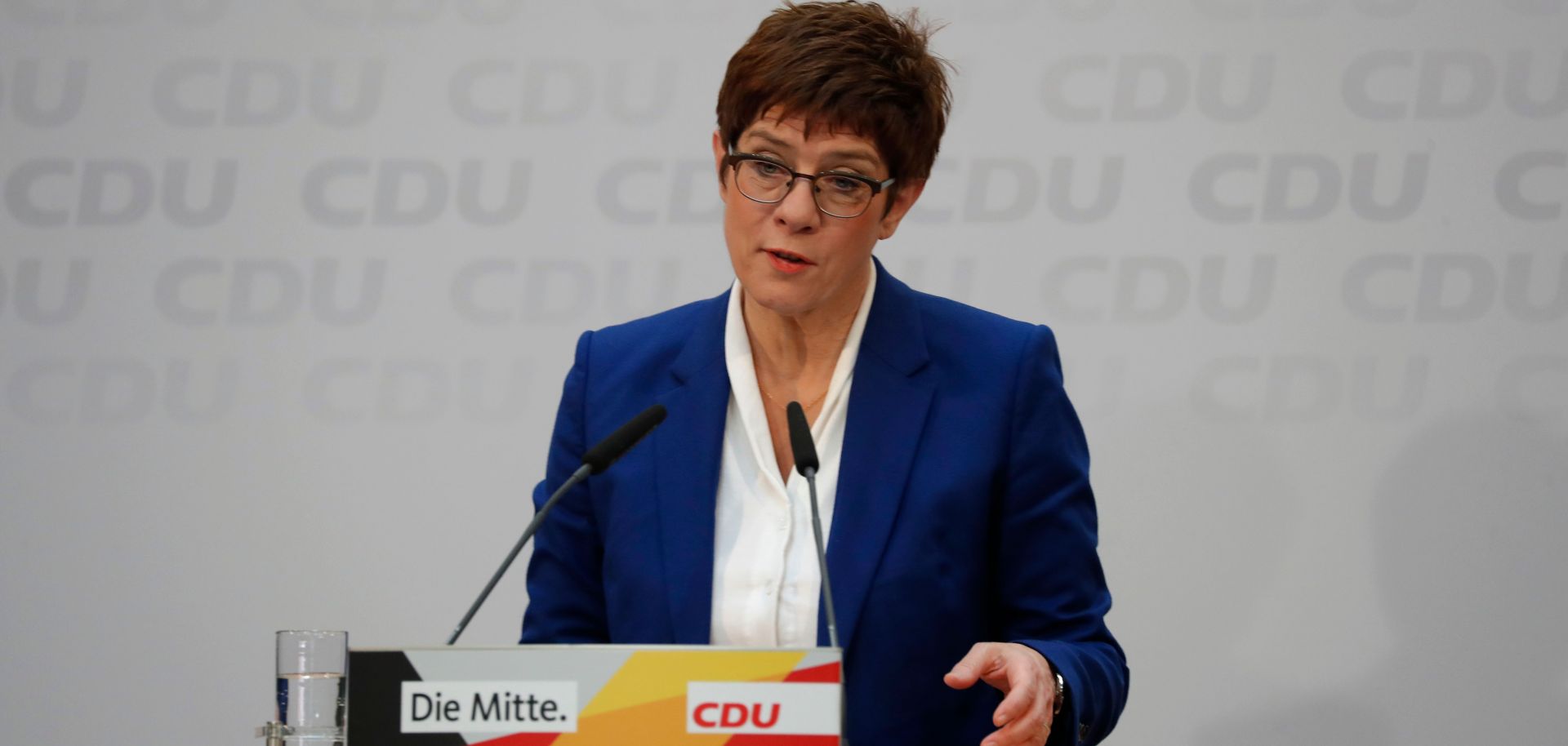
The resignation of Christian Democratic Union party leader Annegret Kramp-Karrenbauer, who many thought would succeed Angela Merkel as German chancellor, has proven to be a distraction for Germany's governing coalition.
Companies and households in Germany will face several sources of risk throughout the year, including political risk from the country's fragile government coalition; economic risk connected to global trade uncertainty and threats to Germany's exports; and institutional risk, caused by strategic divisions within the European Union that will make it hard for the bloc to implement policy. Germany will continue to be stable and prosperous in 2020, but these risk factors could prove disruptive for business, investors and individuals in the country. The Main Risks for Germany in 2020 A Fragile Government Germany is governed by a coalition between the conservative Christian Democratic Union (CDU), its sister party in Bavaria, the Christian Social Union (CSU), and the center-left Social Democratic Party (SPD).
