
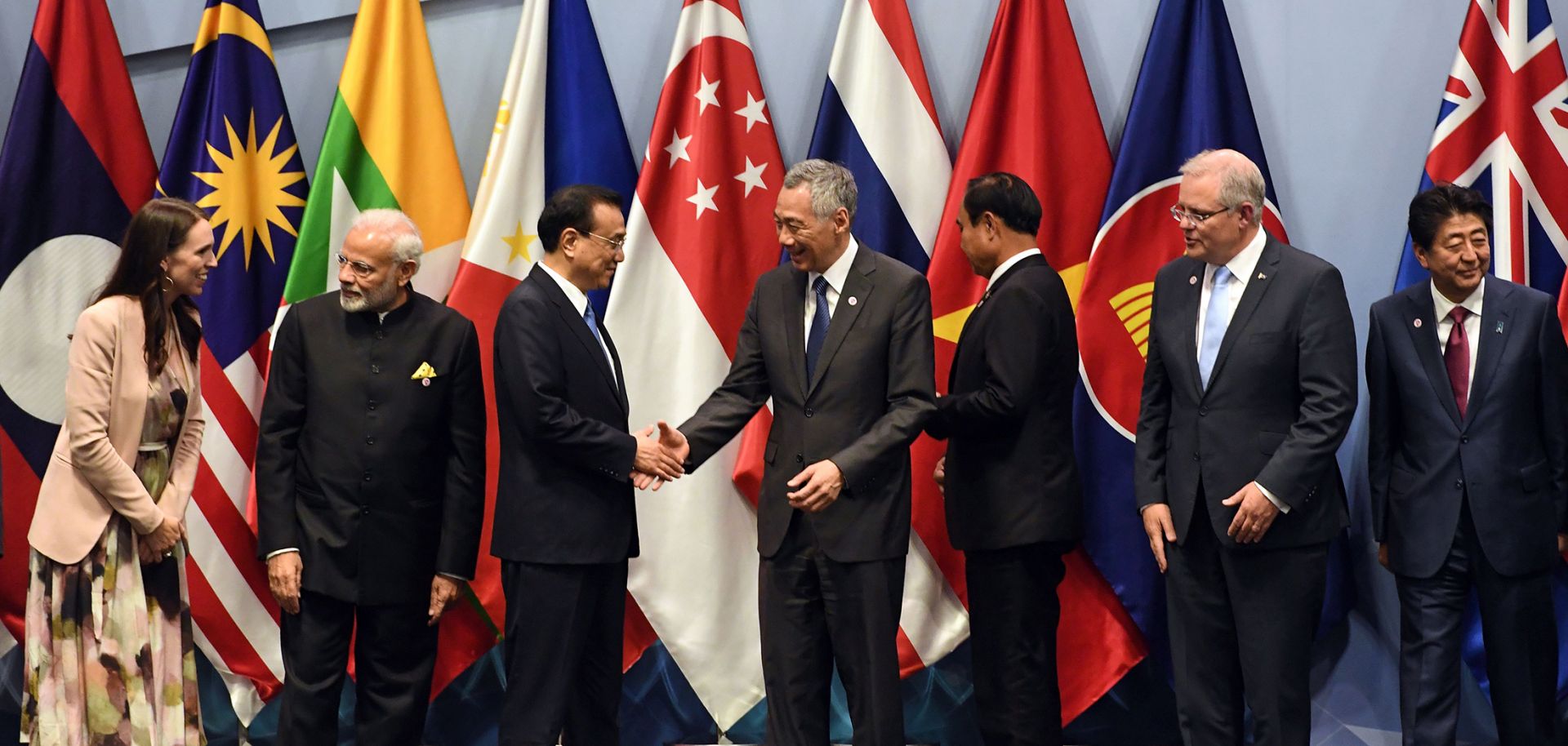
Leaders of the 16 countries negotiating the Regional Comprehensive Economic Partnership assemble for a group photo on Nov. 14, 2018, in Singapore. The proposed trade agreement seeks to integrate the economies of Southeast Asia with China, India, Japan, South Korea, Australia and New Zealand.
A long-running proposal to create the world's largest free trade zone has stagnated under the weight of its members' disagreements. The Regional Comprehensive Economic Partnership (RCEP) is a trade initiative between the Association of Southeast Asian Nations (ASEAN) and its six free trade partners: India, China, Australia, Japan, South Korea and New Zealand. Ambitious in scope, RCEP would encompass 3.6 billion people and account for a third of the world's total economic output. But 25 rounds of talks spanning six years have failed to produce a consensus. Now, lingering obstacles threaten to dash the prospects of sealing a final agreement by the time a high-level ASEAN summit is held in Thailand in November. India, in particular, is the main outlier in RCEP negotiations. Wary that the deal could worsen its politically sensitive trade deficit with China, India is drawing hard lines on the percentage of tariffs it will reduce.
