
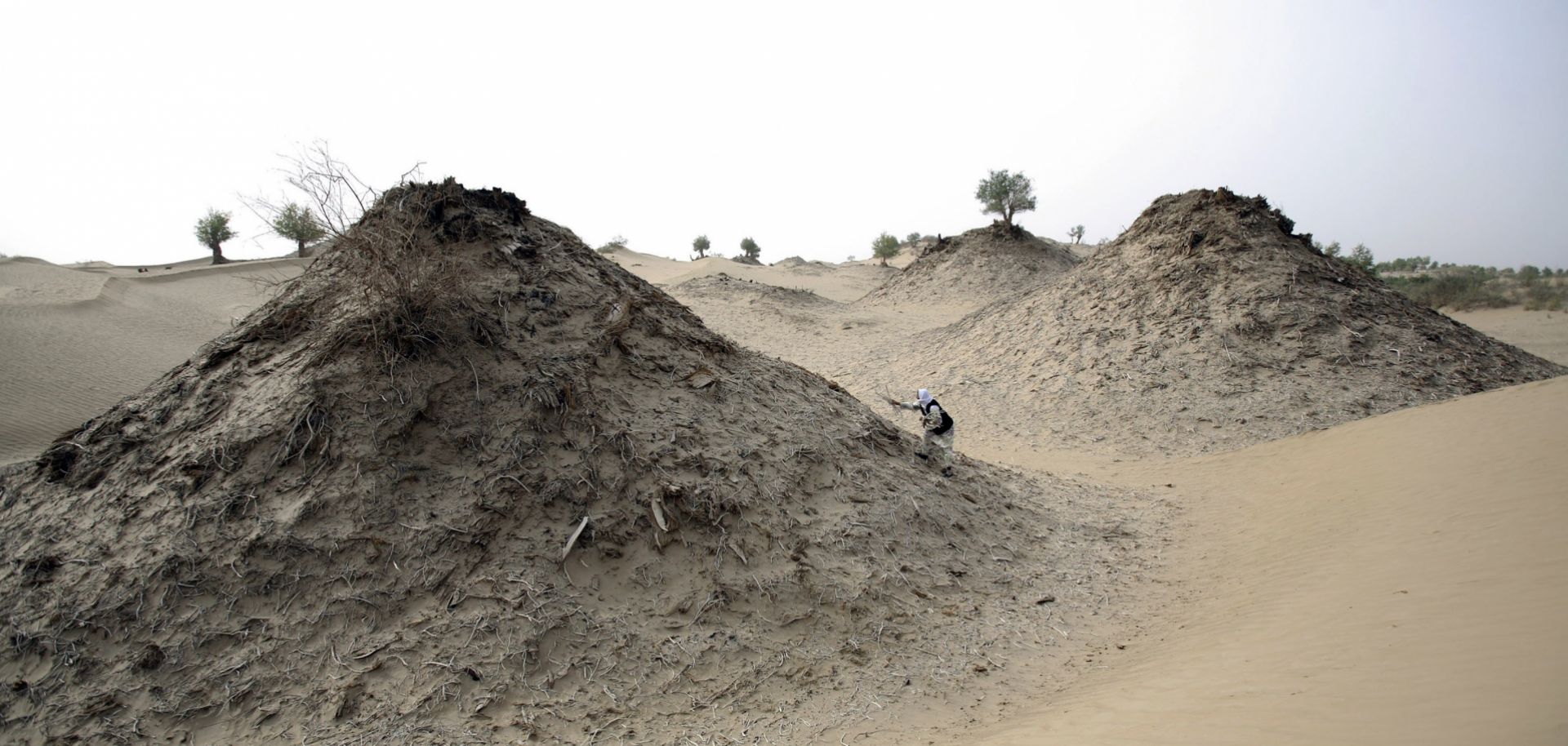
A Keriyan senior citizen picks Euphrates poplar tree branches in China's Xinjiang Uighur Autonomous Region. The area's Taklamakan Desert is one of the driest regions in the world.
The tale of the Silk Road is one of intrigue, war and cities lost. But within this complex and quixotic tableau, it is the story of China's Tarim Basin that best echoes the age-old warning: History is doomed to repeat itself. The ill-fated river network comprises the Kashgar, Yarkant, Hotan and Aksu rivers, which stream from the glacial and snow melt of surrounding mountaintops to converge at Aral, where they merge into the Tarim River. The waterway then flows through the Taklamakan Desert, a sea of sand in the shadow of the Tianshan Mountains and one of the driest regions in the world. The name Taklamakan means "once you enter, you don't come out" — an accurate description, not just of the experiences of hapless ancient travelers but also of the river system whose waters never escape the desert.
