
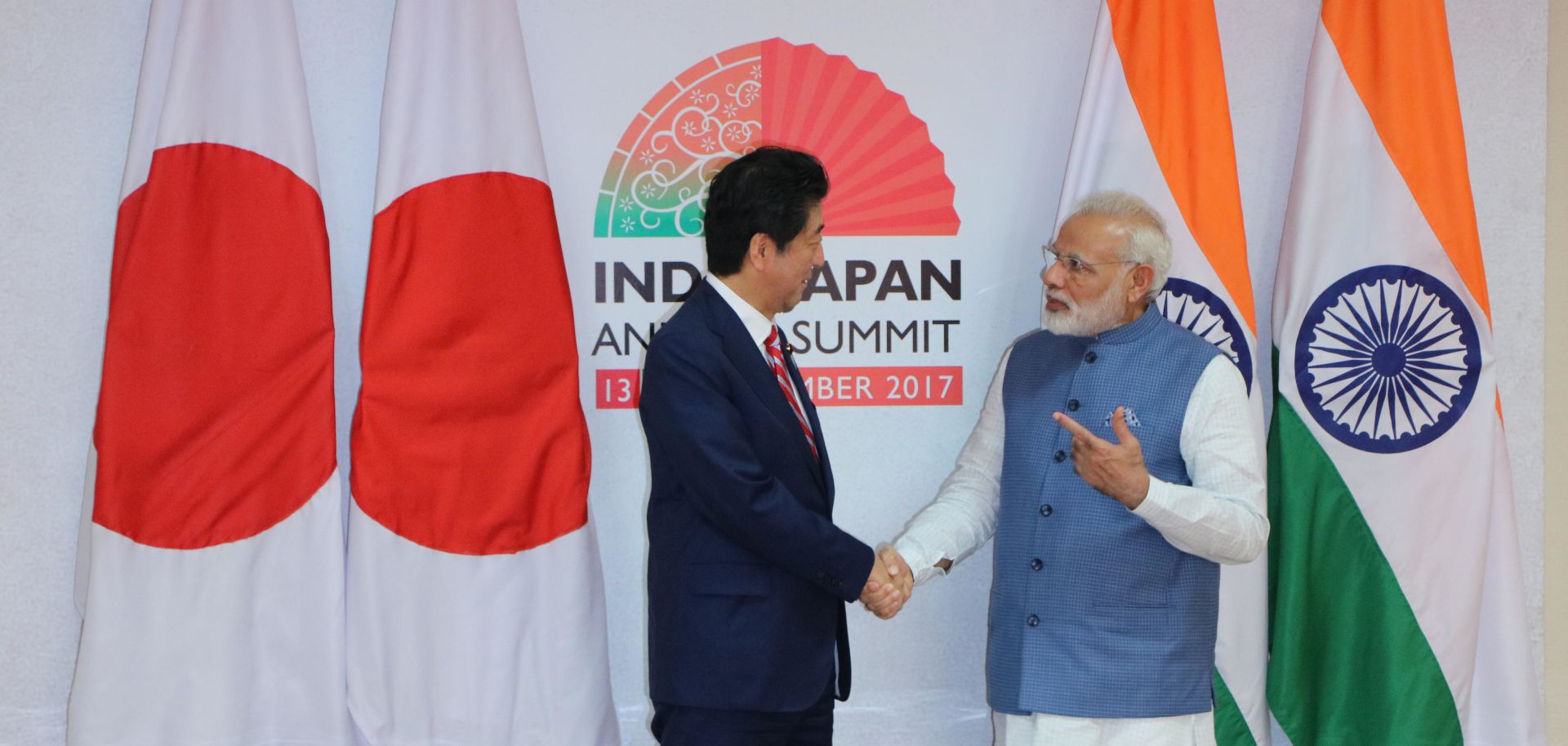
Indian Prime Minister Narendra Modi shakes hands with his Japanese counterpart, Shinzo Abe, during a summit in India. To counter China's rise, Modi's government has sought to bolster India's ties with Japan and other Asian countries as part of its "Act East" policy.
India's emboldened eastern push reflects its aspiration to become one of Asia’s key military and economic powers — and the existential threat that China poses to realizing that dream. Beijing's growing influence, along with its increasingly forceful claims over disputed territories along India's border, is driving New Delhi to deepen its own political, economic and security relations in Southeast Asia and the wider Indo-Pacific under its "Act East" policy . Shortly after taking office in 2014, Prime Minister Narendra Modi launched the government initiative, which includes bolstering India's military presence and infrastructure development along its northeast border. In addition to warding off China's imminent threat to India's territorial sovereignty, developing the country's northeastern wing — whose border with Myanmar positions it as India's gateway into Southeast Asia — has the potential to unlock new export markets for Indian trade, furthering the government's strategy of building a $5 trillion economy.
