
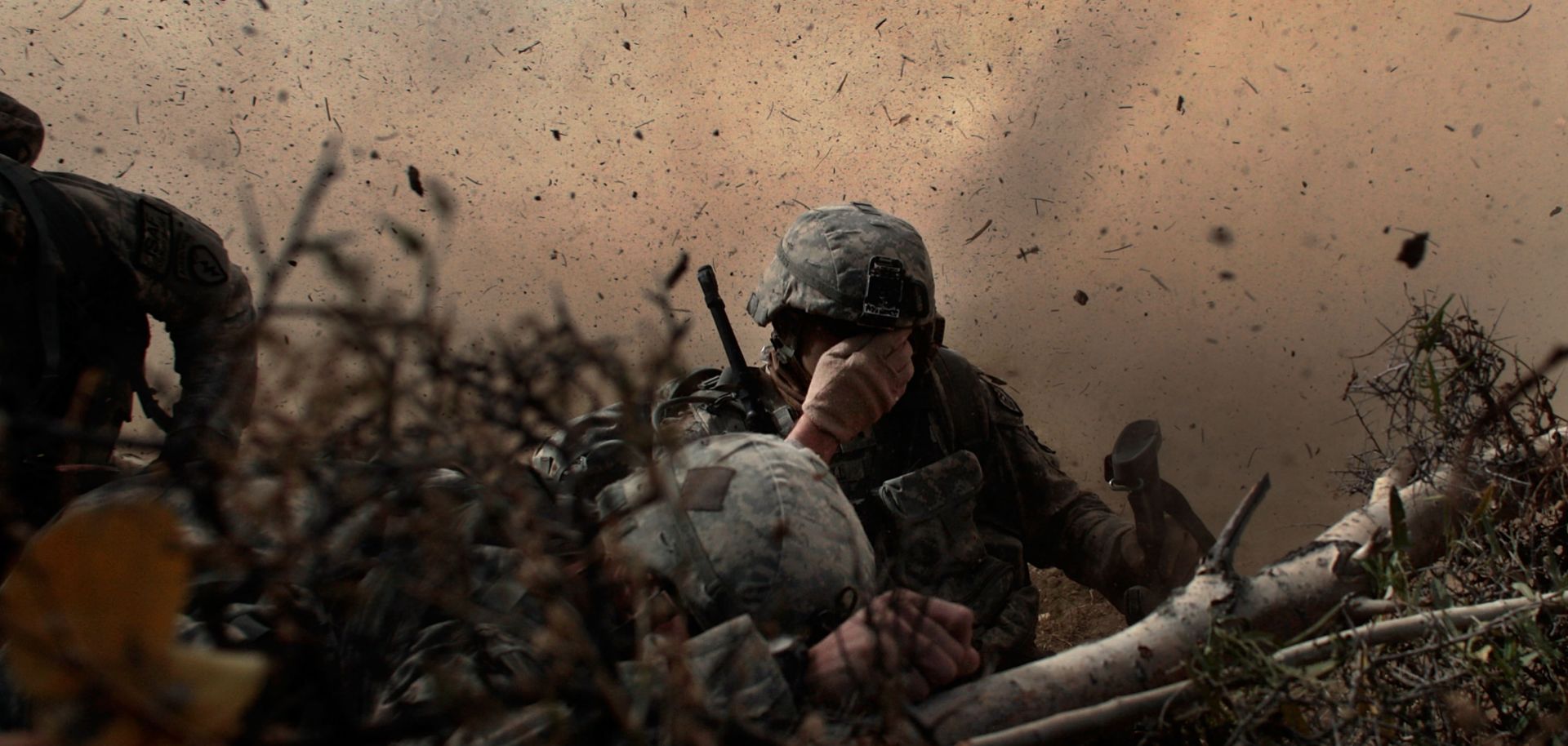
US Army soldiers in the 1/501st of the 25th Infantry Division shield their eyes from the powerful rotor wash of a Chinook cargo helicopter as they are picked up from a mission October 15, 2009 in Paktika Province, Afghanistan. These troops were looking for suspected Taliban weapons stores and hideouts in the Afghan countryside near the Pakistani bordner.
The Afghan War is the longest war in U.S. history. It began in 1980 and continues to rage. It began under Democrats but has been fought under both Republican and Democratic administrations, making it truly a bipartisan war. The conflict is an odd obsession of U.S. foreign policy, one that never goes away and never seems to end. As the resignation of Gen. Stanley McChrystal reminds us, the Afghan War is now in its fourth phase. The Afghan War's First Three Phases The first phase of the Afghan War began with the Soviet invasion in December 1979, when the United States, along with Saudi Arabia and Pakistan, organized and sustained Afghan resistance to the Soviets. This resistance was built around mujahideen, fighters motivated by Islam. Washington's purpose had little to do with Afghanistan and everything to do with U.S.
