
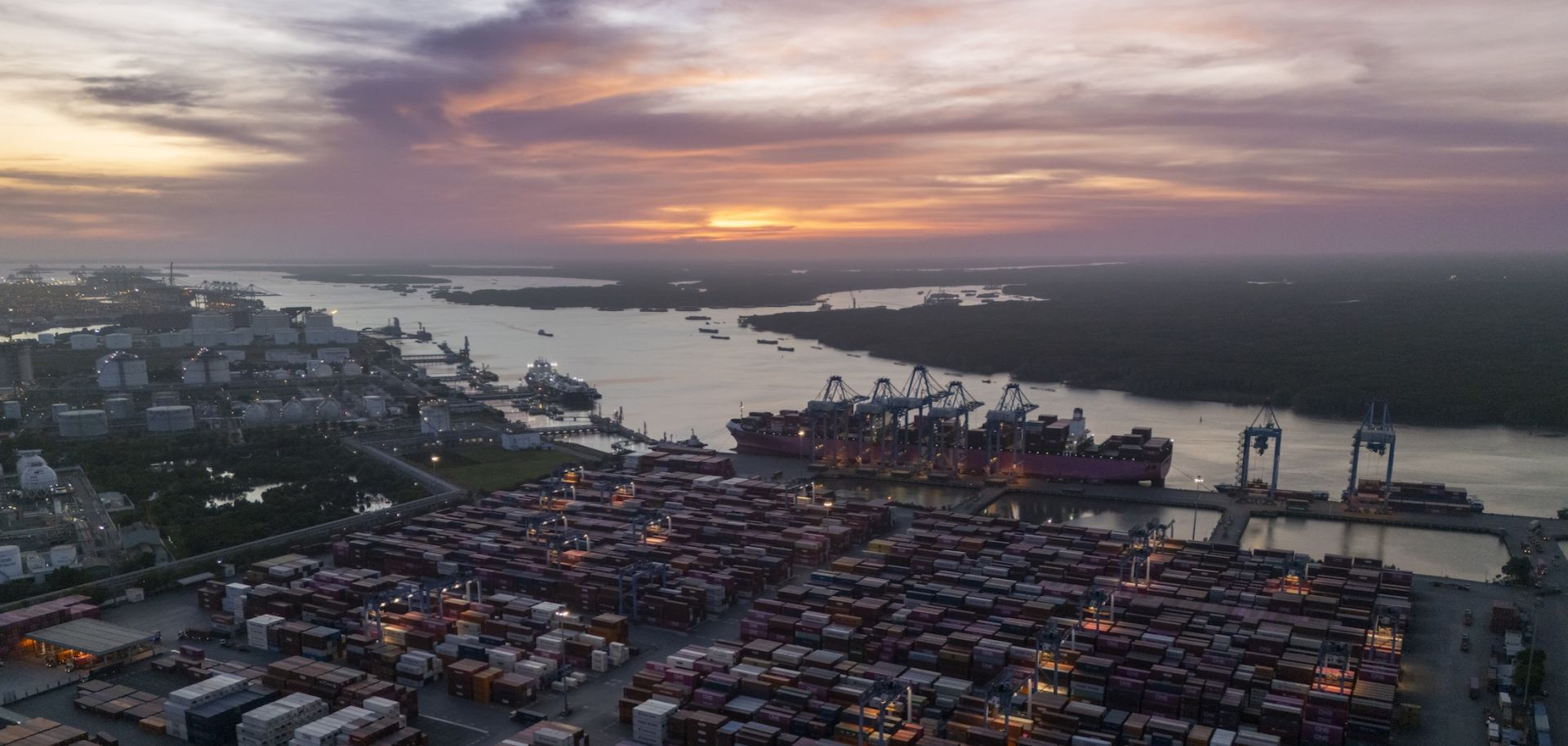
A large container ship is seen docked at a port.
(Getty Images)
A large container ship is seen docked at a port.

U.S.-Vietnam trade talks remain stalled after the U.S. Supreme Court invalidated tariffs imposed under emergency powers, but Washington's new duties and investigations will likely secure only limited concessions, potentially leaving Vietnam exposed to new tariffs. On July 16, as Vietnamese officials met with U.S. counterparts in Washington for the latest round of bilateral trade negotiations, U.S. Trade Representative Jamieson Greer said the United States wants Vietnam to lower tariffs and other barriers to U.S. goods and services, strengthen intellectual property protections and cooperate more closely on economic security. Greer also said Vietnam must align more closely with U.S. export controls to maintain access to advanced U.S. technology. Neither government announced an agreement, a timetable or specific new commitments from the negotiations, which have dragged on for months. Talks remain stalled over U.S. demands for stricter rules of origin and stronger measures against Chinese goods routed through Vietnam to avoid U.S. tariffs on China, as well as disagreements over market access and other trade barriers. The two governments have not agreed on how to identify goods that have been illegally transshipped or what criteria products made in Vietnam with Chinese inputs must meet to qualify as Vietnamese. Greer also alleged that some Chinese goods are sent to Vietnam and simply given a "Made in Vietnam" label.

  • The U.S. goods trade deficit with Vietnam surged 44.3% to $178.2 billion in 2025 compared to 2024, trailing only China and Mexico. It widened to $90.4 billion from January through May, up from $64.8 billion the same period a year earlier, exceeding the corresponding deficits with both China and Mexico.
  • To address U.S. concerns over intellectual property enforcement, Vietnamese authorities have removed over 9,000 infringing products from online marketplaces and blocked over 2,000 suspected online stores during the first half of 2026, according to Vietnam's Ministry of Industry and Trade.

Since 2025, U.S.-Vietnam trade negotiations have been shaped by shifting tariff policies, legal challenges and efforts to establish a more durable bilateral trade framework. In April 2025, Trump announced a 46% tariff on Vietnamese goods under the International Emergency Economic Powers Act (IEEPA), citing the substantial bilateral trade deficit and barriers to U.S. exports. He suspended the rate later that month to allow for negotiations while retaining a 10% tariff on most imports. The talks produced a preliminary understanding in July 2025 that reduced Vietnam's tariff to 20% and established a 40% rate on goods deemed transshipped through Vietnam to evade U.S. duties. An executive order formalized both rates later that month. In October 2025, the two governments expanded the understanding into a framework under which Vietnam would increase access for U.S. industrial and agricultural exports, address other trade barriers, and cooperate on duty evasion and export controls, while the United States retained the 20% tariff. The framework did not resolve several major issues or produce a final agreement. The legal basis for those tariffs collapsed in February, when the Supreme Court blocked the IEEPA tariffs. Vietnam nevertheless said it would continue honoring the July 2025 agreement, and Trump replaced the invalidated tariffs with a temporary 10% tariff under Section 122 of the U.S. Trade Act of 1974, which is set to expire on July 24. Washington has also opened three Section 301 investigations into excess manufacturing capacity, forced labor and intellectual property enforcement, each of which could provide a separate basis for new tariffs on Vietnamese goods. As such, the approaching July 24 expiration and progress of those investigations have increased pressure, primarily on Vietnam, to resolve the negotiations and avoid higher U.S. tariffs.

  • The October 2025 framework included Vietnam Airlines' planned purchase of 50 Boeing aircraft worth more than $8 billion, along with 20 agreements for Vietnamese companies to buy more than $2.9 billion in U.S. agricultural products, in an ultimately failed effort to reduce the trade imbalance.
  • On June 2, the Office of the U.S. Trade Representative concluded that Vietnam had failed to prohibit imports made with forced labor and proposed an additional 12.5% tariff on most Vietnamese goods, with a commitment as part of ongoing trade negotiations to adopt and effectively enforce such an import ban, potentially reducing the tariff to 10%.
  • The White House's intellectual property investigation into Vietnam is due to conclude by Nov. 29, although the deadline could be extended to February 2027. The excess manufacturing capacity investigation will likely conclude by March 2027.

Though interim measures or narrower agreements are plausible, Vietnam's dependence on Chinese inputs will likely prevent a comprehensive agreement, potentially exposing it to stricter U.S. scrutiny and new tariffs. Vietnam will likely offer further concessionary measures, including tighter customs inspections, while requiring exporters and other companies operating in Vietnam to provide more detailed origin documentation, stronger intellectual property enforcement and greater access for U.S. goods. To preserve access to U.S. semiconductor manufacturing tools and other advanced equipment, Hanoi will also cooperate more closely with Washington's efforts to enforce export controls, including by increasing information-sharing with U.S. authorities and strengthening enforcement against the diversion or onward transfer of controlled U.S. technology to restricted Chinese companies. But while these steps could support an interim deal, the two countries are unlikely to reach a broader agreement that settles disputes over rules of origin and Chinese transshipment, market access, export control cooperation and intellectual property enforcement, while establishing agreed tariff treatment for Vietnamese goods. This is because Vietnam's dependence on Chinese inputs limits how far it can accommodate U.S. demands. Indeed, Chinese machinery, components and raw materials are embedded throughout Vietnam's manufacturing ecosystem, making their wholesale replacement unrealistic and even partial diversification slow and costly. Hanoi will therefore resist rules that classify legitimate processing of Chinese inputs as transshipment or broadly exclude Chinese suppliers and investors. The most likely compromise would retain existing origin standards while adding stricter documentation and verification requirements, greater customs data sharing and stronger penalties on relabeling and duty evasion. Unless an agreement or series of agreements also resolves the Section 301 investigations, Washington could use them to impose new duties after the temporary tariff expires on July 24, including the proposed 12.5% tariff over forced labor concerns. Washington will likely calibrate this pressure to limit costs for U.S. companies that depend on Vietnamese factories, but exporters with substantial Chinese content will still face more U.S. audits, customs delays and higher compliance costs regardless of whether a deal is announced. Over time, this pressure will encourage Vietnam and foreign manufacturers to develop domestic suppliers and source more inputs elsewhere in Asia, but it will not sever Vietnam's manufacturing ties with China.

  • Vietnam's national semiconductor strategy, adopted in September 2024, aims to establish at least 100 chip design companies, one semiconductor fabrication plant and 10 packaging and testing facilities by 2030, making access to U.S. equipment and technology critical to Hanoi's effort to move beyond assembly into higher value production.
  • China supplied Vietnam with $186 billion in goods in 2025, accounting for about 41% of Vietnam's total imports. Meanwhile, the United States remained Vietnam's top export destination, receiving $153.2 billion in goods. Vietnamese goods exported to the United States in 2024 were equivalent to around 30% of Vietnam's GDP, representing the highest share among all major U.S. trading partners.
RANE
SUBSCRIBERS ONLY

Expert analysis when it matters most.

Get access to RANE's decision-grade geopolitical intelligence.