
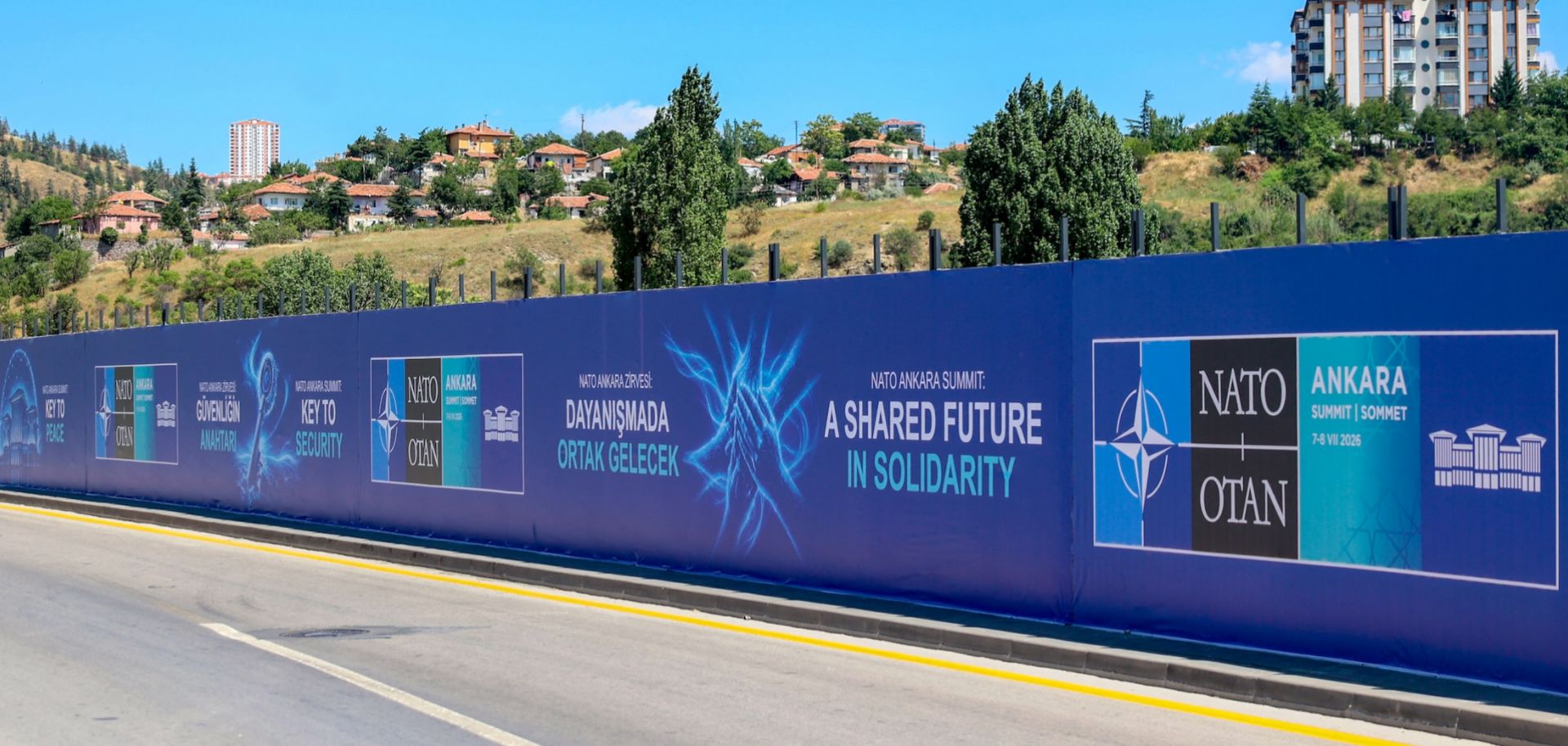
Billboards are seen ahead of the upcoming NATO Summit in Ankara, Turkey, on June 26, 2026.
(ADEM ALTAN / AFP via Getty Images)
Billboards are seen ahead of the upcoming NATO Summit in Ankara, Turkey, on June 26, 2026.

NATO leaders will use the July 7-8 Ankara summit to showcase progress on burden sharing and defense-industrial cooperation, though structural political and production constraints will continue to slow the strengthening of collective defense and support for Ukraine. Turkey will host the 36th NATO Summit in Ankara on July 7-8. Thirty-two leaders from NATO countries, as well as Gulf and Asia-Pacific leaders, are expected to attend. On June 29, Turkish President Recep Tayyip Erdogan said that the focus of the summit would be on alliance unity, which has been strained by the Iran and Ukraine wars, as well as reducing barriers to defense trade and cooperation. Other topics of discussion are contentious issues of burden sharing within the alliance, such as ongoing efforts to increase NATO countries' defense spending and support Ukrainian war efforts. Turkey will concurrently host a Defense Industry Forum on defense production, investment and innovation. 

  • During the 2025 NATO Summit in The Hague, NATO countries agreed to raise security-related spending to 5% of GDP by 2035 (a threshold that no member currently meets, though Poland stands at 4.8%). At least 3.5% of GDP is to be allocated toward NATO Capability Targets, such as spending on military equipment and personnel, while at least 1.5% is to be allocated to security-related spending, which could include boosting cybersecurity, supply chain resilience or critical infrastructure. 
  • NATO Secretary-General Mark Rutte met with U.S. President Donald Trump on June 24 in an effort to smooth over tensions between Trump and NATO allies ahead of the summit. Separately, a high-level EU delegation visited Turkey on June 30 to meet with senior Turkish officials to discuss expanded cooperation on economic and security issues. 

Trump has been critical of NATO allies' low defense spending and limited support for the United States during the Iran war, while Turkey has sought to ease tensions between it and other NATO countries ahead of the summit. Trump frequently alleges that other members of the alliance should increase their defense spending and reduce their reliance on the United States for their security. Relations grew particularly tense in late 2025 and early 2026 over U.S. threats to seize Greenland by force, prompting bilateral frictions with Denmark and leading countries like France and Germany to overtly criticize the White House. These tensions escalated again during the Iran war, which saw most NATO allies provide only limited support to the United States. In April, Trump threatened to withdraw from NATO and reduce the U.S. military footprint in Europe. By contrast, Turkey has tried to smooth over friction with some of its alliance partners to reduce diplomatic obstacles toward improving defense ties during the summit. In a largely symbolic concession to the European Union and the United States, Ankara is taking steps to reopen an Orthodox Christian seminary to appeal to their demands for improved religious freedoms. Additionally, Turkey has postponed the introduction of controversial legislation that would formalize its claims to disputed waters in the Aegean and Mediterranean seas, a flashpoint with fellow NATO member Greece and with Cyprus, which is not a member of the alliance. Meanwhile, Erdogan has used Trump's second term as an opportunity to boost Turkish-U.S. relations, including defense cooperation, and attempt to re-enter the F-35 program. 

  • In May, the U.S. Department of Defense announced that 5,000 of the roughly 36,500 troops in Germany would withdraw within six to 12 months and canceled the deployment of long-range Tomahawk missiles, amid disputes between Trump and German Chancellor Friedrich Merz. Trump has threatened additional troop reductions in Italy and Spain after Rome and Madrid denied logistical support for the U.S. war against Iran.
  • Turkey was kicked out of the F-35 program in 2019 after it acquired Russian-made S-400 air defense systems. U.S. Vice President JD Vance said on June 24 that the Pentagon was reviewing whether it could sell F-35s to Turkey. Meanwhile, the United States has moved forward with the $700 million sale of General Electric engines to power the Turkish-made KAAN fighter jet. 
  • Although some European countries, such as Germany and Italy, have indicated willingness to support demining the Strait of Hormuz, they have conditioned participation on the conflict de-escalating, as U.S.-Iran tensions remain elevated. Any participation in Iran-related efforts would likely not be alliance-wide, as NATO missions require unanimous support and several members, such as Spain, have been critical of Trump's handling of the war. 

NATO countries will likely present multiyear plans for increased defense spending and announce multibillion-dollar defense deals to enhance procurement, though the extent to which Turkey can expand its alliance defense cooperation will be limited. Although NATO countries have until 2035 to reach the 5% of GDP goal, NATO countries will seek to show that they are increasing defense spending to meet the target, in order to assuage Trump's concerns. In 2025, all NATO countries met the previously established 2% of GDP benchmark for the first time since countries agreed to the target in 2014, but only a few countries currently surpass even the 3.5% threshold for NATO Capability Targets. Media reports suggest that the Defense Industry Forum will be an opportunity to announce blockbuster deals, including with U.S. and European defense companies — many of which have likely been in the works for several months — in order to demonstrate efforts to boost defense capabilities and support European weapons-production capabilities. Turkey will likely try to leverage its growing indigenous defense sector to meet some of Europe's needs, likely resulting in drone sales, particularly to countries bordering Russia. Turkey will likely pressure NATO countries to allow it to participate in European-centric defense programs, such as Security Action for Europe (SAFE), a 150-billion-euro ($172-billion) program of low-interest loans for defense procurement. However, Greece and Cyprus are likely to prevent this, limiting the extent to which Turkey is able to expand its defense cooperation with Europe. Turkey will likely also seek to strengthen security along NATO's southern flank — a process that already began with NATO countries reinforcing defense systems in the Eastern Mediterranean and Turkey early in the Iran war. Finally, the attendance of some Gulf officials will likely provide Turkey an opportunity to try to expand defense cooperation with Gulf countries, especially with Turkish air defense systems.

  • Poland, Latvia and Lithuania currently meet the 3.5% target. Other countries, including Germany and the United Kingdom, have plans to meet the target either ahead of or on the 2035 deadline. 
  • Although Turkey, as an EU candidate country, is eligible to participate in the SAFE program, all EU countries must unanimously approve a country's participation. Greece has previously threatened to block Turkish participation amid ongoing Greece-Turkey tensions, including over disputed maritime waters in the Aegean Sea. 
  • Turkish defense exports have increased in recent years as Turkey has grown its indigenous defense sector, with just under 60% of exports going to NATO countries. Turkey has exported drones to Ukraine, Poland and Lithuania. 
  • In a June 25 interview, Rutte said that NATO allies were expected to announce billions of dollars in defense deals at the summit. One potential deal that could be announced is a German-U.S. deal that would enable Germany to domestically manufacture PAC-3 Patriot missiles. 
  • In March, NATO air defenses shot down a few Iranian missiles either heading toward or entering NATO airspace, resulting in NATO countries reinforcing their air defenses. Germany deployed a Patriot missile battery to Turkey between June and September. 

NATO support for Ukraine will be one of the summit's priorities, but new military aid commitments will probably not meet Kyiv's immediate air defense needs as support shifts even further from direct U.S. aid toward slower, European-financed purchases of U.S.-made weapons. Allied support for Ukraine will be another key agenda item at the summit. Ukraine's battlefield experience and urgent needs continue to drive NATO planning around replenishing depleted air defense stockpiles, production capacity and procurement timelines. The summit will likely yield high-profile Ukraine-relevant defense contracts, including at the Defense Industry Forum. These are especially likely in areas where Ukraine's wartime adaptation is relevant to NATO's own capability planning and demand for combat-tested technologies, such as unmanned systems, electronic warfare and rapid software-driven adaptation. But most of these packages will likely be broader joint production or procurement commitments, not immediate deliveries to Ukraine, and will do little to alleviate Kyiv's current needs now and ahead of what is likely to be another difficult winter under Russian bombardment. In Ankara, Ukrainian President Volodymyr Zelensky will press for new contributions to NATO's Prioritized Ukraine Requirements List, or PURL, through which allies and partners fund purchases of U.S.-made equipment for Ukraine. However, given limited interceptor availability and production capacity, even new pledges will likely remain insufficient. They are unlikely to produce a markedly better result than the roughly $1 billion in new PURL contributions already announced at the Ukraine Defense Contact Group meeting under the Ramstein format in June. 

  • NATO and the United States launched PURL in July 2025 to fund U.S.-sourced military equipment for Ukraine. The mechanism now accounts for roughly 90% of Patriot interceptors supplied to Ukraine, compared with about 75% late last year.
  • According to Kiel Institute data, direct U.S. aid to Ukraine has fallen by roughly 99% since 2025. PURL has only partially preserved access to U.S.-made systems by shifting the financing burden to allies and partners.
  • The NATO-Ukraine Council meeting in Ankara will be held at the ministerial level, a lower-profile format than the leader-level meetings held at the 2023 and 2024 NATO summits.
  • Ankara will continue to use its defense ties with Ukraine as part of its broader effort to limit Russian influence across Eurasia, even as it seeks to avoid a full rupture with Moscow. This is especially relevant in the Black Sea, where Ukrainian strikes have weakened Russia's naval position, and in the South Caucasus and Central Asia, where Turkey is trying to expand its influence as Russia's authority is weakened by the war.
RANE
SUBSCRIBERS ONLY

Expert analysis when it matters most.

Get access to RANE's decision-grade geopolitical intelligence.