
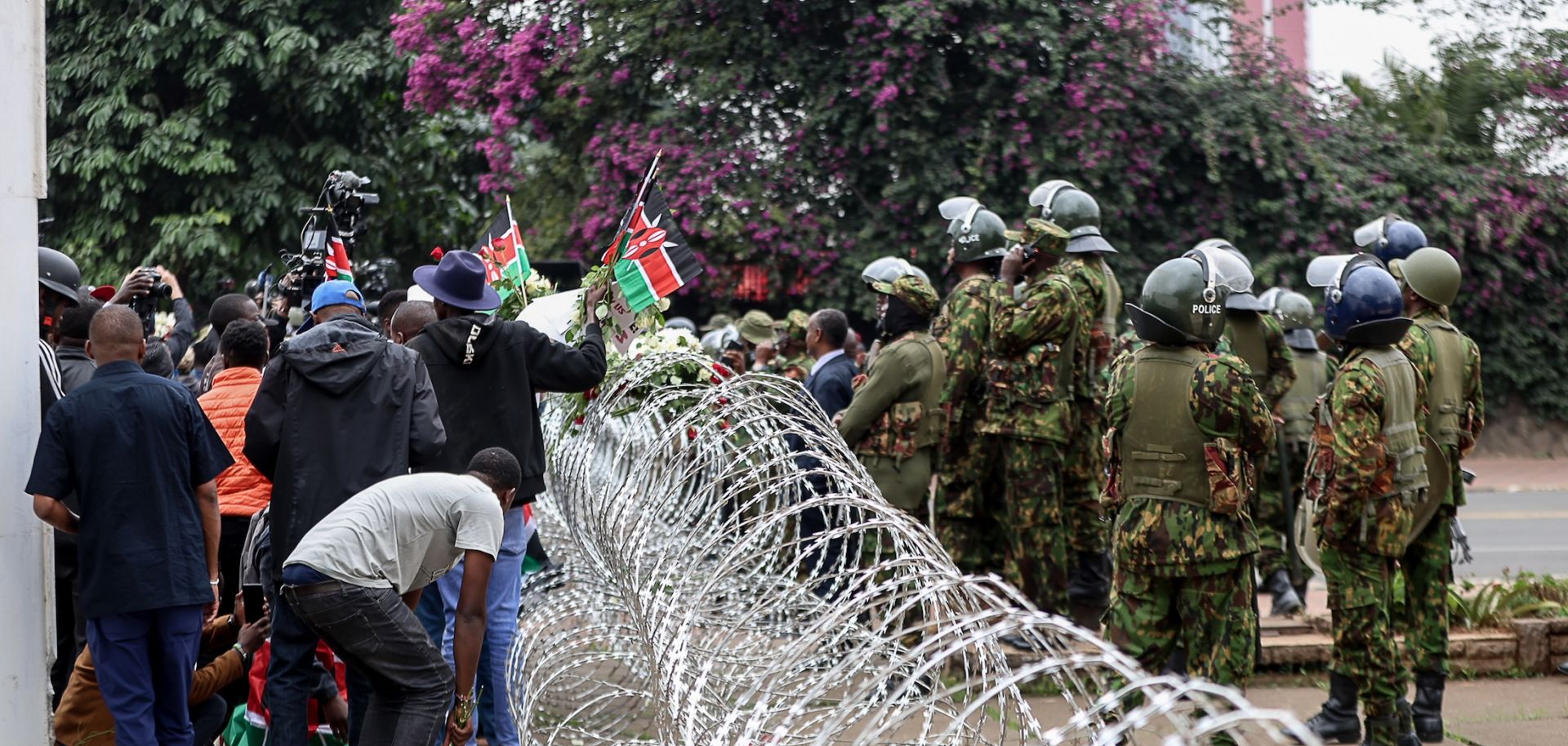
In Kenya, political tensions will deepen ahead of next year's general election, as President William Ruto seeks to shore up his flagging popularity, his opponents try to overcome divisions to unify and all sides brace for rising risks of violence. On June 25, Siaya County Gov. James Orengo, alongside other opposition leaders, joined Gen Z demonstrators marking the anniversary of mass anti-government protests in June and July 2024 and 2025, during which at least 127 people were killed by security forces. Although opposition figures have long participated in anti-government demonstrations, their involvement is particularly notable ahead of the August 10, 2027 general election, as they seek to build momentum against Ruto's administration. However, the opposition remains fragmented. Internal divisions have emerged within the Orange Democratic Movement (ODM), one of the main opposition parties, following the sudden death of leader Raila Odinga in October 2025. Since then, Orengo has led a faction that has adopted a more confrontational stance toward the government. By contrast, Raila's brother, Oburu Odinga, leads a rival faction that has pursued closer cooperation with the Ruto administration. This has reportedly included exploratory talks on possible pre-election cooperation ahead of the 2027 general election. Discussions are reportedly focused on ODM's representation and potential seat-sharing within a broader governing alliance.

- The 2024 protests were triggered by the Finance Bill 2024, which proposed tax increases on fuel, digital services and essential goods to raise revenue and reduce Kenya's fiscal deficit under an International Monetary Fund-backed reform program. However, the Gen Z-led demonstrations quickly evolved into a broader movement against the rising cost of living, unemployment, corruption, poor governance and perceived political elitism. The protests escalated after security forces responded with live ammunition and mass arrests, further eroding public confidence in Ruto, whose popularity has since declined amid ongoing economic hardship and accusations of authoritarianism.
- Other prominent opposition figures include former Vice President Kalonzo Musyoka, leader of the Wiper Democratic Movement and a leading presidential contender; former Interior Cabinet Secretary Fred Matiang'i, the Jubilee Party's official 2027 presidential candidate; and former Deputy President Rigathi Gachagua, leader of the Democracy for the Citizens Party (DCP) and one of the most influential political figures in the key Mount Kenya region. Despite their shared opposition to Ruto, competing presidential ambitions and the absence of a unified coalition continue to divide the opposition, leaving significant uncertainty over whether it can unite behind a single candidate capable of mounting a credible challenge to Ruto in the 2027 election.
- Orengo is backed by Edwin Sifuna, senator for Nairobi County and one of ODM's most prominent younger leaders. Sifuna, who was recently removed as the party's secretary-general, maintains that his ouster was unprocedural and illegal. He has emerged as a key voice in ODM's more confrontational faction, frequently criticizing cooperation with President Ruto's administration. Sifuna also mainly draws support from urban voters in Nairobi and segments of ODM's youth and grassroots base.
ODM divisions have split the party into a pro-engagement wing led by Oburu Odinga and a hard opposition bloc led by James Orengo, while wider opposition fragmentation and competing ambitions continue to block the emergence of a unified anti-Ruto coalition ahead of the 2027 election. The fracturing of the ODM is rooted in Raila Odinga's July 2024 political agreement with Ruto, which ended years of confrontation following the 2022 election and the 2024 anti-government protests. Framed as a "broad-based government" arrangement aimed at promoting national stability and advancing reforms after the Gen Z protests exposed deep public discontent, the deal saw several senior ODM figures appointed to Cabinet and other senior government positions. The party agreed to cooperate with the Ruto administration on key legislative priorities, such as economic recovery measures, anti-corruption reforms and institutional stability initiatives aimed at managing post-protest unrest. Although the agreement reduced political tensions between the ODM and the Ruto administration, it divided the party between those who viewed cooperation as a pragmatic way to influence government and those who argued it undermined the party's long-standing role as Kenya's principal opposition force. However, Odinga's death in October 2025 accelerated factionalization between a pro-engagement wing aligned with Oburu Odinga and a more confrontational bloc led by Orengo. Both sides are now competing for control of ODM's direction and its positioning ahead of the 2027 elections. More broadly, the opposition to Ruto has become even more fragmented since the president fell out with Gachagua in 2024. Gachagua was impeached and removed from office after a political breakdown within Ruto's Kenya Kwanza coalition, largely driven by tensions over control of the key Mount Kenya voting bloc, key to Kenyan elections, as well as accusations of ethnic favoritism and internal disagreements over patronage and economic policy. Following his ouster, Gachagua repositioned himself as a vocal critic of the government. He launched the Democracy for the Citizens Party (DCP), entrenching his role as a central figure in mobilizing discontent in the Mount Kenya region. At the same time, opposition realignment efforts have seen key alliances shifting. Musyoka has re-emerged as a leading opposition presidential contender and has engaged in talks with Gachagua and other opposition figures, reflecting attempts to consolidate anti-Ruto forces across ethno-regional blocs (Kalonzo's Ukambani base and Gachagua's Mount Kenya network). However, these efforts remain informal and fragile. Competing presidential ambitions continue to prevent the formation of a unified opposition coalition ahead of the 2027 elections.
- Kenyan elections have traditionally been shaped by regional and ethnic voting blocs — including the Kikuyu, Meru and Embu of Mount Kenya, the Kalenjin of the Rift Valley, the Luo of Nyanza, the Luhya of Western Kenya, the Kamba of Ukambani and some Coast Province communities. However, the electorate is now becoming more fluid. Younger and urban voters increasingly prioritize the cost of living, governance and corruption alongside traditional ethnic loyalties.
- ODM's strongest support base is in the western Nyanza region, particularly Siaya, Kisumu, Homa Bay and Migori counties, where it has historically dominated due to deep-rooted loyalty to the Odinga political network. In addition, ODM draws limited but consistent backing in urban informal settlements, especially in Nairobi, though its influence outside these areas is more dependent on coalitions rather than firm regional dominance.
The electoral calendar will put pressure on ODM leaders to choose a clear direction in their stance toward Ruto after next spring's primaries, but the risk of further splits ahead of next year's polls remains high. Divisions within the ODM will likely intensify before the party primaries, concluding on May 9, 2027, as rival factions compete for control of the party machinery and nominations ahead of the Independent Electoral and Boundaries Commission (IEBC)'s nomination window, between May 29, 2027, and June 11, 2027. The outcome of the primaries and subsequent party leadership decisions will determine which faction can consolidate control over ODM's official nomination structures and will therefore be able to issue party tickets going into the general election. Given that the IEBC is likely to recognize only candidates endorsed by the party's legally recognized leadership, this creates a political incentive for different ODM factions to unite to stand a chance of challenging Ruto's coalition. But this reality also means that some factions may seek to break away from the ODM before the IEBC makes its official recognition decisions. Even the ODM making it through the primaries intact would be unlikely to eliminate internal divisions, as the Orengo-led opposition wing could still reject formal alignment with Ruto and instead break away or realign with other opposition forces, hoping to gain a dispensation from the IEBC. Consequently, the risk of party fragmentation and broader opposition realignment is likely to persist regardless of which faction secures control of the ODM, while Ruto will continue to weaken the party's bargaining position through targeted co-optation of regional elites. The opposition faction winning control over the party would harden its stance against state collaboration, with Orengo, Sifuna and ODM lawmaker Babu Owino steering a more confrontational posture while drawing informal support from networks linked to former President Uhuru Kenyatta in parts of central Kenya. However, such an outcome would be unlikely to resolve the party's internal divisions. ODM leaders and ministers aligned with the pro-engagement faction could resist a strategic shift away from cooperation with Ruto, increasing the likelihood of defections or a formal party split.
- Sifuna, who is 44, appears to be the most plausible emerging long-term standard-bearer for a post-Raila ODM given his relative youth, national profile and appeal among urban voters. Orengo, 75, is more likely to serve as a transitional figure than a future presidential contender.
- By contrast, should the pro-engagement faction succeed in sidelining key figures such as Sifuna or further consolidate control of ODM's leadership structures, the Orengo-aligned Linda Mwananchi faction could choose to break away or align with another opposition platform before the primaries rather than contest a process it views as compromised.
Ruto will focus on shoring up his support in the ODM stronghold of Western Kenya to compensate for ebbing support in the Mount Kenya region following his split with Gachagua. Ruto is likely to retain a significant advantage heading into the August 2027 general election because of his access to state resources and opposition divisions, enabling him to continue co-opting regional elites despite declining public approval. Ruto's electoral support in Mount Kenya has weakened following his fallout with Gachagua, though he retains support among Kalenjins and ethnic Somalis in parts of northern and eastern Kenya. The president has lost support from his traditional Kalenjin base and urban youth due to socioeconomic grievances. Despite these challenges, Ruto is likely to remain the frontrunner unless the opposition successfully unites behind a single presidential candidate. Such a challenge would most likely take the form of a broad coalition combining ODM's anti-government wing led by Orengo and Sifuna, Musyoka's Wiper movement, Matiang'i's Kisii support base, former Justice Minister Martha Karua's influence in central Kenya and Gachagua's grassroots Mount Kenya network. Gachagua has already indicated that he would support the strongest opposition candidate rather than insist on running himself, improving the prospects of a negotiated unity ticket. Together, these leaders could consolidate support across both western and central Kenya, including the populous Mount Kenya region and potentially sections of the Coast. Such an alliance could also gain Kenyatta's backing, which would strengthen its financial resources and political networks. However, forging such a coalition is likely to be structurally difficult as coalition politics in Kenya is driven less by ideology than by elite bargaining over top government posts. These tensions are further amplified by competing presidential ambitions and the need to balance distinct regional voting blocs, making agreement on a single flagbearer and power-sharing framework inherently fragile. These precedents suggest that although a united opposition would significantly improve its electoral prospects against Ruto, maintaining cohesion through candidate selection and into the post-election period is likely to remain a major challenge. Failure to do so would likely leave Ruto's incumbency advantage intact and significantly improve his prospects of securing a second term.
- Key coalitions in Kenya have often ended in fragmentation. The National Rainbow Coalition, led by former President Mwai Kibaki as presidential candidate and formed as a broad alliance including Raila Odinga and other opposition leaders, defeated KANU under longtime President Moi in 2002, but splintered within three years over disagreements on constitutional reform and power-sharing. More recently, the National Super Alliance, which brought together Raila Odinga (ODM), Kalonzo Musyoka (Wiper), Musalia Mudavadi (Amani National Congress) and Moses Wetang'ula (Ford Kenya) for the 2017 election, fractured following disputes over strategy, leadership succession and Raila Odinga's 2018 rapprochement with then-President Kenyatta.
Kenya is likely to face election-related insecurity ahead of 2027 driven by the rising risk of targeted attacks, disruptive protests and opportunistic urban crime, all of which could disrupt public order, economic activity, transport and supply chains in the coming year. Kenya is likely to face heightened insecurity in the run-up to the election, driven by a combination of political violence, social unrest and opportunistic criminality. There will be a growing risk of politicians using organized groups to disrupt their rivals' rallies, public gatherings and civic events. These risks are likely to be exacerbated by corruption and political influence within the security apparatus, which could weaken deterrence and undermine impartial enforcement. Security agencies have also been repeatedly accused of excessive use of force during demonstrations and limited accountability, contributing to arrests, injuries and fatalities that risk further escalation in politically charged contexts. These dynamics increase the likelihood that future protests — particularly those involving Gen Z-led movements and allied political figures — could face a harsh police response, raising the potential of a cycle of escalation as political leaders seek to mobilize their respective youth bases. Urban criminal networks in Nairobi, Kisumu and Mombasa may increasingly be instrumentalized or exploited to intimidate opponents, disrupt campaign events or weaken perceptions of state control, further blurring the boundary between criminal activity and political violence. There will also be a heightened risk of opportunistic looting and vandalism, particularly in crowded public spaces, during periods of mass mobilization. This would disrupt supply chains, transport networks and commercial activity, while increasing pressure on security personnel and emergency response systems.
- According to Interior Cabinet Secretary Kipchumba Murkomen in May, more than 100 organized criminal gangs are operating across Kenya. Many have evolved from loosely organized youth groups into decentralized criminal networks, operating primarily in urban centers but increasingly expanding into peri-urban and rural areas. Authorities have warned that some are allegedly patronized by politicians to mobilize supporters, intimidate rivals and disrupt political events. They also engage in drug trafficking, extortion, illicit alcohol sales, land-grabbing and kidnappings.
- On April 6, during a church service in Nairobi's Eastleigh area, Gachagua alleged that gangs disrupted the event in what he claimed was a politically motivated attack involving Nairobi Gov. Johnson Sakaja and Ruto's allies, prompting his security detail to fire shots to disperse the assailants. He claims this was just the latest in a pattern of similar attacks on him since his October-November 2024 impeachment, including an attack on his convoy in November 2024.