
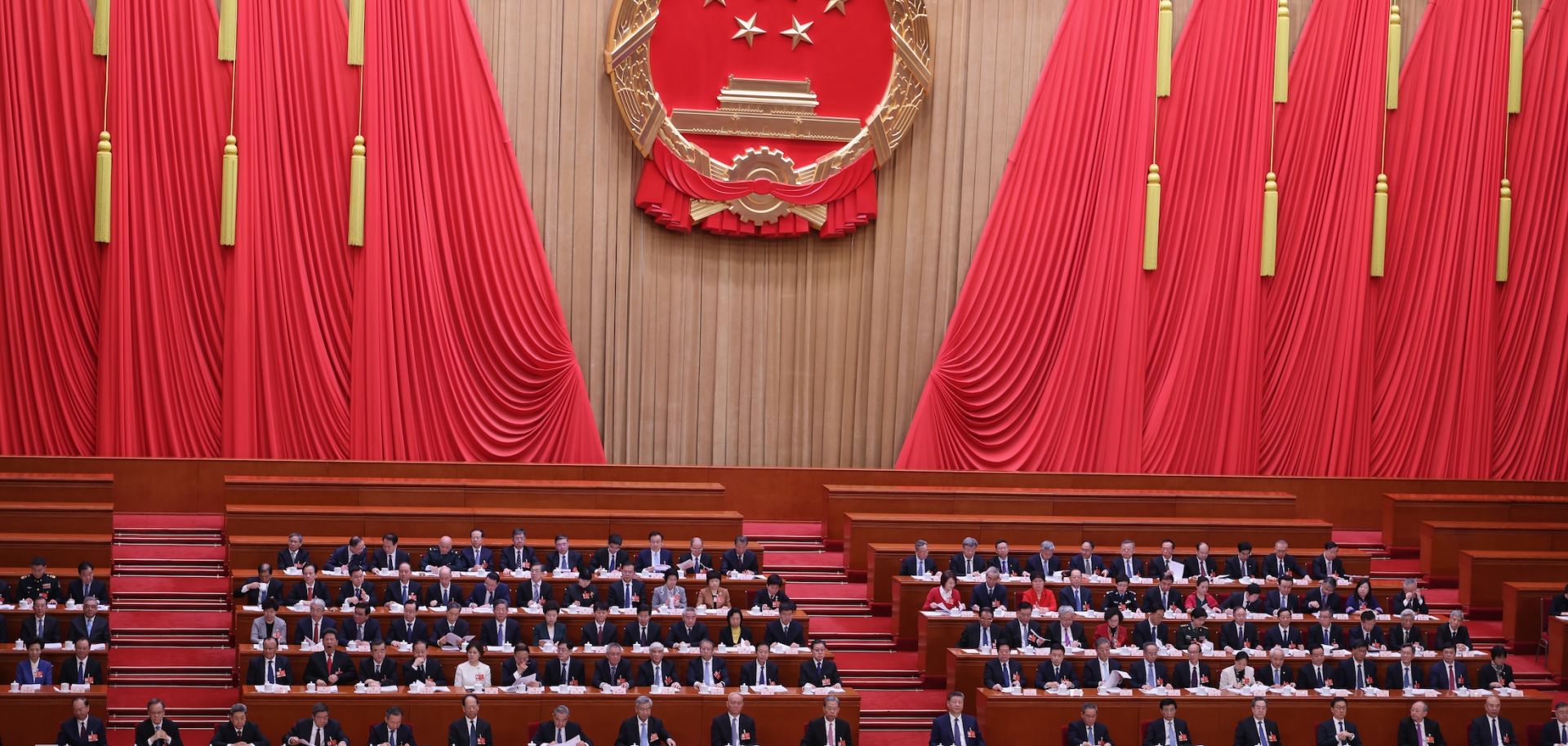
Chinese President Xi Jinping (center) and Premier Li Qiang attend a plenary session of China's National People's Congress (NPC) at the Great Hall of the People on March 9, 2026, in Beijing, China.
(Lintao Zhang/Getty Images)
Chinese President Xi Jinping (center) and Premier Li Qiang attend a plenary session of China's National People's Congress (NPC) at the Great Hall of the People on March 9, 2026, in Beijing, China.

On June 17, China's State Council released the "15th Five-Year Plan for Implementing the Employment-First Strategy" (FYP), intended to supplement the 15th FYP for economic development, released in March and the key guiding document for China's economic policy from 2026-2030. The employment FYP lays out both job market challenges and Beijing's goals for managing a massive and quickly aging working population, estimated by China's National Bureau of Statistics to number 851 million people in 2025, down 0.8% from 2024. It places a particular emphasis on wielding new technologies, like AI, to boost employment while minimizing job destruction. The FYP was published as Beijing seeks to revive consumption levels following the COVID-19 pandemic, alleviate societal discontent over growing wage inequality and seemingly shrinking job opportunities and deter youth protests. On this latter point, college students disgruntled by poor economic conditions have been the key drivers of some of China's largest protest movements, including the White Paper protests of November 2022 and the infamous Tiananmen Square protests and bloody crackdown of 1989. Once again in China, youth unemployment and underemployment are steadily rising, raising Beijing's concerns about societal and political stability.

The plan, as a whole, is not meant to answer how exactly Beijing will pursue employment-related policies over the next five years; that answer will reveal itself slowly as Beijing releases annual economic plans, as well as ad hoc and long-planned regulations. Rather, the FYP signals what is important to Beijing and which employment-related policies businesses and local officials should adopt to stay in Beijing's good graces. Reviewing the employment FYP, including some of its contradictory goals, can help give early insights into Beijing's mindset about economic policy, including the prioritization of stability above growth when the two are at odds. Compounding employment, demographic and economic pressures have raised the stakes for policymakers to maintain leadership legitimacy by showing citizens that their policies are working in a political system devoid of elected representation.

Employment: The Foundation of Governance and Growth

As early as 1986, previous employment FYPs had been titled either "Employment-Promotion" or "Career-Development" plans. However, the latest plan is titled an "Employment-First Strategy," clearly indicating a prioritization of employment above other economic goals. The opening section of the document frames employment as critical to achieving some of the top policy priorities of the Chinese Communist Party (CCP), including President Xi Jinping's concepts of a "people-centered development approach," in contrast to focusing on headline growth, and "high-quality development," versus China's earlier rapid but volatile growth path. It also calls preventing large-scale unemployment risks "the bottom line", a reference to Xi's slogan since 2013 that cadres should adopt "bottom-line thinking" to forestall the greatest threats to CCP rule. This aligns with recent signaling in the 2026 Government Work Report, which serves as an annual progress update and implementation plan for the FYPs. The report listed keeping the urban unemployment rate at "around 5.5%" as the second item in a list of "main expected goals" for 2026, behind only hitting a GDP growth rate of 4.5-5.0%. The priorities are again illustrative. When the CCP lists its goals in policy documents, usually the top items are of critical importance, indicating both a greater government intent to facilitate this goal with regulation and a higher likelihood of engendering compliance, coercively if need be, by local officials and businesses.

Just as importantly, China's employment environment directly affects businesses working in or serving the Chinese market, with real-world impacts beyond CCP regime stability. Labor supply and demand are increasingly mismatched, a potential roadblock to China's tech innovation plans. Many college graduates are unable to secure work in their chosen fields, while factories and tech companies are unable to find sufficient skilled labor in emerging fields. This supply disparity is intimately tied to Beijing's concerns about youth unemployment and social unrest. Add to this other disparities between inter-regional labor markets and between whole classes of employees — the one-third to one-half of urban residents who are migrant workers in China's largest cities — and understanding China's shifting employment situation is critical to tracking how the economy and the business environment will develop. Reviving consumption, one of Beijing's chief economic goals in the post-COVID-19 era, hinges on a shift to "high-quality" employment — i.e. better wages, more benefits and more job stability — for China's lower class (including migrant workers), who are responsible for the majority of national consumption growth. Another chief goal, reviving the ailing real estate market, is tied to employment, as Beijing's primary policy for soaking up excess real estate supply is housing migrant workers in both government- and private-run rental properties, a policy that is only possible if migrants are employed and compensated sufficiently to pay their rent.

Priority Sectors: Expectations Versus Realities

To facilitate these ends, the FYP delineated in what sectors, businesses and populations the government will focus its employment-promotion work. The sectoral emphases illustrate Beijing's industrial policy priorities and areas where the CCP's employment concerns are the most acute. These priority areas include advanced manufacturing, modern services, sectors that support rural revitalization and small- and medium-sized enterprises (SMEs), which employ the vast majority of Chinese workers. In manufacturing, the plan called for more high-tech jobs in factories as well as in supporting roles, like logistics and supply chain companies. It also urged authorities, businesses and universities to cultivate talent in emerging strategic industries like aerospace, new materials and flying vehicles, as well as in future industries like embodied intelligence, biomanufacturing and hydrogen energy. 

The FYP pointed to infrastructure as a source of employment for China's low-skilled, rural workers, highlighting in particular transportation, water conservancy, new energy systems and construction projects — areas which will enjoy elevated central funding while China's real estate sector (and related employment) remains depressed. With the same aim — employing China's most disadvantaged populations — the plan urged more employment in poorer geographies like central, western and northeastern China, as well as in ethnic minority and border areas. To that end, the plan urges businesses and entrepreneurs to consider work and investment in rural and inland areas. In services, the plan called out elderly care, health care and child care as key areas for employment promotion. With China's aging population, the first two are expected to see demand growth while the third will see demand fall, but all are critical to Beijing's efforts to cope with and reverse China's demographic decline. The plan also calls for boosting cultural and tourism services and related sectoral employment as part of Xi's efforts to bolster China's soft power and support retail sales in dining and other tourism-adjacent sectors. 

For all of these goals, Beijing will see mixed success in bolstering employment in key sectors. Business activity and employment will, in all likelihood, remain weak in China's inland and rural areas, given their paucity of services and infrastructure and industrial agglomeration on the coasts. Likewise, though some Chinese movies, games and toys will continue gaining traction, China will remain well behind cultural export leaders like South Korea and Japan. China will likewise remain a second-tier destination for Western tourists, constraining employment gains. By contrast, employment in medical and elderly care will thrive, as China's aging population is increasing demand for these services. In all of these sectors, regardless of their prospects for success, Beijing will provide easier access to state subsidies, research facilities and cheap land and capital, as well as smoother business licensing, investment approval and visa procedures for domestic and foreign companies. Beijing will generally prioritize policy support for Chinese companies, but in sectors where domestic offerings are limited, foreign companies that bolster employment will receive particularly favorable treatment.

The Costs to Businesses of Employing the Masses

The plan will likely lead to higher costs for businesses, particularly state firms and platform giants, as Beijing presses them to expand employment and improve benefits. Other industries will also face pressure from China's umbrella union, the All-China Federation of Trade Unions, and from state negotiators. In the public and private sectors, the plan promises to expand policy support for industries that contribute most to boosting employment, to use employment absorption capacity as a key metric for prioritizing investment projects and to establish a state evaluation system for reaching high-quality, full employment. Companies that aim to stay in Beijing's good graces will need to outline their plans for at least maintaining, if not expanding, employment, despite factory automation and supply chain diversification. The public sector, already growing under Xi, will bear the brunt of this push to boost employment, particularly the seasonal employment of recent college graduates. 

Still, the private economy will not be immune to Beijing's policy expectations and the higher labor costs driven by this push for better wages, benefits and more stable employment. The plan explicitly calls on the platform economy — which mainly refers to e-commerce giants like Alibaba, Tencent, JD.com and Pinduoduo — to "generate more job opportunities," "formulate labor rules fairly" and "pay wages in full and on time." This signals that, as during other recent regulatory pushes like the government's crackdown on destructive price competition, Beijing will focus its political guidance and regulations on adjusting the hiring practices of platform giants. This is due to the relative ease of enforcement in an oligopolistic industry and due to platform companies' integration of services and products with myriad other industries. The plan also noted that Beijing would promote collective bargaining by China's single umbrella union and strengthen "macro-guidance" (national policy), pushing companies to rectify wage imbalances, such as between senior and junior employees and contracted and non-contracted workers. Likewise, it pledged to "strengthen tripartite mechanisms for coordinating labor relations," suggesting more direct government involvement in wage negotiations. In such negotiations, government officials are likely to privilege the demands of labor over management, so long as they do not conflict with Beijing's industrial development policies.

The Underemployed: Keeping Tabs on Students and Migrants

The plan focused employment support measures on college graduates and migrant workers, groups that pose both risks to regime stability and opportunities for consumption growth. The document called for a 100-day recruitment drive for 10 million college graduates and a 100-day online recruitment drive for SMEs to hire graduates. Both efforts aim to stem the yearly spike in unemployment that aligns with 12-13 million college graduates hitting the summer job market, and the goal — 10 million employed in 100 days — is certainly ambitious. In the likely event that youth unemployment continues to rise steadily despite the FYP, unrest will likewise grow, driving greater efforts by Beijing to surveil and suppress restive youth. The plan also pledges to pressure government agencies, state-owned enterprises and "leading enterprises" (likely a reference to e-commerce and gig economy giants like Alibaba and Tencent) to hire more college graduates. Relatedly, it laid out a propaganda campaign to weaken the stigma against college graduates working in "grassroots level" jobs, a reference to gig economy jobs as well as employment in factories and rural areas. Besides seeking to avoid the unrest that stems from unemployment, this speaks to Beijing's concerns about labor market supply-and-demand imbalances that could undermine export industries and tech innovation. Similarly, the plan asserted that Beijing would guide universities to align college majors with industry needs through real-time job market monitoring, and it pledged to link state funding and enrollment quotas to related graduate employment outcomes. Relevant for both youth and migrant workers, the plan repeatedly referenced the need to register and monitor the underemployed and unemployed, ostensibly to provide them with career and stopgap employment services, but this will also facilitate public security efforts to track restive populations and preempt protests.

The portions of the plan pertaining to rural migrant workers focused on clearing employment barriers and expanding social benefits to boost consumption, but they are also intended to curb social unrest. Migrant workers suffered disproportionately from the employment destruction of the COVID-19 pandemic, and migrants helped grow the ranks of youth-led protests against lockdowns during this time. The plan pledged to loosen restrictions on migrant workers' access to urban social services, housing and formal employment under the decades-old Hukou system, which ties a person's right to work to their place of origin. Likewise, it promised to improve the benefits and social services available to people with flexible employment, such as in food delivery and livestreamer retail positions — sectors in which Beijing has already expanded labor protections. Many of these policies for employing college students and migrants will face slow implementation, however, as they ultimately rely on funding from cash-strapped local governments. Furthermore, local governments that force employers to expand benefits risk companies relocating to other provinces, depriving authorities of tax and land revenues that could fund social services. Though Beijing has long sought to loosen Hukou restrictions, it does not wish to eliminate the system altogether, as it facilitates control of labor flows, allowing Beijing to encourage migrant workers to settle in smaller, less developed cities that are also facing the greatest oversupply issues in real estate. Thus, Beijing's pressure to expand services and benefits for migrant workers and gig economy workers will remain greatest in these smaller cities, allowing companies and officials in Tier 1 cities to largely avoid costly Hukou reforms. 

An Uneasy Balance Between AI and Employment

Lastly, throughout the plan, Beijing was of two minds on AI: pushing the technology's applications across all sectors to boost productivity and create new jobs, but also expanding monitoring and regulations to mitigate the risks of AI-driven job destruction and related unrest. The plan pledged to guide China's massive public research and development funding toward AI applications with high job-creation potential, including emerging fields like embedded intelligence. It also aims to apply AI to primary and secondary industries to bolster the efficiency of leviathan state firms, support workplace safety and fill jobs in high-risk environments, likely in an aim to defuse public discontent over a surge in workplace incidents in recent years. In line with labor ministry pledges earlier in 2026, the plan called for establishing monitoring and assessment systems to understand the impacts of AI on employment. If recent court cases related to AI job replacement in tech hubs like Hangzhou (the headquarters of Alibaba) and Guangzhou are any indication of policy direction, Beijing will eventually use these systems to require that companies first attempt to retrain or reallocate workers before proceeding with demotions or layoffs related to AI implementation. As with the plan's employment and benefits promotion schemes, enforcement of employment preservation schemes related to AI adoption will likely focus on household-name domestic companies with large payrolls, like Alibaba and Tencent. 

By targeting domestic firms, Beijing is seeking to preserve China's attractiveness to foreign businesses. Targeting only the most affluent and innovative Chinese companies also allows Beijing to set the corporate standards on AI adoption. Still, if large Western firms in China threaten to eclipse their Chinese competitors by enabling greater AI-related job displacement, or to hollow out the business of Chinese upstream suppliers by rapidly offshoring to slimmer, more AI-integrated foreign suppliers, Chinese regulators could levy fines to deter such behavior. They could also wield recent regulations aimed at curbing supply chain diversification out of China to impose import or export bans or visa restrictions. The diversity of industries and vast number of firms in China suggest Beijing will not be able to stop AI-related job displacement at large or to guarantee that AI creates more jobs than it destroys, but Beijing's aim is to signal that if companies apply AI at the expense of employment, there will be political costs in addition to budgetary savings. 

Domestic and foreign firms can expect China's balancing act between the industrial advancement and job destruction aspects of AI to be a cat-and-mouse game, with regulation by necessity lagging behind negative employment impacts. Likewise, given how quickly Chinese industries are adopting AI compared with their Western counterparts, China is in uncharted regulatory territory, further supporting a reactive stance. Political stability — which is undergirded by societal stability — is paramount in China, particularly under Xi, so if layoffs start to propagate within and among industries, Beijing will likely impose temporary moratoria on AI applications or restrictions on entire use cases of AI as it seeks to master this balancing act, raising regulatory uncertainty (relative to its already high uncertainty in China) for AI applications.

No Silver Bullet: China's Race Against the Employment Clock

The primary utility of this employment plan, as with all other supplemental plans to the national FYP, is to serve as a signaling tool for Beijing's employment policy priorities for 2026-2030 to businesses and officials at the ministerial and local levels. Thus, it is difficult to say from the document alone exactly how Beijing will pursue each of these goals and what success China will have at the national or industry level. As outlined above, many of the employment goals work at cross-purposes, like upgrading China's industries with AI while simultaneously limiting youth and overall unemployment. Furthermore, as with other Asian powers facing rapidly aging populations — like Japan, South Korea and Taiwan — China has no silver bullet for optimally employing its dwindling working age population in the long term. Prior to the rapid spread of AI, however, cross-regional migrant flows were projected to preserve a growing urban workforce in China's Tier 1 and Tier 2 coastal cities, the growth engines of the economy, through the mid-2030s. Though AI has likely shortened this timeline, China still has years to experiment with policies like Hukou reform, youth employment schemes and rectifying imbalances in labor supply and demand before employment pressures undermine topline economic growth. Given the stakes for social stability and China's long-term development, Beijing is likely to employ an increasing number of punishments, in addition to the current slew of recommendations and inducements, to fulfill these goals as this employment inflection point approaches.

RANE
SUBSCRIBERS ONLY

Expert analysis when it matters most.

Get access to RANE's decision-grade geopolitical intelligence.
