
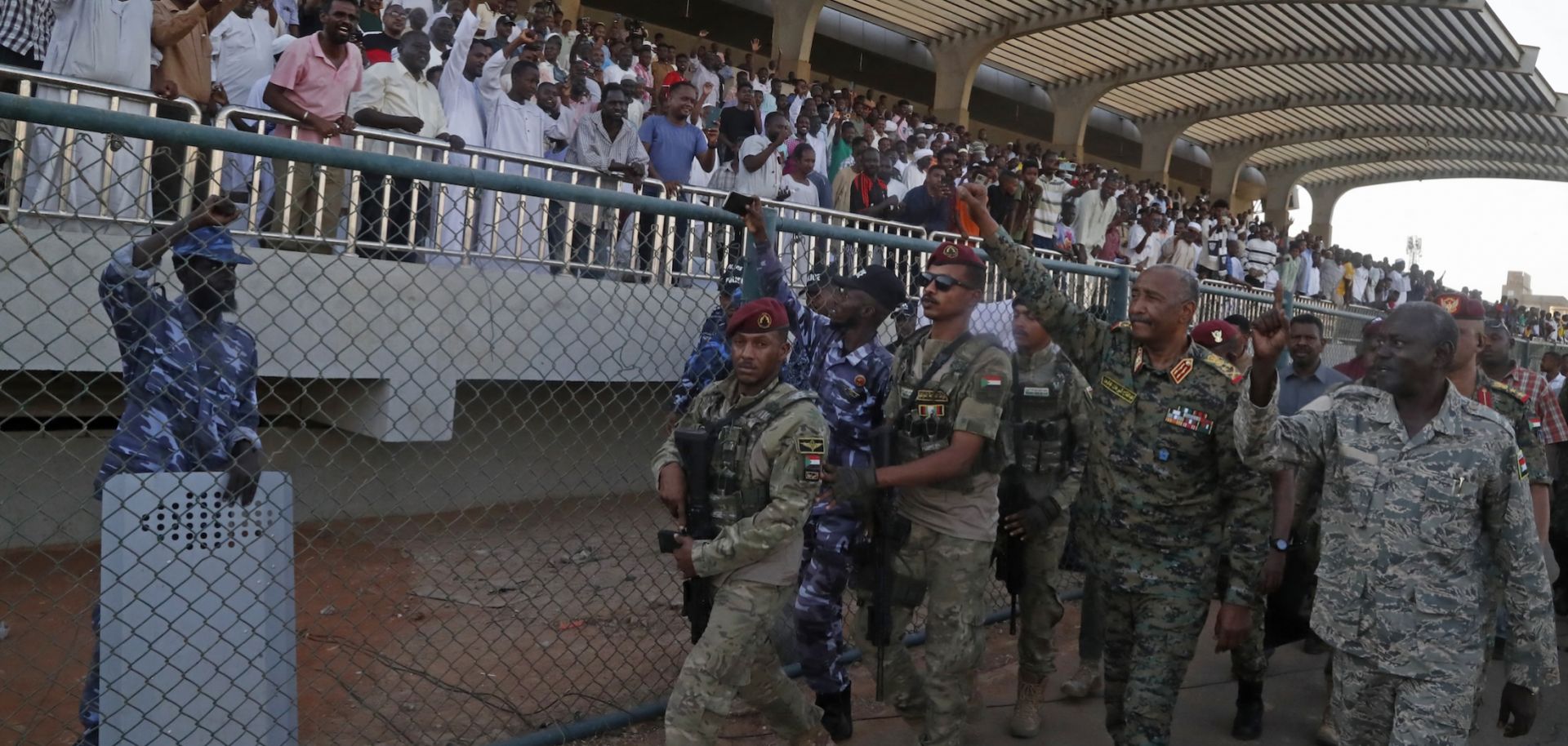
Sudan's de facto leader and army chief, Abdel Fattah al-Burhan, waves to spectators after attending a soccer match at Kober Stadium in Khartoum on May 15, 2026.
(Ebrahim Hamid / AFP via Getty Images)
Sudan's de facto leader and army chief, Abdel Fattah al-Burhan, waves to spectators after attending a soccer match at Kober Stadium in Khartoum on May 15, 2026.

An offensive by Sudan's paramilitary Rapid Support Forces, or RSF, on the city of El Obeid is unlikely to result in the United States imposing decisive sanctions on the group's support network due to Emirati lobbying, aggrieving the rival Sudanese Armed Forces, or SAF, and curbing the prospect of a nationwide humanitarian truce in the coming months. Since mid-June, the RSF has massed forces around El Obeid, the capital of Sudan's North Kordofan state, and escalated drone attacks on the city, including energy infrastructure, civilian facilities and SAF military sites. This comes as the paramilitary group has secured new military equipment in recent months, including technical vehicles and armored cars, almost certainly with the backing of its main foreign patron, the United Arab Emirates. The rapid deterioration of humanitarian conditions around El Obeid in recent weeks has triggered renewed international backlash against the paramilitary group, with seven European countries warning on June 23 that an RSF land offensive on El Obeid appeared "imminent." Against this backdrop, on June 26 the U.S. Treasury Department announced new sanctions on eight people and entities linked to the RSF's recruitment of Colombian mercenaries and the SAF's military logistics. Washington also reiterated its demands for the two warring parties to accept an unconditional three-month humanitarian truce.

  • The June 26 U.S. sanctions notably targeted retired Colombian military officer Alvaro Andres Quijano Becerra, who the U.S. Treasury says has been leading the recruitment of former Colombian soldiers in Sudan. An estimated 300 to 400 Colombian mercenaries are assessed to be fighting for the RSF, funded by Emirati-linked financing, supporting the RSF by operating drones and artillery.

The RSF's apparently imminent offensive on El Obeid comes as international mediation efforts have stalled due to the SAF's maximalist position and diplomatic focus shifting to Iran, while the RSF's recent offensive in the southeastern Blue Nile State is losing momentum. In September 2025, the United States, Egypt, Saudi Arabia and the United Arab Emirates moved forward plans to de-escalate Sudan's civil war, starting with a three-month humanitarian truce, followed by a permanent ceasefire and nine-month transition period. Although the RSF nominally accepted the proposal in November 2025 following its capture of the eastern city of El Fasher, the SAF has continuously rejected these plans. SAF leader Abdel Fattah al-Burhan insisted as recently as June 27 that the army would not enter peace talks with the RSF unless the paramilitary group dismantled its forces. Meanwhile, the outbreak of the Iran war in late February resulted in mediation efforts being deprioritized as both Washington and its Arab partners shifted their focus to Tehran. But while Saudi Arabia appears to have scaled back some support for the SAF, the United Arab Emirates has sustained its military support for the RSF. Abu Dhabi appears to have scaled up its provision of military equipment to the RSF through Ethiopia over the past year, setting the stage for the paramilitary group to launch an offensive in Blue Nile State in January. This enabled the RSF to seize the strategic border town of Kurmuk in March and then progress north in the direction of Ad-Damazin, Blue Nile state's capital. However, RSF momentum has largely stalled over the past two months, as the SAF reinforced its position and successfully recaptured several localities.

  • The RSF capturing El Obeid would strengthen its position in Kordofan and decisively weaken SAF positions in the area, potentially setting the stage for RSF progress toward the southeastern White Nile State in the medium term.

The RSF's offensive on El Obeid will initially focus on fully besieging the city and could cause a new humanitarian catastrophe, but Emirati lobbying will likely dissuade the United States from imposing decisive sanctions against the paramilitary group, aggrieving the SAF and making a nationwide humanitarian truce in the coming months less likely. The RSF's massing of troops and drone attacks on SAF logistics in the El Obeid area indicate that the paramilitary group is likely to press ahead with a ground offensive on the city in the next few months. The RSF is likely to initially focus on fully encircling El Obeid by seizing positions along the westward route connecting it to the cities of Er Rahad and Kosti, the last major axis for the SAF to supply its units in El Obeid by road. The ensuing siege of the city would force SAF units to rely on aerial supplies. Even if the SAF were to succeed in maintaining control of the El Obeid-Kosti route, escalating RSF attacks could cause a humanitarian catastrophe, with a siege of El Obeid potentially resulting in tens of thousands of fatalities. While the offensive on the city will lead to mounting international backlash against the RSF, Emirati lobbying will likely dissuade the United States from imposing decisive sanctions against the paramilitary group. The United Arab Emirates has doubled down on its security and economic partnership with the United States following the outbreak of the Iran war, shoring up Abu Dhabi's status as one of the most reliable U.S. allies in the Middle East when other Gulf Arab countries are reassessing their relationships with Washington. Given the RSF's importance to Abu Dhabi's broader strategic agenda in northeast Africa, this suggests that U.S. President Donald Trump's administration is unlikely to decisively increase pressure on the paramilitary group's support network, such as secondary sanctions on its weapon suppliers, in order to preserve its partnership with Abu Dhabi. Together with recent U.S. sanctions on the SAF, this is likely to reinforce the SAF leadership's perception that Washington is biased against it. While the international focus on El Obeid means the warring parties could set up humanitarian corridors to and from the city, the SAF is unlikely to drop its maximalist position as it seeks to project resolve against the RSF. This will further undermine Sudan's peace process and limit the prospects of a nationwide humanitarian truce for the next few months.

  • Democratic lawmakers in the U.S. Congress have advanced legislation to block U.S. arms sales to the United Arab Emirates while it continues to provide material support to the RSF. However, these bills have made little progress as they largely do not enjoy the support of most Republican lawmakers.
RANE
SUBSCRIBERS ONLY

Expert analysis when it matters most.

Get access to RANE's decision-grade geopolitical intelligence.