
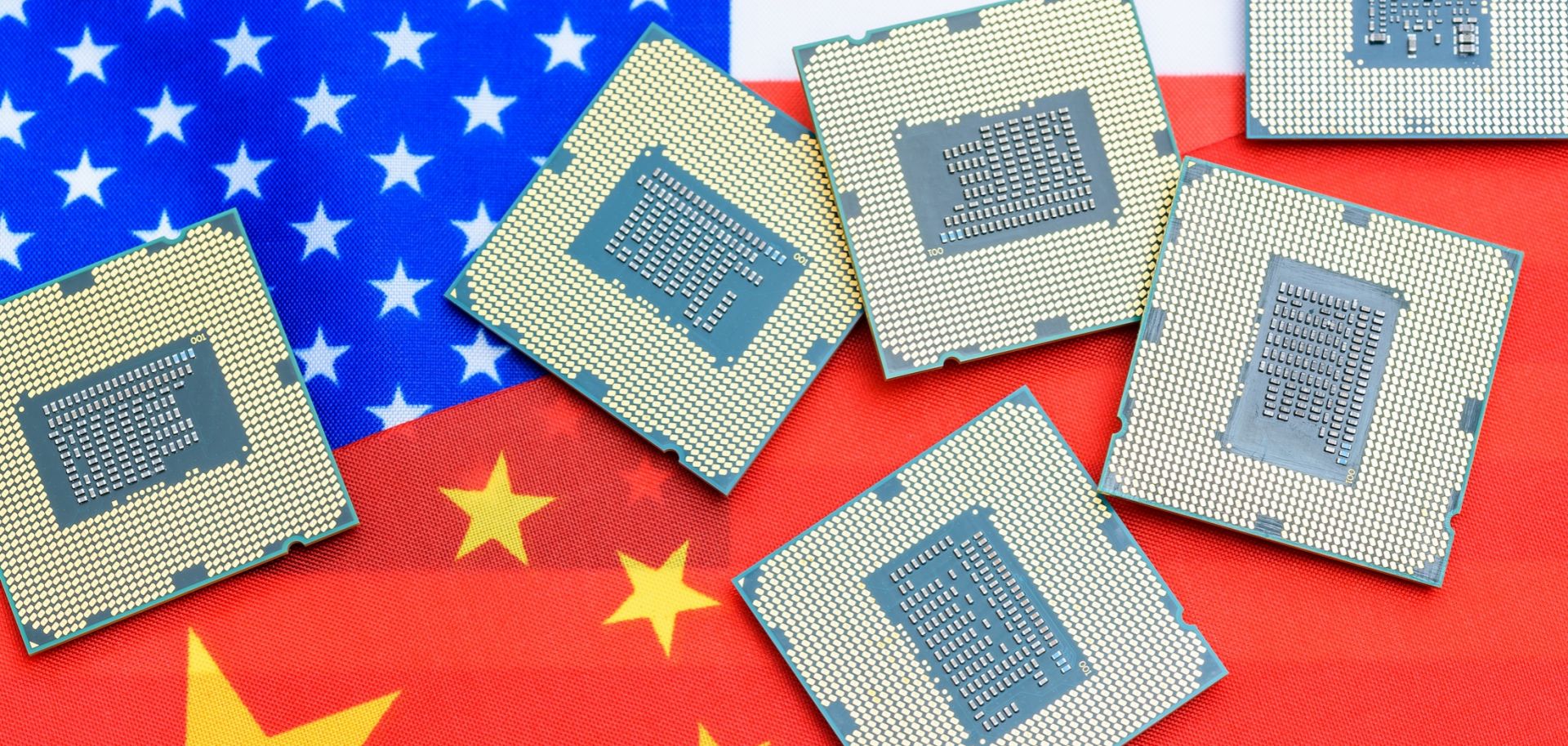
Computer chips are seen on top of the U.S. and Chinese flags.
(Getty Images)
Computer chips are seen on top of the U.S. and Chinese flags.

Recent Trump administration moves to limit the public release and export of frontier AI models represent a shift that threatens to slow U.S. innovation and hand Chinese rivals a victory in the development and foreign sale of competing models. On June 26, U.S. artificial intelligence firm OpenAI confirmed media leaks that, under pressure from the Trump administration, it would initially roll out its newest GPT-5.6 series of models only to a limited number of trusted entities vetted by the federal government. OpenAI said it did not "believe this kind of government access process should become the long-term default," but said its decision was the best way to work with the Trump administration to facilitate wider access in the future. The same day, rival Anthropic said that the Department of Commerce had similarly cleared it to release its flagship Mythos 5 cybersecurity model to a small set of government approved organizations, after a two-week standoff that had resulted in the firm suspending access to that model (and another, Fable 5, which remains inaccessible) for all users after the Commerce Department abruptly imposed export license controls on June 12. Meanwhile, on June 23, The New York Times reported that the Trump administration has been pressuring Meta to submit its models to voluntary review, as it is the only major U.S. tech firm that has yet to do so. 

  • The Commerce Department's decision was triggered by Amazon sharing a report with the White House in which its researchers described how they were able to "jailbreak" (i.e. bypass guardrails in) Anthropic's Mythos 5 model. The Trump administration then cited national security concerns to block Mythos 5's (and Fable 5's) availability to foreign users. But due to its inability to fully verify all users' nationality, Anthropic instead suspended access to the models for all customers. While Amazon and Trump administration officials have said the vulnerability was significant, Anthropic has downplayed its severity and argued it cannot reasonably guarantee that any model is completely immune to hacking, prompting a legal tech firm to file a lawsuit on June 23 challenging the government's authority to impose such restrictions.
  • According to an unnamed source familiar with the matter cited in a June 25 Axios article, the White House intervened with OpenAI because GPT-5.6 has "Mythos-like" capability. Since the original Mythos was rolled out in April, it has gained a reputation for being highly adept at finding vulnerabilities in digital networks and increasingly being able to exploit them, spiking cybersecurity concerns across the globe. 
  • On June 2, U.S. President Donald Trump signed an executive order giving federal authorities 60 days to create "a classified benchmarking process" to assess advanced AI models' capabilities, including to determine the threshold for what models would qualify as "covered frontier models." Developers of such models would be given a 30-day window to give the federal government early access, but the order says this is voluntary.

The recent moves represent a shift from the Trump administration's previously more laissez-faire approach to AI regulation, as it tries to balance AI competition with China against national security threats. President Trump came into office promising to reverse what he characterized as former President Joe Biden's stifling of AI innovation, saying that unshackling AI labs from regulation was crucial for national and economic security, particularly to compete with China. Among other things, Trump signed an executive order in December 2025 that directed the Department of Justice to establish a task force to challenge state AI regulations in federal court, and in March 2026, the White House released an AI framework that strongly favors innovation over regulation. The more recent June executive order was framed as promoting AI innovation, with the final text even narrower on regulation than earlier leaked drafts suggested. The recent pressure on Anthropic, Meta and OpenAI thus represents something akin to an about-face for the Trump administration, which is now apparently just as, if not more, concerned about the uncontrolled release of highly effective cybersecurity models that could be exploited by China or other rivals as it is about giving AI developers wide latitude for innovation. This illustrates how the White House is currently caught in a balancing act between two competing priorities: the desire to nurture AI labs' development of frontier models to try to stay ahead of increasingly competitive Chinese ones, and the need to ensure that those same models cannot be exploited by China and other cyber threat actors.

  • According to multiple rankings, Chinese AI labs' best models are becoming increasingly sophisticated and cost a fraction of the frontier models developed by U.S. competitors. Most recently, Chinese firm Z.ai's GLM-5.2 model has been found to be nearly on par with the leading U.S. models at finding cybersecurity vulnerabilities (though behind in other areas) while costing about half as much to run.
  • In addition to concerns about China and other foreign countries gaining access to the most advanced cybersecurity models, U.S. AI developers have repeatedly accused Chinese developers of carrying out distillation attacks, in which hackers submit a large volume of fake queries to improve certain capabilities of frontier models.
  • The Trump administration has had a particularly contentious relationship with Anthropic, which pushed back against what it characterized as the Department of Defense's desires to use its models to facilitate mass surveillance and fully autonomous weapons. Earlier this year, this led the Pentagon to declare Anthropic a "supply chain risk to national security," effectively barring anyone doing business with the military from working with the company. Although parts of the U.S. federal government have continued to use Mythos, Trump administration officials have repeatedly clashed with Anthropic since then.

A continuation of the Trump administration's more restrictive approach to frontier AI models risks slowing U.S. innovation, giving China more time to close the gap with the leading U.S. developers and further facilitating the worldwide adoption of Chinese models, including in European countries. The U.S. restrictions on access to Anthropic's and OpenAI's frontier models effectively amount to a licensing regime that, in the absence of a clear clearance process (which, according to the June 2 executive order, is meant to be voluntary, not mandated), has sent chills across leading AI labs. Although the limits are meant to ensure the security of the models, and even though the Trump administration will likely eventually give developers a green light to release their models more widely, further ad hoc moves along these lines threaten to slow U.S. innovation. This is because the abruptness of the federal directives, opaqueness about authorities' concerns, lack of clarity on a path to remediation and charges that the Trump administration is playing politics with certain companies would send a signal to developers that their best models may remain in a state of effective purgatory for a potentially prolonged period (as remains the case for Anthropic's Fable 5). To be sure, the June 23 lawsuit and potential future lawsuits challenging the government's authority to impose export controls on Anthropic's and other frontier models may eventually force the White House to recalibrate. However, as demonstrated by its tariff policy, the Trump administration would likely try to find new ways to replicate its regulatory ability, even if only via informal pressure, as seen in its current pressure on Meta to provide its models for ostensibly voluntary review. Thus, a continuation of the current regulatory agenda would undermine the economics behind frontier model development, which requires massive upfront costs (and use of foreign talent) in the hopes of selling access across the globe. The immediate beneficiary of such a development would be China, whose firms would find it easier to close the already narrowing AI gap with the best U.S. models. Chinese firms would also find it comparatively easier to spread their models abroad. Already, they have the upper hand in large parts of the developing world, where paying for Chinese models that are, in many cases, rapidly becoming nearly as good as the leading U.S. ones but cost far less is highly attractive. Further U.S. limits on frontier model exports would also give China greater inroads into rich markets like Europe, where growing concerns about overreliance on U.S. tech would only be amplified by additional U.S. export restrictions on the best models.

  • Underscoring Europe's vulnerabilities, the United Kingdom's AI Security Institute is reportedly the only non-U.S. entity approved by the Trump administration for access to OpenAI's new GPT-5.6 model. While further U.S. export restrictions would undoubtedly add to calls for European countries to develop so-called "sovereign AI," European firms face significant limits in terms of securing sufficient investment and talent (including both U.S. employees and technology), wading through a much stricter regulatory regime and being able to scale, among other challenges.
  • Chinese companies already dominate the field of smaller open-weight models, such as GLM-5.2, whose core parameters (i.e., weights) are publicly released. This means they can be downloaded and run on hardware operated anywhere, enabling their much wider customization and, in turn, adoption. This has abetted their commercial application and global diffusion, setting them apart from the huge, closed-weight models favored by the leading U.S. AI labs, which continue to prioritize developing frontier models even as many companies are starting to impose limits on employees' use of them due to high costs.
  • Despite its recent shift, the Trump administration remains unlikely to formalize a strict licensing regime, as doing so would be inimical to its pro-innovation stance and because its concerns appear to be motivated primarily by concerns over Chinese (and other foreign) hacking, not the general societal impacts of AI, which the White House continues to frame as a net positive. In some ways, however, the current de facto process may actually be more harmful to long-term U.S. innovation because it leaves AI developers in the dark about when, why and for how long the U.S. government is likely to intervene compared to the clarity of a formal licensing system, even if it were strict.
  • Some U.S. AI developers may respond to the new restrictions, especially if they continue, by creating models that stay just under whatever threshold would trigger a federal review. They could also develop twin models: one that stays below the threshold they make publicly available, and another that breaches it but is provided only to select organizations. As already seen with the limited number of approved users for the most advanced models, this would create a dual-track system in which a small group of entities has access to the most advanced capabilities while the vast majority have relatively second-rate ones.
RANE
SUBSCRIBERS ONLY

Expert analysis when it matters most.

Get access to RANE's decision-grade geopolitical intelligence.