
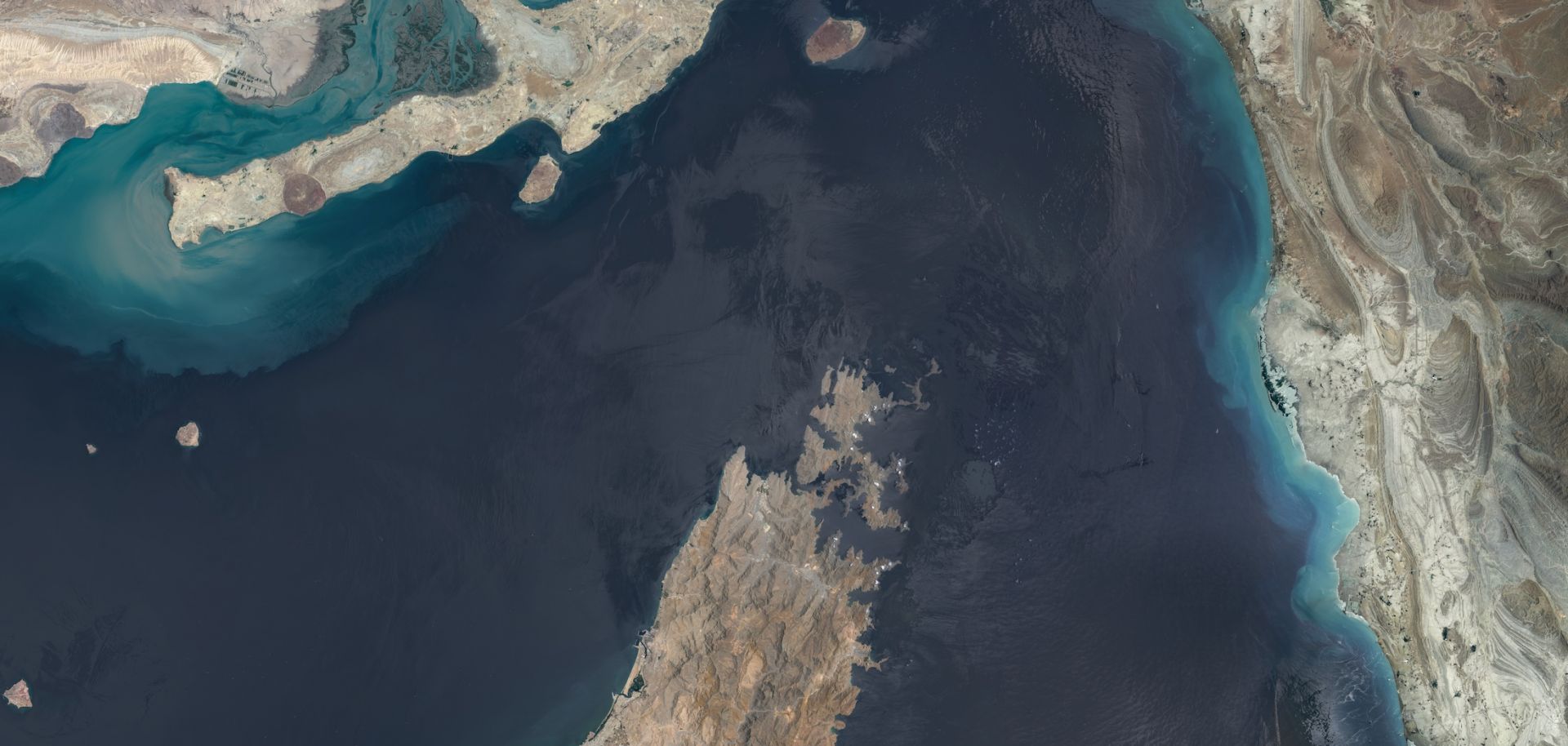
Maps4media-processed Sentinel-2 satellite imagery shows a broad overview of the Strait of Hormuz on June 16, 2026.
(Photo enhanced and published by Maps4media via Getty Images)
Maps4media-processed Sentinel-2 satellite imagery shows a broad overview of the Strait of Hormuz on June 16, 2026.

A reported Iranian attack in the Strait of Hormuz illustrates the stumbling blocks to ongoing U.S.-Iranian diplomacy that, while affording some near-term relief for supply chains reliant on the strait, will likely eventually stall on more contentious negotiations, which could prompt a resumption of limited U.S. strikes. On June 25, the United Kingdom Maritime Trade Organization reported that a cargo vessel transiting the Strait of Hormuz had been struck by a projectile, which U.S. officials subsequently blamed on Iran. This was the first reported attack in the strait since the U.S.-Iran memorandum of understanding was signed on June 17, and it is the latest sign of the challenges the United States faces in restoring shipping through the Strait of Hormuz to prewar levels. The attack occurred the same day that U.S. Secretary of State Marco Rubio concluded a three-day visit to Gulf Arab countries as part of a bid to win local support for ongoing American efforts to diplomatically resolve the confrontation with Iran. His visit came against the backdrop of the United States temporarily lifting key economic and oil sanctions on June 22 as part of a 60-day interim deal between Washington and Tehran, a move that allowed Iranians to begin exporting oil at scale almost immediately for the first time since the war began on Feb. 28. The Wall Street Journal also reported on June 19 that the United States might soon unfreeze some of Iran's assets abroad, including $6 billion trapped in Qatar. These developments signaled stability to global shippers and energy markets, with Brent oil futures on June 25 declining to around $71 per barrel, well down from the war highs of around $100 a barrel. Additionally, Kpler, a maritime tracking company, said over 70 ships had crossed the Strait of Hormuz on June 24, a postwar high. However, these figures remain well below the approximately 100-150 daily crossings that occurred prior to the war, and shipping volumes declined again in the aftermath of the June 25 attack as shipping companies reevaluated the safety of transiting the strait. 

  • On June 24, the U.S. Senate joined the House in passing a largely symbolic war powers act resolution designed to signal the end of congressional support for an open-ended confrontation with Iran, though the Senate reversed it a day later.
  • Rystad Energy, a Norway-based energy consultancy, said on June 25 that Iran might soon surpass prewar crude oil export volumes, rising to 3.1 million barrels per day by August, should U.S. waivers and current production volumes persist. Such an increase in exports would mark a notable boom for otherwise economically isolated Iran.
  • As a result of the attack on the ship near Oman, the International Maritime Organization temporarily suspended operations to rescue trapped mariners inside the Persian Gulf the same day, further hampering efforts to normalize shipping through the strait. 
  • Iranian Deputy Foreign Minister Kazem Gharibabadi wrote in a June 26 X post, "Safe passage through the Strait of Hormuz cannot be guaranteed under ambiguous arrangements, parallel routes or decision-making that does not take Iran's role as a coastal state into account," in an effort to assert Iran's influence over the Strait of Hormuz. 

The Trump administration is exhibiting little political will to return to large-scale confrontation as it prioritizes keeping the memorandum of understanding intact and increasing energy flows through the Strait of Hormuz, which is enabling Iran to resume crucial oil exports and reducing its motive to return to full-scale war. Although President Donald Trump has threatened to resume bombing should Iran fail to make good on its obligations as part of the June memorandum of understanding, so far there has been little sign that the Trump administration is willing to resume full-scale war, despite several obstacles Iran has presented in negotiations. Global energy markets have begun to stabilize in the aftermath of the memorandum of understanding, making Trump less eager to re-escalate the conflict and upset them again, while the White House seems content to prioritize reopening the Strait of Hormuz and normalizing energy flows, rather than pressing for a quick resolution to contentious nuclear negotiations. Meanwhile, Iran is benefiting significantly from the resumption of its oil exports and ability to sell oil at scale, with millions of barrels of backed-up oil now flowing into international markets and bringing in much-needed income for the economically beleaguered Islamic Republic. The United States has also made progress in stabilizing the Lebanon front, a key demand of Iran, spurring the Israelis to entrench along current front lines and step away from an expansive offensive against Hezbollah, Iran's closest regional ally. This came after a reportedly harsh conversation between President Trump and Israeli Prime Minister Benjamin Netanyahu, in which Trump suggested that the United States might withdraw some of its diplomatic protection of Israel unless it complied with his overall demands to cease expansive operations in Lebanon to preserve the memorandum of understanding.

  • Netanyahu and Israeli Defense Minister Israel Katz have maintained the position that the Israel Defense Forces will remain in southern Lebanon and interdict any Hezbollah threats. 

Iran's interest in changing the status quo in the Strait of Hormuz, combined with Israel's willingness to violate the ceasefire with Hezbollah, will likely continue to complicate U.S.-Iran talks and hamper the full normalization of the strait and energy flows in the coming weeks. Iran is insisting on imposing fees or tolls on the Strait of Hormuz in conjunction with Oman as part of a new status quo for the strait. However, this proposal is a non-starter for the United States, which demands a restoration of freedom of navigation, while Oman has continuously insisted that it has no real interest in fees and wants the Strait of Hormuz's final status to include input from partners throughout the region, like the United Arab Emirates, which also sits on the strait. Although Tehran does not want to fully scuttle the memorandum of understanding, it will likely try to enforce its new status quo through at least periodic, limited harassment of shipping transiting non-approved routes in the coming days and weeks. Such aggressive maneuvers would result in American military retaliation, particularly against the launch sites involved in attacking international shipping, sustaining a less likely risk of a larger escalation if a pattern of Iranian attacks sparks energy price increases or harms global stock markets. Meanwhile, Israel's government has maintained a political commitment to defeating Hezbollah and, while currently heeding the White House's warnings about further escalation against the group, will likely continue to carry out intermittent strikes and skirmishes with the militants. Israel will also focus on defeating a group of Hezbollah militants who were reportedly besieged underground at the village of Taanayel in southern Lebanon, where the militants are surrounded by Israeli troops. This failure to fully comply with Iran's demand for a cessation of fighting in southern Lebanon may spark Iranian announcements of the re-closure of the Strait of Hormuz, additional attacks on international shipping or even direct strikes against Israel once more. While none of this turbulence will necessarily upend the United States' desire to continue negotiations with Iran in the near term, recurrent violations and a lack of trust will nevertheless make it difficult for the strait to normalize in the near term and for shipping companies to rely on this logistics route. 

  • Republican lawmakers and the White House are particularly concerned about elevated gasoline prices in the United States ahead of the midterm elections in November, in which current polling indicates the Democrats have a strong chance of taking control of one or both congressional chambers and, in turn, halting much of the Trump administration's domestic agenda. 
  • Despite some reports that Tehran is pitching to share revenue with Gulf Arab states (including a report that Oman sees this policy as inevitable given Iran's leverage in the region), they are resistant to collaborating with Iran on a tolling system. This reluctance is partly due to concern about ceding more regional authority to Iran and partly to concern about their economic models, as many shipping companies might permanently route around the Gulf in response to such tolls.

Regardless of how negotiations on less controversial matters progress in the coming days and weeks, Iran is unlikely to make significant concessions on its nuclear program, risking stalled talks, renewed U.S. economic pressure and/or U.S. attacks. Strain on the memorandum of understanding will likely mount as talks broach more contentious issues, namely Iran's nuclear program, and other topics that were omitted entirely from the memorandum of understanding, chiefly Iran's ballistic missile program and support for its regional proxies. The United States may try to include Iran's ballistic missile and proxy strategy in a final deal, as these issues are priorities of Israel and Gulf countries due to the regional security risks they pose. However, Iran's hard-liners will push for minimal concessions and may threaten to exit negotiations entirely over U.S. demands on these issues, as both are key parts of the country's national security strategy and regional deterrence. As a result, the United States will prioritize reaching a deal on Iran's nuclear program, which Washington has already indicated is its main priority. To this end, Iran would likely agree to restart international nuclear inspections — which Iranian officials have thus far said would happen after a final deal — and will likely make concessions on the downblending of its highly enriched uranium stockpiles. However, Iran will resist making more permanent concessions to its nuclear program, such as dismantling nuclear sites including Fordow, Isfahan and Natanz, due to a combination of nationalism, mistrust of the Trump administration and a desire to retain the technological progress made so far. Though the United States will be reluctant to resume full-scale war, the Trump administration might renew economic pressure on Iran, such as by reimposing a blockade, or return to limited attacks if the administration believes it can pressure Iran to make more concessions or break a deadlock. 

  • The United States has not signaled urgency in dealing with Iran's missiles or proxies, given the energy emergency caused by the Strait of Hormuz's closure, though Washington's hawks remain focused on the threat posed to the United States and regional allies. On June 25, The Wall Street Journal reported that the United States was considering shifting military assets away from Iran after Iranian missile and drone strikes significantly impacted U.S. forces in Bahrain, a signal that the United States is growing more likely to alter its force posture than to impose restrictions on Iran's missile arsenal. 
  • In order for Iran to agree to major curbs to its nuclear program, Tehran would almost certainly require significant economic concessions, including the release of billions of additional frozen funds, as well as a more secure final diplomatic deal than the Obama-era Joint Comprehensive Plan of Action, from which the Trump administration withdrew during the president's first term. But even then, Iranian hard-liners would remain unlikely to make major nuclear concessions, resulting in a drawn-out negotiation process with few tangible results. 
RANE
SUBSCRIBERS ONLY

Expert analysis when it matters most.

Get access to RANE's decision-grade geopolitical intelligence.