
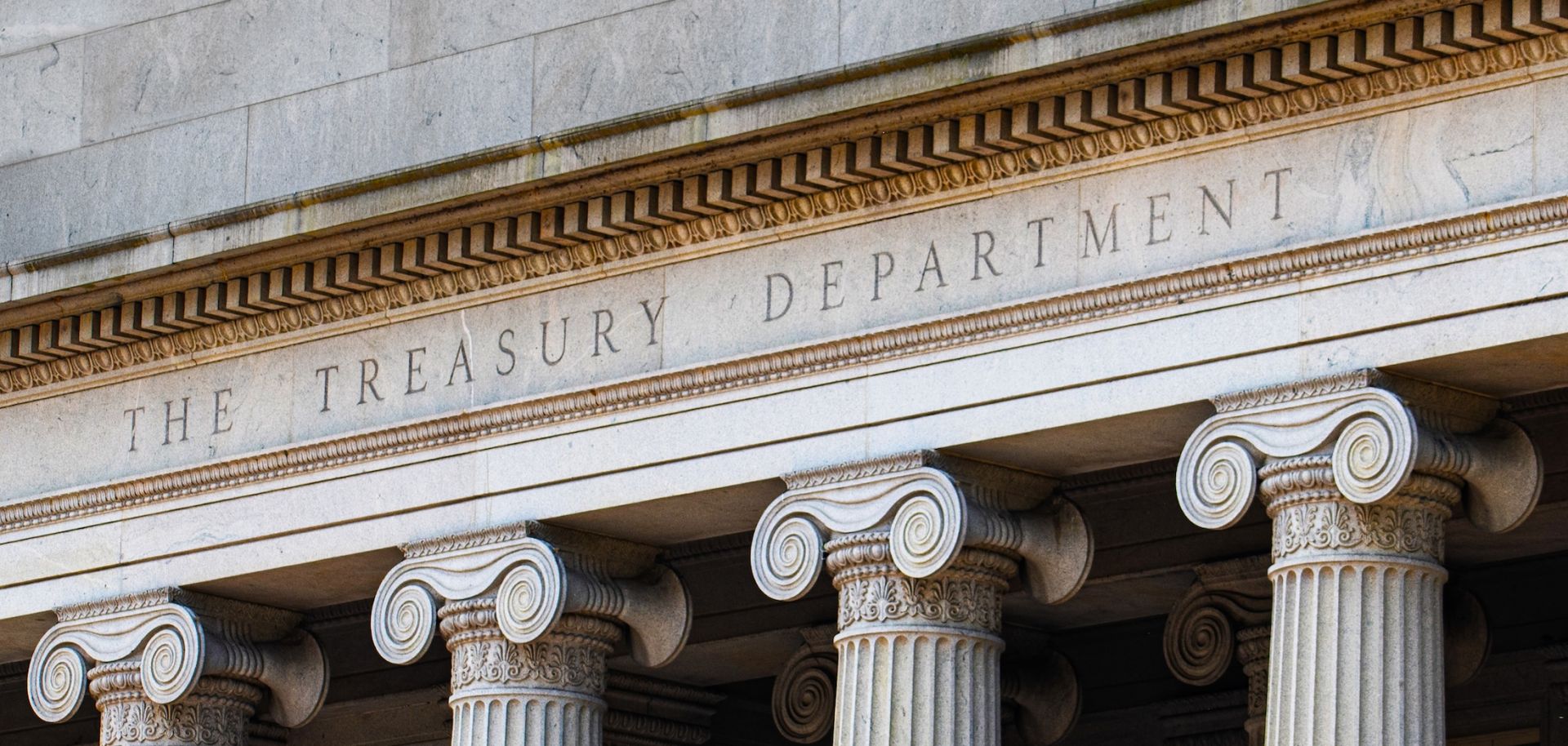
The U.S. Treasury Department building in Washington, D.C.
(DOUGLAS RISSING via Getty Images)
The U.S. Treasury Department building in Washington, D.C.

The week before Washington and Tehran reached an agreement to extend their ceasefire in mid-June, the U.S. government began to explore the possibility of seizing frozen Iranian assets. As part of this exploration, Treasury Secretary Scott Bessent instructed his staff to search for legal ways to seize Iranian assets and use them to compensate Gulf countries for the damage they suffered during the regional war. The announcement was likely meant to increase pressure on Iran to come to the negotiating table.

Such action is rare in the United States, where legal restrictions have historically limited the use of foreign asset seizure as a diplomatic instrument. Instead, the U.S. government has tended to freeze foreign assets, including those held by foreign governments, and has even frozen foreign government assets held in countries other than the United States, most notably those belonging to Iran. 

U.S. efforts to seize Iranian assets now seem to have been superseded by the June 17 U.S.-Iran memorandum of understanding to negotiate an end to their conflict. To this end, negotiators are discussing the U.S. release of $12 billion in frozen Iranian financial assets, and the United States and Qatar have also begun working on establishing a framework to unfreeze $6 billion in Iranian assets held in Qatar. The framework is meant to allow Iran to use these unfrozen assets to purchase humanitarian goods and U.S. agricultural products. Going further, the establishment of a $300 billion fund to finance Iranian reconstruction is under consideration, intended to incentivize Tehran to abide by a future peace agreement.

The Limits of U.S. Legal Authority

Although the United States no longer appears interested in seizing Iranian assets, the credibility of Washington's recent threat warrants assessment. Seizing sovereign assets is, in principle, a potent means of imposing permanent, material economic and financial costs on a country, costs that are significantly more impactful than the temporary losses imposed by merely freezing assets. In Iran's case, the International Monetary Fund estimates that the government's largely frozen international currency reserves were around $34 billion at the end of 2025, or more than 10% of Iran's gross domestic product. The permanent forfeiture of these assets would have caused a tangible financial loss, constraining Iran's ability to finance imports and reconstruction following a diplomatic agreement with the United States amid an already significant decline in economic output and high inflation, with the IMF projecting the economy will shrink by more than 6% in 2026 and that inflation will reach almost 70%.

However, seizing foreign assets is complex. The U.S. government has the legal authority to seize foreign assets in the United States, but its ability to seize sovereign assets held outside the United States is very limited. To seize assets located outside the United States, the U.S. government must rely on the cooperation of the jurisdiction in which the assets are located. For instance, if the U.S. government has signed a Mutual Legal Assistance Treaty with the government in whose jurisdiction Iranian assets are held, it can submit a formal request to transfer the assets following a civil or criminal forfeiture order issued by a U.S. judge. The U.S. government can also, in principle, seize non-sovereign foreign assets if the targeted Iranian funds are held in an overseas branch of a U.S.-headquartered bank, or if the targeted assets are held in a foreign bank that maintains a correspondent banking account in the United States. Between 2016 and 2019, for example, the U.S. government relied on the so-called correspondent banking loophole to target Malaysia's state-owned investment fund 1MDB, with the U.S. Department of Justice executing seizure warrants targeting the correspondent banking accounts of foreign financial institutions.

Additionally, sovereign foreign assets are harder for the U.S. government to seize than private foreign assets because they customarily benefit from sovereign immunity. Under international law, as well as domestic legislation such as the U.S. Foreign Sovereign Immunities Act, the circumstances under which the United States can seize sovereign assets — especially central bank assets — are few. 

However, legal avenues do exist. First, under the Trading with the Enemy Act, a government that is engaged in armed conflict with the United States loses its right to U.S. legal protections, exposing it to asset seizure. Second, under the Patriot Act, the U.S. government can confiscate sovereign assets, including central bank reserves, if the foreign government is actively involved in war with the United States or if the United States has been attacked by that country or its proxies. Third, under the Terrorism Risk Insurance Act, U.S. courts can task sovereign assets with paying out compensation to American victims of terrorism, provided the asset owner is officially designated by the State Department as a state sponsor of terrorism. For example, when the Taliban took control of Afghanistan in 2021, the U.S. government froze $7 billion of the Afghan central bank's reserves and used half of those funds to settle ongoing legal claims brought by the families of 9/11 victims. 

In the case of Iran, Congress has previously passed legislation that explicitly allowed the U.S. government to seize Iranian central bank assets held in a New York correspondent account at Citibank. To bypass standard foreign sovereign immunity laws protecting central banks, Congress passed the Iran Threat Reduction and Syria Human Rights Act in 2012, determining that these funds should be made available to satisfy court rulings. The U.S. Supreme Court subsequently validated the law, thus greenlighting the permanent transfer of these funds to the litigants. Following a successful lawsuit related to the 1983 Marine barracks bombing in Beirut, Lebanon, litigants secured a multi-billion-dollar judgment against the Iranian government for sponsoring terrorism. 

Another legal loophole pertains to the use of central bank assets held in the United States. In January 2025, the U.S. Supreme Court rejected Argentina's petition to protect funds held in a Federal Reserve account under the Foreign Sovereign Immunities Act and permitted the seizure of $210 million in Argentine central bank assets. The funds had previously been used as collateral under the Brady Plan to restructure its debt. U.S. courts allowed the seizure to go forward due to the "commercial" nature of these funds, thus circumventing FISA. This means that assets deemed to serve commercial purposes, such as investment or trade finance, rather than "core central bank functions," such as monetary policy and exchange rate management, can, in principle, be seized.

Finally, in 2024 Congress passed legislation that paves the way for the United States to seize Russian central bank reserves. Specifically, the Rebuilding Economic Prosperity and Opportunity for Ukrainians Act explicitly allows the U.S. government to seize frozen Russian sovereign assets (including Russian central bank reserves) in the United States as a lawful "countermeasure" under international law. While this legislation applies only to Russian assets, it could set a precedent for future acts targeting other countries' central bank reserves as well.

The U.S. government's ability to seize central bank assets held outside the United States appears very limited due to a lack of legal jurisdiction. While the U.S. government could apply diplomatic pressure on countries holding these assets, such as by threatening financial and trade sanctions, the countries in question would still likely need to change domestic legislation to transfer these assets to the United States or seize them themselves, making this a lengthy, uphill endeavor. As a result, U.S. threats to confiscate other countries' sovereign central bank reserves are most potent when those reserves are held in the United States. 

Assessing the Threat of U.S. Asset Seizures

With these constraints in mind, how credible was Bessent's threat to seize Iranian central bank assets? Most of Iran's frozen funds are located in South Korea, Japan, EU countries, China, India and Iraq, not in the United States. As we have seen, Washington's ability to unilaterally seize Iranian central bank assets held abroad is limited, and it is difficult to see how China or India would have gone along with the seizure of Iranian assets in the context of a war they opposed — or at least refused to support — and given their reliance on Iranian oil imports. To a lesser degree, the same is true of European governments, not least given their recent reluctance to seize Russian assets outright for fear of undermining the euro. Washington was always going to derive greater leverage from its ability to keep frozen, unfreeze or threaten to seize Iranian assets than outright seizure, as well as by controlling the foreign-currency revenue Iran generates through energy exports through the Strait of Hormuz. About 90% of Iran's energy exports and 80% of its total exports pass through the strait, with total exports amounting to $100 billion last year. The $24 billion or so worth of Iranian central bank assets are relatively less important than the ability to generate export revenues and be able to use them to finance imports. The threat to seize Iranian central banks was neither credible nor effective compared to America's ability to limit Iranian export revenues and freeze export proceeds.

The U.S. government's ability to freeze and seize foreign assets held by sovereign governments — particularly foreign central banks — has implications that extend beyond its effectiveness as a diplomatic tool. It may also affect the role of the U.S. dollar as the world's leading international currency. However, these effects are likely to remain limited as long as the United States does not engage in large-scale asset seizures, which remains unlikely.

The dollar's dominant position in the post-WWII international financial system rests on foundations including U.S. military power, the size of the American economy, the depth and openness of U.S. financial markets, and a record of macroeconomic stability. Equally important is the rule of law. Foreign investors and governments are willing to hold dollar-denominated assets in part because they believe that U.S. laws constrain the government's ability to arbitrarily freeze or confiscate assets. In recent decades, the United States has frequently frozen the assets of geopolitical adversaries. However, its ability — and willingness — to permanently seize those assets, especially those held by foreign central banks, has been more limited. Domestic legislation places important constraints on the use of asset seizure as a policy tool. Although the perceived risk of confiscation has increased, it remains relatively low, particularly for countries that maintain cooperative relations with the United States.

The threat of asset seizure can increase the costs of noncompliance for countries such as Iran, which risk permanently losing access to their assets if they fail to meet U.S. demands. Still, permanently seizing assets also entails a loss of diplomatic leverage. Freezing and unfreezing assets often provides greater flexibility. An indefinite asset freeze can impose economic and financial costs similar to those of outright confiscation, while preserving the possibility of future relief. This gives the United States an additional bargaining tool, allowing it to offer the release of frozen assets as an incentive for compliance.

This raises the question of whether asset seizure, as opposed to asset freezing, could undermine foreigners' willingness to hold assets in the United States and dollar-denominated assets more broadly. The answer is nuanced. The possibility of seizure undoubtedly serves as a warning to potential adversaries, encouraging them — where feasible — to reduce their exposure to the dollar, as Russia did before the 2022 invasion of Ukraine. However, countries that maintain friendly relations with the United States have far less reason to fear becoming targets of asset confiscation. They are therefore unlikely to significantly reduce their dollar holdings, given the currency's continued centrality to the international financial system. Moreover, even if the United States were to weaken the legal safeguards protecting foreign sovereign assets, it is far from clear that governments and private investors would substantially divest from dollar assets. The main alternatives remain relatively unattractive. The euro is constrained by the fragmentation of European sovereign debt and financial markets, while the yuan is limited by capital controls and weaker legal protections.

The dollar's dominance is unlikely to be threatened as long as asset seizure remains targeted at a small number of economically marginal geopolitical adversaries, such as Afghanistan and Iran. A more indiscriminate use of this tool, which would be legally and politically improbable, could gradually erode confidence in dollar assets. By increasing the perceived risk of confiscation, it would reduce the dollar's appeal as a reserve currency for central banks as well as an investment and transaction currency for private actors. At the same time, it would enhance the relative attractiveness of alternative international currencies, particularly the euro and the yuan.

RANE
SUBSCRIBERS ONLY

Expert analysis when it matters most.

Get access to RANE's decision-grade geopolitical intelligence.