
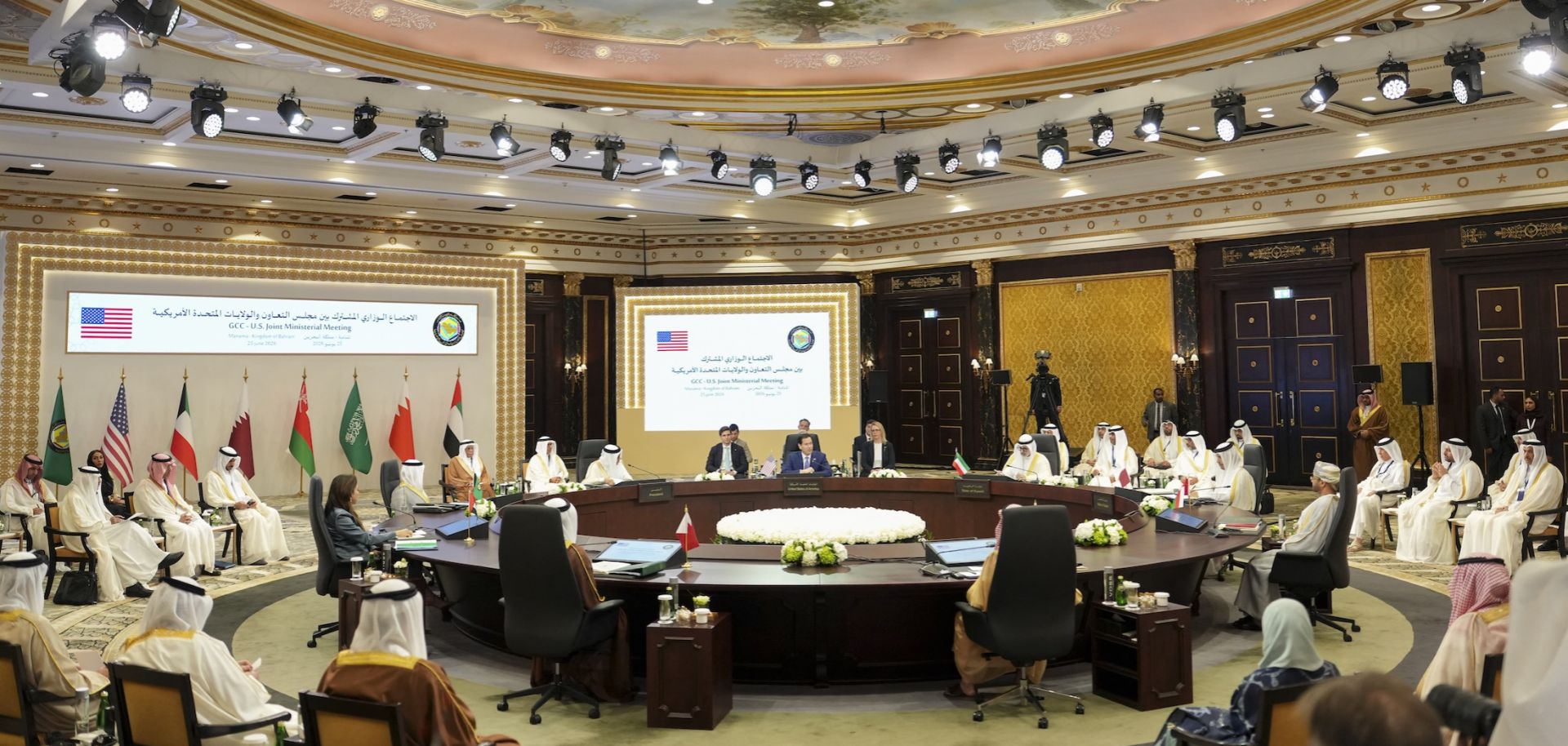
U.S. Secretary of State Marco Rubio (C, top) meets with GCC foreign ministers during his visit to the Middle East to discuss with Arab Gulf allies the interim deal between the U.S. and Iran on June 25 in Manama. While Qatar and Saudi Arabia explore restoring trade ties with Iran, the United Arab Emirates is aligning its security with Israel and the United States.
(Eric Lee/POOL/AFP via Getty Images)
U.S. Secretary of State Marco Rubio (C, top) meets with GCC foreign ministers during his visit to the Middle East to discuss with Arab Gulf allies the interim deal between the U.S. and Iran on June 25 in Manama.

For now, Gulf Arab states will likely facilitate the implementation of the U.S.-Iran memorandum of understanding, but over time, splits will deepen between hawkish states like the United Arab Emirates and more dovish ones like Qatar, weakening Gulf regional unity and making some states priority targets for future Iranian attacks. Gulf Arab states have reacted tepidly to the June 17 signing of the U.S.-Iran agreement, a 14-point document outlining a framework for de-escalation that includes a halt to all military operations across the region, explicitly including Lebanon and a 60-day window for U.S.-Iran nuclear negotiations. The agreement has opened the door for major improvements in regional trade and security conditions, including the lifting of the U.S. and Iranian blockades of the Strait of Hormuz, pledges to see U.S. troops draw down from the region and U.S. efforts to ensure the viability of the agreement by pressuring Israel to contain its military campaign against Hezbollah in southern Lebanon. Still, the agreement has triggered largely cautious responses across Gulf Arab states, reflecting the deep strategic fissures within the Gulf Cooperation Council (GCC), whose members all faced Iranian missile and drone attacks during the recent conflict.

  • Gulf Arab states were largely muted in their response to the memorandum of understanding, though there was a quiet welcome that the agreement meant the war that had struck them so hard would not resume.
  • Qatar, acting as a key mediator alongside Pakistan and Turkey, has been central to facilitating the negotiation process, aiming to balance regional stability with its own pragmatic engagement with Tehran.
  • The United Arab Emirates, which endured the most attacks of any Gulf Arab state, has called for full compliance with the memorandum of understanding to ensure a comprehensive and immediate halt to regional hostilities. Emphasizing the necessity of adherence to international law and respect for sovereignty, Abu Dhabi has also stressed that the protection of critical maritime routes, particularly the Strait of Hormuz, remains essential for securing regional stability and prosperity.

Since the 1979 Iranian Revolution, Gulf states have not acted in unity toward Tehran. Many backed Iraqi dictator Saddam Hussein's invasion of Iran in 1980 before later seeing Tehran as a useful balancer against Iraq after its 1991 invasion of Kuwait. But after the U.S. invasion of Iraq in 2003 and then the Arab Spring of 2011 produced power vacuums that allowed Iranian influence to reach by land to Lebanon, Gulf states' approaches to Iran split. Hawks like Saudi Arabia and the United Arab Emirates favored containment and rolling back Iranian influence where possible, while others like Qatar and Oman were more pragmatic toward Iran's ascendency. This phase reached a crescendo with the hawks' alignment with U.S. President Donald Trump's first administration, which favored a maximum economic pressure campaign against Iran to fundamentally alter its foreign policies in favor of the United States and its hawkish regional partners. But when this campaign resulted in major attacks on key hawks — like the 2019 Iranian-backed attack on Saudi Aramco at Abqaiq and Houthi attacks on Abu Dhabi in 2022 — the hawks began to shift away from confrontation and toward tense pragmatism. Saudi Arabia concluded a formal detente with Iran in 2023. Though the hawks nominally remained opposed to Iran's proxies, missiles and nuclear program, they grew increasingly skeptical that the United States had a viable strategy to impose conditions on Iran and that the confrontations would be worth the risks to their economic models.


The Iran war has deepened GCC states' divergent strategies toward Iran. Some now prioritize containment through de-escalation with Tehran while others have doubled down, aligning their security with the United States and Israel. Before the war, Gulf states had broadly lobbied for de-escalation and containment, fearing that a direct conflict between Iran and the United States and/or Israel would expose them to exactly the kind of Iranian retaliation that later materialized. During the war, however, Gulf governments, including the United Arab Emirates and Saudi Arabia, reportedly wanted the United States to weaken Iran and took part in direct strikes on Iran. However, the April ceasefire left Iran damaged but not decisively degraded, while the memorandum of understanding's terms put Iran on a path to potential significant economic rehabilitation. This outcome widened existing rifts inside the Gulf. The United Arab Emirates, Kuwait and Bahrain were the states most directly exposed to Iranian attacks during the war and even after the ceasefire. Abu Dhabi in particular was angered by the lack of a unified Arab or GCC response beyond statements and rhetorical condemnation. In the aftermath, Gulf states moved along different tracks. Saudi Arabia, Qatar and Oman leaned back toward de-escalation and containment, reopened or expanded channels with Iran and coordinated with mediators such as Turkey, Egypt and Pakistan to reduce escalation risks and impose fresh constraints on Iran. By contrast, the United Arab Emirates, Bahrain and to a lesser extent Kuwait, are less actively engaged with Tehran. Abu Dhabi especially reinforced its security ties and alignment with the United States and Israel.

  • The war saw notable signs of deepening Israeli-Emirati cooperation. The United Arab Emirates hosted an Israeli Iron Dome battery and troops over the course of the war, the first such deployment in an Arab country. Reports also emerged of the Israelis deepening their military cooperation with the UAE-aligned Somaliland region of Somalia, using the area for flights to attack Iran.

On the surface, most Gulf Arab states are likely to play a constructive role in implementing the memorandum of understanding, including facilitating talks, unfreezing assets, monitoring the status of the Strait of Hormuz and even pledging reconstruction and investment aid. As they recover from the effects of the regional war, most Gulf Arab states remain focused on their internal economic development strategies, which were upended by the weekslong conflict, making them eager to supplement American diplomatic efforts to end the conflict. At the same time, Gulf Arab capitals lack the leverage and influence in Washington to spur a change in America's stance toward Iran, making them followers rather than drivers in shaping the memorandum of understanding's implementation and follow-on diplomacy. Gulf Arab states are likely to play a supplementary role in supporting American efforts to implement the memorandum of understanding, likely in the form of continued facilitation of future talks, particularly on the nuclear file. Countries like Qatar and potentially Saudi Arabia and Oman could restore economic ties with Iran, as well as monitor freedom of navigation in the Strait of Hormuz.

  • Despite repeated attacks on Qatar, Doha has shown an eagerness to remain a regional facilitator to demonstrate its diplomatic utility to the United States, its primary security guarantor and to de-escalate the risks of potential future Iranian attacks.
  • Reports from Reuters suggest a potential $300 billion reconstruction fund held out as an enticement for Iran to cooperate on the nuclear file is being provided by Gulf Arab companies, though details remain uncertain.
  • Though reports have emerged of potential UAE pragmatism toward Iran — including a report it agreed to release $10-$20 billion in assets — the United Arab Emirates has denied such reports. There have instead been reports of the United Arab Emirates cracking down on Iranian economic ties to the country itself, including by closing Iranian banks and restricting Iranians' visas.

The United Arab Emirates will likely retain its hawkish policies, doubling down on U.S. and Israeli security ties, being reticent about restoring economic ties with Iran and, as a result, remaining as the most likely Gulf target for future Iranian attacks. Despite likely near-term attempts to reduce tensions with Tehran and some Gulf Arab neighbors, the United Arab Emirates is likely to broadly maintain its hawkish approach to Iran and increasingly act as a unilateral, transactional power in the postwar Gulf order. Abu Dhabi's perception that it faces continued threats from Iranian and proxy attacks, already hawkish posture toward the Iranian regime, Abraham Accords framework with Israel and frustration with the weak collective Arab or GCC response during the war which will likely reinforce its preference for interest- and security-based partnerships over slow-moving regional institutions like the GCC. Recent reporting that Israel sent air defense assets and personnel to the United Arab Emirates during the Iran war shows that the UAE-Israel relationship has already moved beyond symbolic normalization into broader and more practical defense cooperation. The United Arab Emirates will increasingly see Israeli intelligence, air defense, cyber, surveillance and defense-technology cooperation as necessary tools to offset Iranian missile, drone, proxy and covert threats. Nor is the United Arab Emirates likely to fully rehabilitate its prewar economic ties with Iran. Abu Dhabi is likely to comparatively restrict trade links with Tehran and crack down on Iranian-owned businesses and individuals in informal hubs of Iranian economic activity, such as Dubai. Over time, this could make the United Arab Emirates' policy toward Iran more flexible than other Gulf states. However, the strategy also comes with risks. A more unilateral and transactional foreign policy may expose Abu Dhabi to greater Iranian retaliation and deepen rifts with Gulf states that remain more committed to multilateral or de-escalatory frameworks.

  • Prewar Emirati-Iranian trade ties stood at several billion dollars per year, most of it through black-market channels designed to avoid U.S. sanctions, making volumes difficult to quantify.
  • Though Bahrain and Kuwait will remain hawkish toward Iran, Bahrain will remain too reliant on Saudi Arabia for a unilateral foreign policy toward Iran, while Kuwait's internal parliamentary splits and exposed geography to Iranian attacks are unlikely to result in a major shift toward a more assertive anti-Iran position in the region.
  • On May 1, the United Arab Emirates finally left OPEC after years of Emirati complaints that the cartel was not meeting the country's economic needs. This was a further sign of intra-GCC divisions.

Saudi Arabia, Qatar and, to a different extent, Oman will pursue a more multilateral approach to the postwar order while keeping pragmatic channels open with Iran. Driven by their concern for the economic models, Saudi Arabia, Qatar and Oman are more likely to try to build on the institutional momentum supporting the memorandum of understanding, while at the same time deepening new partnerships to diversify away from the United States. Riyadh's deepening military relationship with Pakistan is the clearest example of this strategy. Pakistan reportedly deployed troops, JF-17 fighter jets, drones and HQ-9 air-defense systems to Saudi Arabia during the Iran war under the 2025 mutual defense pact, giving Saudi Arabia an additional layer of deterrence. At the same time, the emerging diplomatic coordination among Saudi Arabia, Qatar, Turkey, Egypt and Pakistan suggests a looser regional framework of Islamic countries, focused on multilateral approaches to regional challenges, including Iran. This approach is designed to help these countries reduce their reliance on America due to Washington's increasingly volatile decision-making, but it would also serve to open channels with Tehran on areas of cooperation. Qatar and Oman are also likely to tie themselves to multilateral approaches. Qatar will likely remain a key mediator in the U.S.-Iranian diplomatic track and Oman will remain open to talks with Iran about the status of the Strait of Hormuz as part of a final settlement for navigation in the area. In both cases, Qatar and Oman will aim to use diplomacy to reduce the direct risks of future Iranian attacks on their countries while at the same time working to try to maintain political and security ties with Washington. Compared to the United Arab Emirates, all three countries are comparatively more likely to normalize economic relations with Iran should Tehran's diplomatic progress with Washington make this viable.

  • During the 2017-21 blockade of Qatar by the United Arab Emirates, Saudi Arabia and Bahrain, Iran emerged as a major source of food and medicine for Doha, giving the country a key lifeline when its air and sea routes were otherwise undermined by its neighbors.
  • In September 2025, Pakistan and Saudi Arabia signed a mutual defense pact designed to boost each other's security.

This divergent approach will further feed into existing intra-GCC differences, worsening ties between the United Arab Emirates and some of its neighbors, like Saudi Arabia and Oman, as Abu Dhabi seeks to maintain pressure on Iran. Short of a return to regional escalation, some Gulf Arab states will take more hawkish approaches to Iran than others, meaning that if Iran does seek to undermine its neighbors' economies or security, it will first target the more hawkish countries. These are likely to see diminishing Iranian economic and cultural influence, while the dovish countries may see such influence grow. The United Arab Emirates will likely oppose Omani efforts to normalize any settlement with Iran over navigation in Hormuz that might imply Iran has the right to impose fees or tolls in the strait. Abu Dhabi will lobby the United States against this outcome as well as use economic leverage over Oman to shape its diplomacy. The United Arab Emirates is also likely to lobby the United States to slow-walk economic rehabilitation for Iran and oppose Qatari, Saudi or Omani efforts to restore economic ties with Iran without significant concessions. Meanwhile, the Emiratis are likely to continue to host Israeli forces and covert operations targeting Iran, even if such efforts produce diplomatic friction with their neighbors. This overall trend will likely feed into deepening mistrust between the United Arab Emirates and most of its neighbors, manifesting in worse tensions in proxy theaters like Sudan and undermining efforts to develop intra-GCC infrastructure designed to bypass the Strait of Hormuz.

  • Iran sees U.S. bases in the region as critical targets in the event of regional escalation, making all GCC states, regardless of orientation, targets in the case of U.S.-Iranian conflict.
  • Iran targeted Saudi Arabia's Abqaiq in 2019 in part because Riyadh was more hawkish in that era, as it also sought to undermine energy markets and pressure the United States away from its maximum economic pressure campaign, suggesting Iran might resume targeting energy locations across the Gulf if the memorandum of understanding does not ease economic pressure enough.
  • Part of what drove the blockade on Qatar in 2017-21 was the United Arab Emirates and Saudi Arabia's belief that Doha was not combating Islamism enough to secure their political models, suggesting that divergences over Iran may fuel similar tensions as Gulf states take different approaches to economic engagement with Tehran.
RANE
SUBSCRIBERS ONLY

Expert analysis when it matters most.

Get access to RANE's decision-grade geopolitical intelligence.
