
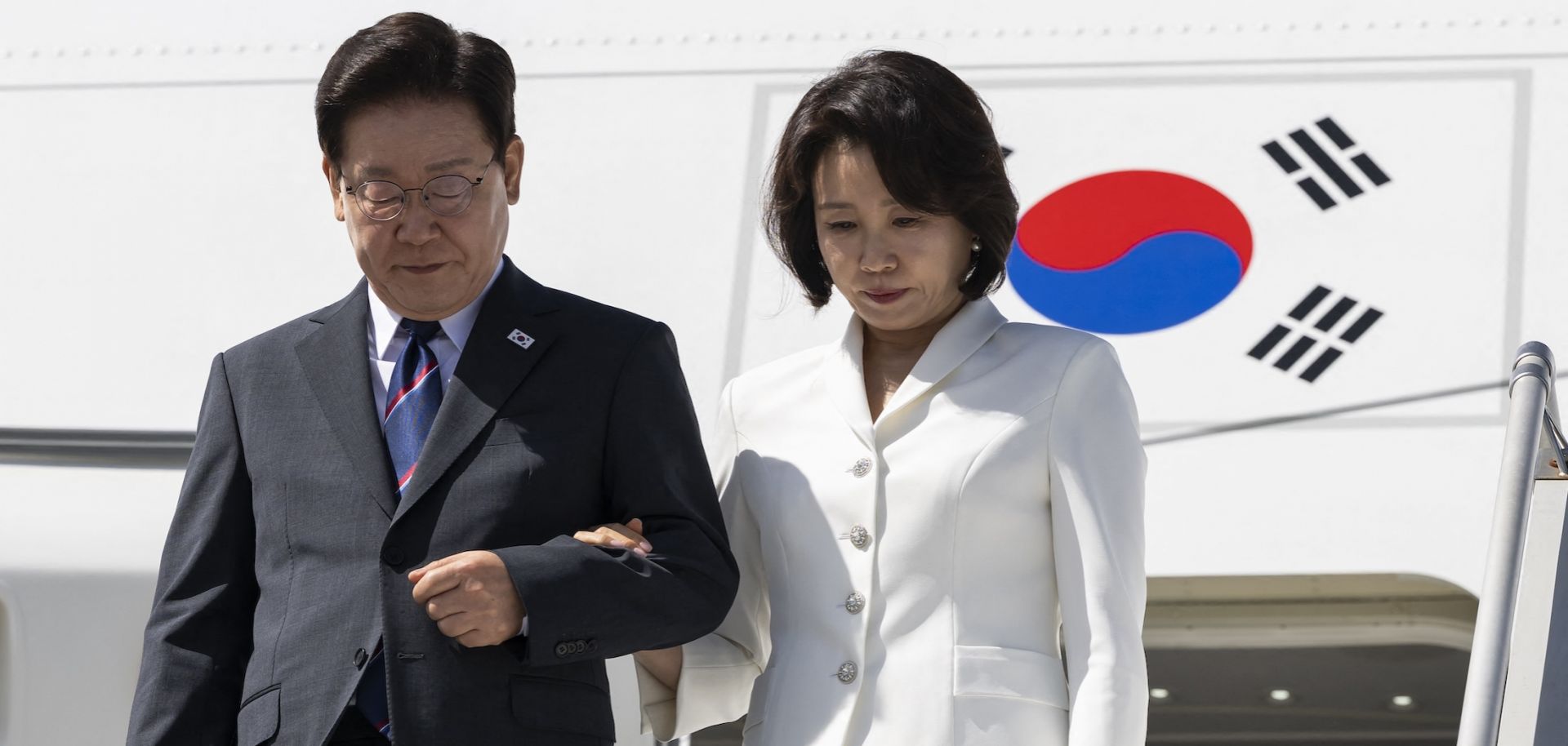
South Korean President Lee Jae Myung (left) and his wife disembark from the plane at Geneva Airport as they arrive to attend the G7 summit on June 16, 2026.
(MARTIAL TREZZINI / POOL / AFP via Getty Images)
South Korean President Lee Jae Myung (left) and his wife disembark from the plane at Geneva Airport as they arrive to attend the G7 summit on June 16, 2026.

A ballot scandal poses the first major challenge to South Korean President Lee Jae Myung, potentially strengthening his political enemies, sullying his chances at a second term, and straining U.S. and Japanese security cooperation, but it could also facilitate closer economic ties with China. June 4 marked one year in office for Lee, and though his party's victory in the June 3 local elections seemed at first to be an anniversary gift, it has since transformed into a major political challenge. Lee's left-wing Democratic Party (DPK) won 12 of 16 mayoral and gubernatorial seats, a gain of seven that bolstered his leadership bona fides and seemingly underlined the disarray of the opposition People Power Party (PPP) following former President Yoon Suk Yeol's December 2024 martial law bid and subsequent impeachment in April 2025. Within hours of DPK celebrations, however, news and social media stories about ballot shortages at at least 91 of over 14,000 polling stations circulated online, at first mainly as a rallying cry for disappointed PPP voters. As the days passed, however, DPK supporters and lawmakers also called for an investigation amid reports detailing the extent of the issue. Soon after, the National Election Commission chairman resigned, partly under pressure from Lee, who tried to distance himself from the body. To that end, Lee called for a police investigation, and DPK and PPP lawmakers on June 18 jointly launched a 45-day probe into the incident. Recent polls, however, show that Lee and the DPK's efforts to address the issue were perceived as too little, too late. At the same time, protests against the alleged ballot misconduct, ongoing since June 4, have centered on the Olympic Handball Stadium in eastern Seoul, with attendance persistently in the several thousands. The location has since served as a campaign platform for PPP head Jang Dong-hyeok, who has called for re-elections in the six out of 16 seats affected by polling station issues. Lee's administration has largely stuck to social media, calling for calm and denouncing protesters' scuffles with police and their refusal to let sports ministry officials access offices.

  • Realmeter, a mainstay of Korean political surveys, showed in a June 15 poll that support for the DPK had fallen by 7.6 points to 38% over the last two weeks, while PPP support had risen by 5.8 points to 44%. It also marks the first time since May 2025 — just before Lee came to office — that support for the conservatives has outstripped Lee's liberals. In addition, the poll showed that Lee's net approval rating (approval minus disapproval) had dropped to +7.3% from the consistent +20-30% he had enjoyed since taking office.

Though Lee's position remains stable, the ballot scandal risks strengthening the opposition, forcing Lee to scale back laws curbing public criticism, and jeopardizing his plans to seek a second term. At this point, a scandal and some bad polling are unlikely to weaken Lee's ability to pass policy. His presidential term lasts through 2030, his DPK holds a 167-seat majority in the 300-seat National Assembly, and the local election wins will facilitate policy implementation. Nonetheless, Lee's handling of the ballot scandal will serve as a high-stakes test for his public support and his ability to prevent the kinds of large-scale unrest seen surrounding his predecessor's impeachment, when protests grew into the hundreds of thousands and occasionally ended in violence. South Korea has a rich protest culture stemming from its bloody democratization in the late 1980s and early 1990s, with citizens favorably disposed to protesters and disinclined to sympathize with crackdowns, so a president's handling of protests tends to offer more risks than benefits. This is especially so as Lee has politicized the prosecutor's office and criminalized political dissent in his first year in office, undermining his claims to objectivity. Though he will attempt to use legal tools to suppress PPP-driven protests, they will likely be perceived as heavy-handed and an abuse of power by most South Koreans. To wit, Lee's handling of the ballot scandal protests seems to have contributed to his recent approval drop, with the RealMeter poll showing PPP support among voters in their 20s and 30s, a group heavily represented in the protests, surpassing the majority mark. Moreover, Lee's efforts to counter protests could help unify a fractious opposition, with PPP lawmakers still feuding over Yoon's legacy and whether Jang should step down following the June 3 election losses. This unity could prolong protests over the ballot scandal and other issues, potentially prompting Lee to ease the pace of special prosecutions targeting conservative leaders and to scale back legislation aimed at curbing criticism of his administration. It could likewise further impede Lee's already uphill efforts to pursue a constitutional amendment that would allow him to run for a second term.

  • Since coming to office, Lee has wielded special prosecutions to secure prison sentences against several Yoon administration officials, including those not directly connected to his martial law bid. A prosecution organized by Lee's DPK is also currently seeking to sentence Seoul Mayor and PPP member Oh Se-Hoon to prison over a polling misconduct case from 2021. Additionally, DPK lawmakers have passed into law Lee's proposals to criminalize the propagation of “fake news” and the act of “distorting legal principles” by judges and prosecutors, and extended the statute of limitations for false information cases during elections, in a bid to curb accusations of election misconduct. Lee has also called for the DPK to pass legislation to ban “hate speech,” ostensibly targeted at protesters who chant anti-China slogans, but legislators have yet to introduce such a bill.
  • Under the South Korean constitution, presidents are permitted to serve only a single five-year term. However, Lee and his DPK have openly discussed the prospect of expanding this to two four-year terms. This would require a national referendum, hence the importance of popular support for Lee, and a two-thirds majority in the legislature. Although a supermajority poses a significant hurdle, the PPP's internal fractures may weaken its ability to block the vote.

Lee's handling of the ballot scandal and associated protests may strain diplomatic and security relations with the United States and Japan, while potentially strengthening ties with China. Since Yoon's martial law bid and impeachment, the PPP has proven adept at lobbying allies in the United States. Early in President Lee's term, the administration of U.S. President Donald Trump criticized Lee for persecuting religious groups, in reference to a DPK special prosecution investigation against the Unification Church and its ties to the PPP. Moreover, in the current ballot scandal protests, some attendees have wrapped themselves in the U.S. flag, a tactic PPP protesters also used during Yoon's impeachment trial to garner American sympathy. In addition, Korean conservative leaders have already appealed to Trump's broader network of advisors on this issue. Trump's intervention, even just via verbal warnings, could politicize and impede U.S.-South Korea security cooperation, including Seoul's efforts to accelerate the transfer of wartime control over U.S. forces stationed in South Korea, as well as joint efforts to build for South Korea a nuclear-powered submarine to strengthen deterrence against China and North Korea. South Korea-Japan relations could also suffer, as Lee is likely to lean on anti-Japan rhetoric to drum up nationalist support amid domestic pressures. Indeed, Lee has already begun to emphasize historical grievances with Japan in the wake of the ballot scandal, which could imperil not only the two countries' early efforts to sign a wartime logistics pact, but also joint efforts to secure critical mineral and energy supply chains amid disruptions to Chinese rare earths and Strait of Hormuz oil flows. By contrast, Lee's efforts to suppress conservative protests could, perhaps unintentionally, facilitate his plans to improve economic ties with China amid uncertain U.S. trade policies, as Lee has spent the last year condemning conservatives for using "hateful" anti-China rhetoric during protests to criticize his soft stance on Beijing.

  • On June 16, former conservative prime minister Hwang Kyo-Ahn appeared on the conservative U.S. talk show War Room, hosted by former Trump advisor and current political supporter Steve Bannon, to urge the Trump administration to investigate the South Korean election scandal.
  • On June 8, after the first weekend of ballot protests and a RealMeter poll that same day that showed his approval dropping, Lee expressed doubt about signing a wartime logistics supply pact with Japan during a speech marking his presidential anniversary. He noted that Tokyo must first “genuinely apologize” for and directly address “unresolved historical issues,” a reference to Japan's World War II occupation of Korea. This marked his most vocal criticism of Japan since becoming president and a departure from his rhetoric since June, which had focused on the two Asian powers cooperating on economic security and military affairs in an era of geopolitical competition.
RANE
SUBSCRIBERS ONLY

Expert analysis when it matters most.

Get access to RANE's decision-grade geopolitical intelligence.